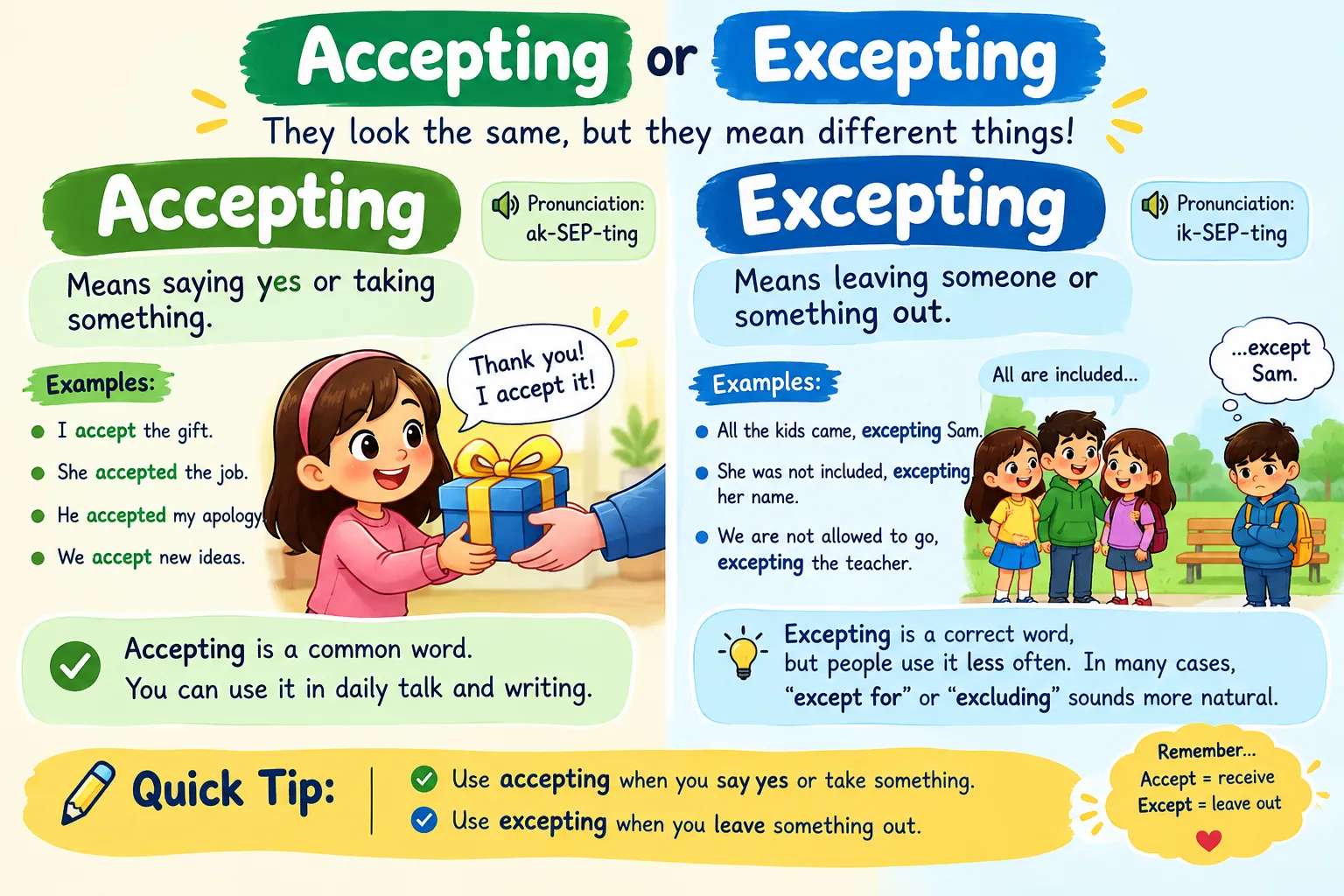
Accepting means saying yes or receiving something. Excepting means leaving something or someone out.
Have you ever mixed up two words that look almost the same? It happens to many people. You may write an email and type “excepting” when you mean “accepting.” The words look alike, but their meanings are quite different.
Imagine your friend offers you a gift. You smile and take it. You are accepting the gift. Now, imagine a teacher says all students can join a game, except Tom. The teacher is excepting Tom from the group, though this word is less common in daily speech.
The difference between accepting or excepting can be hard to spot at first. Both words come from the same root word, but they are used in different ways.
Accepting is common in daily talk, emails, and work. Excepting is less common. It often means “excluding” or “leaving out.”
Once you learn this simple rule, you can choose the right word with ease. This guide explains both words with clear rules, easy examples, and tips for better writing.
Pronunciation
| Word | US pronunciation | UK pronunciation |
|---|---|---|
| Accepting | ak-SEP-ting | ak-SEP-ting |
| Excepting | ik-SEP-ting | ik-SEP-ting |
The stress is on the second part of each word: SEP. The first vowel may sound a little different by speaker and accent.
Also read more about:https://syntexra.com/dysfunction-or-disfunction/
Difference Between Accepting and Excepting
1. Meaning
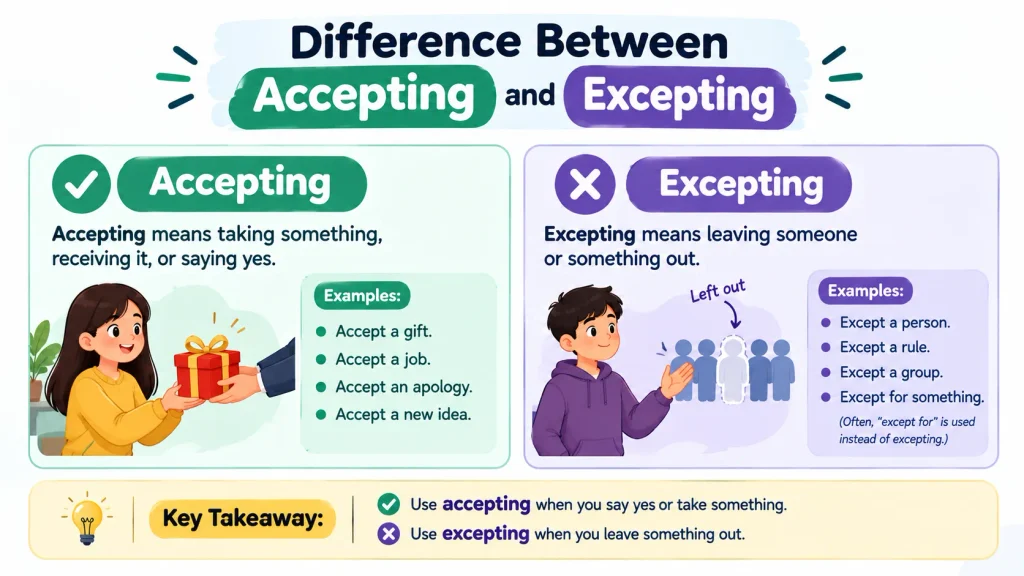
Accepting means taking, receiving, or saying yes to something.
Excepting means leaving something or someone out.
Examples:
- I am accepting your kind offer.
- Everyone came, excepting those who were ill.
2. Use in Daily Life
Accepting is common in daily speech and writing.
Excepting is rare in daily speech. People often use “excluding” or “except for” instead.
Examples:
- She is accepting a new job.
- Excepting the cost of food, the trip was cheap.
3. Use With Offers
Accepting means saying yes to an offer.
Excepting means leaving something out of a group or rule.
Examples:
- He is accepting the job offer.
- Excepting one small fee, the service is free.
4. Use With People
Accepting can mean welcoming or being open to people.
Excepting can mean leaving people out.
Examples:
- Our school is accepting new students.
- Excepting the two new students, everyone knew each other.
5. Use With Rules
Accepting may mean agreeing to a rule or plan.
Excepting may mean that a rule does not cover a certain person or thing.
Examples:
- The team is accepting the new rule.
- The rule applies to all staff, excepting the manager.
6. Use in Work
Accepting often appears in job offers, payments, and business deals.
Excepting may appear in formal lists or terms that leave something out.
Examples:
- We are accepting orders until Friday.
- Excepting urgent cases, all requests will be handled next week.
7. Grammar
Both words can act as forms of verbs.
Accepting is the -ing form of “accept.”
Excepting is the -ing form of “except.”
Examples:
- She is accepting help.
- He is excepting some items from the list.
8. Tone
Accepting often sounds warm or positive.
Excepting sounds formal and can feel distant.
Examples:
- Thank you for accepting me as a friend.
- Excepting late entries, all forms were checked.
9. Common Meaning in a Sentence
Accepting often shows that someone agrees or receives something.
Excepting often shows that something is not included.
Examples:
- We are accepting all major cards.
- Excepting Monday, the shop is open every day.
10. Easy Word Swap
You can often replace accepting with “taking” or “saying yes to.”
You can often replace excepting with “excluding” or “leaving out.”
Examples:
- She is accepting the gift. → She is taking the gift.
- Excepting the last page, the report is ready. → Excluding the last page, the report is ready.
Nature and Behaviour of Accepting and Excepting
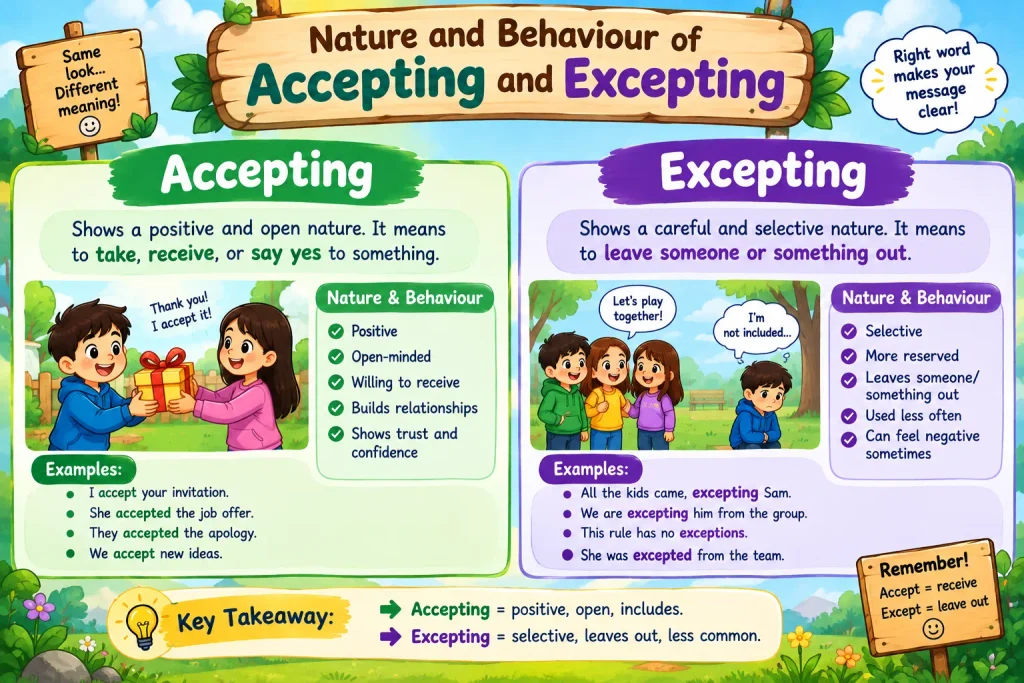
Accepting
Accepting is about saying yes, receiving, or being willing to take something. It can refer to a gift, an offer, an idea, or a person.
Examples:
- Maya is accepting the award.
- He is accepting that he made a mistake.
Excepting
Excepting is about leaving something out. It is a formal word and is not often used in everyday talk.
Examples:
- Excepting one item, the list is complete.
- The rule covers all days, excepting public holidays.
In many cases, “except for” or “excluding” sounds more natural than “excepting.”
Why People Get Confused About Accepting and Excepting
These words look and sound very similar. Both have the same ending, and both come from related word roots.
The main difference is their meaning:
- Accepting: saying yes or receiving something.
- Excepting: leaving something out.
Think of it this way: when you accept a gift, you take it. When you except an item from a list, you leave it out.
A simple memory tip is this: accept = agree or receive; except = leave out.
Comparison Table
| Feature | Accepting | Excepting |
|---|---|---|
| Main meaning | Receiving or saying yes | Leaving out |
| Base word | Accept | Except |
| Common use | Daily speech and writing | Formal or less common writing |
| Example | I am accepting the offer. | Excepting one fee, it is free. |
| Similar word | Receiving | Excluding |
| Usual tone | Often positive or neutral | Often formal or neutral |
Both words are correct English words. The right choice depends on what you want to say.
The Origin of Accepting and Excepting
The two words have a shared history in Latin, but they developed different meanings.
Accept comes from the Latin word accipere, which means “to receive” or “to take.” Over time, English used “accept” for taking an offer, agreeing to something, or receiving a person or idea.
Except comes from the Latin word excipere, which means “to take out” or “to exclude.” English uses “except” when one thing is left out of a group.
The endings in accepting and excepting show that an action is taking place or being described.
Their history helps explain the difference today: one is about receiving, while the other is about leaving out.
British vs. American English
There is no major difference between British and American English in the meaning or spelling of these words.
Both forms use:
- Accepting for receiving or saying yes.
- Excepting for leaving something out.
Examples in American English:
- We are accepting applications today.
- Excepting one small detail, the plan is ready.
Examples in British English:
- The school is accepting new pupils.
- Excepting bank holidays, the office opens each day.
In both places, “excluding” or “except for” may sound more natural than “excepting” in many sentences.
Which One Should You Use?
In the United States
Use accepting when you mean receiving or saying yes. Use excepting only when you mean leaving something out.
In the United Kingdom
The same rule applies. The meanings and spellings are the same as in American English.
For Global English
Choose the word that matches your meaning. If you mean “receive,” use accepting. If you mean “leave out,” use excepting, though “excluding” or “except for” is often clearer.
Common Mistakes
Mistake 1: Using “Excepting” for Saying Yes
Incorrect: She is excepting the job offer.
Correct: She is accepting the job offer.
Mistake 2: Using “Accepting” to Leave Something Out
Incorrect: Accepting Monday, the shop is open all week.
Correct: Except for Monday, the shop is open all week.
Mistake 3: Mixing Up the Base Words
Incorrect: I except your apology.
Correct: I accept your apology.
Mistake 4: Using “Excepting” When “Except for” Sounds Better
Less natural: Excepting the rain, we had a good day.
More natural: Except for the rain, we had a good day.
Mistake 5: Thinking the Words Mean the Same Thing
Incorrect: The two words can always replace each other.
Correct: They have different meanings and should be used with care.
Everyday Usage Examples
In Emails
Accepting:
- Thank you for accepting my meeting request.
- I am accepting the offer and look forward to joining the team.
Excepting:
- Excepting the attached file, all parts of the form are complete.
- The office is open daily, excepting public holidays.
In most work emails, “excluding” or “except for” may sound clearer than “excepting.”
On Social Media
Accepting:
- I am accepting new challenges this year.
- Learning to love yourself starts with accepting who you are.
Excepting:
- Everyone is invited, excepting those who have already signed up.
A more natural social media version is: “Everyone is invited, except those who have already signed up.”
In News
Accepting:
- The college is accepting applications for the new term.
- The group is accepting donations for local families.
Excepting:
- Excepting a few delays, the project is on track.
News writing often uses “excluding” or “apart from” instead.
In Formal Writing
Accepting:
- The board is accepting the new proposal.
- The court is accepting the document as evidence.
Excepting:
- Excepting the items listed below, all goods are covered by the policy.
- The rule applies to all members, excepting those named in the notice.
Usage Trends
Accepting is widely used in everyday English. People use it to talk about offers, payments, ideas, feelings, and change.
Excepting is much less common. Writers often choose “except,” “except for,” or “excluding” because these forms are shorter and clearer.
You are more likely to see “accepting” in emails, job posts, school notices, and daily conversation. You may see “excepting” in formal or older writing, but it is not the usual choice in casual speech.
For clear writing, choose the simplest word that gives the right meaning.
Metaphors and Similes
These words are not usually metaphors or similes by themselves. But they can be used in figurative ways.
Accepting
Accepting can describe opening your mind or heart to an idea.
- She is accepting change like a door opening to new light.
- Accepting help is like letting someone share your load.
Excepting
Excepting can suggest drawing a line around what is included.
- The rule stood like a fence, excepting no one but the owner.
- Excepting one dark cloud, the sky was bright.
Connotative Meaning
A word’s connotation is the feeling or idea it brings to mind.
Accepting: Positive or Neutral
“Accepting” can feel kind, open, or welcoming.
Example: “The team is accepting people from all backgrounds.”
It can also be neutral.
Example: “We are accepting payments by card.”
Excepting: Often Neutral or Formal
“Excepting” usually sounds formal. It may feel like a rule or a limit.
Example: “Excepting staff members, no one may enter this room.”
The word is not always negative. It simply shows that something is left out.
Idioms and Proverbs
There are no widely used idioms built around the exact words “accepting” and “excepting.” However, related words appear in common sayings.
“Learn to accept”
This means to stop fighting a fact or situation.
Example: “He is learning to accept that plans can change.”
“Accept the truth”
This means to admit that something is real or true.
Example: “She had to accept the truth about the mistake.”
“The exception proves the rule”
This saying is used when a special case points to a general rule, though its meaning is often misunderstood.
Example: “The sign says the pool is open daily except Sunday. That exception shows the usual schedule.”
Literature and Movies
The exact words “accepting” and “excepting” are common English word forms, not names tied to one famous book or film. Still, stories often explore the ideas behind them.
Literature
Wonder — R. J. Palacio, 2012, United States
- Genre: Children’s fiction
- Theme: Kindness, friendship, and accepting people who seem different
The story shows why it matters to welcome others and treat them with care.
Pride and Prejudice — Jane Austen, 1813, United Kingdom
- Genre: Romance and social fiction
- Theme: First impressions, change, and accepting people for who they are
The characters learn that their first views of others may be wrong.
Movies
Wonder — 2017, United States
- Genre: Family drama
- Theme: Kindness, belonging, and acceptance
The King’s Speech — 2010, United Kingdom and Australia
- Genre: Historical drama
- Theme: Facing challenges and accepting help
These works show the wider idea of acceptance. They do not focus on the grammar difference between “accepting” and “excepting.”
Why This Difference Matters
Using the right word helps readers understand your meaning.
If you write “I am excepting your offer,” readers may pause because you likely mean “I am accepting your offer.” The wrong word can make a message unclear.
This matters in school work, job emails, reports, and daily messages. A small spelling choice can change the whole meaning of a sentence.
Learning the difference also helps English learners build stronger word skills. It teaches them to look at the base word, not just the spelling.
Remember the key rule:
- Accepting means receiving or saying yes.
- Excepting means leaving something out.
If “excepting” feels awkward in your sentence, try “except for” or “excluding.” Clear words make clear writing.
Usefulness in Daily Life
You can use these words in many daily situations.
- At work: “We are accepting applications.”
- At school: “The teacher is accepting late work.”
- With friends: “Thank you for accepting my apology.”
- In a list: “Everyone is invited, except for Sam.”
- In a rule: “The offer covers all items, excluding delivery.”
Most of the time, you will use “accepting” more often than “excepting.” When you need to leave something out, “except for” is often the easiest choice.
Situational Preference
Choose accepting when you talk about a gift, offer, apology, idea, or person. It works well in daily speech, emails, school work, and business writing. Choose excepting only when you mean leaving something out. It is correct, but it can sound formal or stiff. In casual writing, “except for” is often better. In a report or policy, “excluding” may be clearer. Before you send a message, ask yourself: “Do I mean to receive something, or to leave something out?” That quick check can help you choose the right word.
Possible Questions
1. What is the main difference between accepting and excepting?
Accepting means receiving or saying yes. Excepting means leaving something out.
2. Is “excepting” a real word?
Yes. It is the -ing form of “except.” It is correct, but less common than “except” or “excluding.”
3. Is it “accepting an offer” or “excepting an offer”?
It is accepting an offer. You say yes to an offer; you do not leave it out.
4. Can I use “excepting” in formal writing?
Yes, but “excluding” or “except for” may be clearer in many cases.
5. Are accepting and excepting pronounced the same?
They sound very similar, but the first vowel differs for many speakers. Accepting often starts with the sound in “cat” or “about” depending on accent; excepting often starts with a short “ih” sound.
6. Does British English use these words differently from American English?
No. Their meanings and spellings are the same in both forms of English.
7. What is an easy way to remember the difference?
Think of accept = agree or receive and except = leave out.
Conclusion
Accepting and excepting look alike, but they do not mean the same thing. Accepting means taking something, receiving it, or saying yes. You may accept a gift, a job, an apology, or a new idea. The word accepting is common in daily talk and writing. Excepting means leaving someone or something out. People use this word less often. In many sentences, “except for” or “excluding” sounds more natural. To choose the right word, think about your meaning. Are you saying yes to something? Use accepting. Are you leaving something out? Use excepting, or say “except for.” This simple rule can make your emails, schoolwork, and other writing easier to understand. Just remember: accept means to receive, and except means to leave out. With practice, you will learn the difference and use each word with more confidence.

Eman Sarfraz is a professional content writer, researcher, and English language specialist with strong expertise in English grammar, vocabulary, word meanings, synonyms, and antonyms. I creates well-researched, accurate, and easy-to-understand content that helps readers master English concepts and communicate with greater confidence.