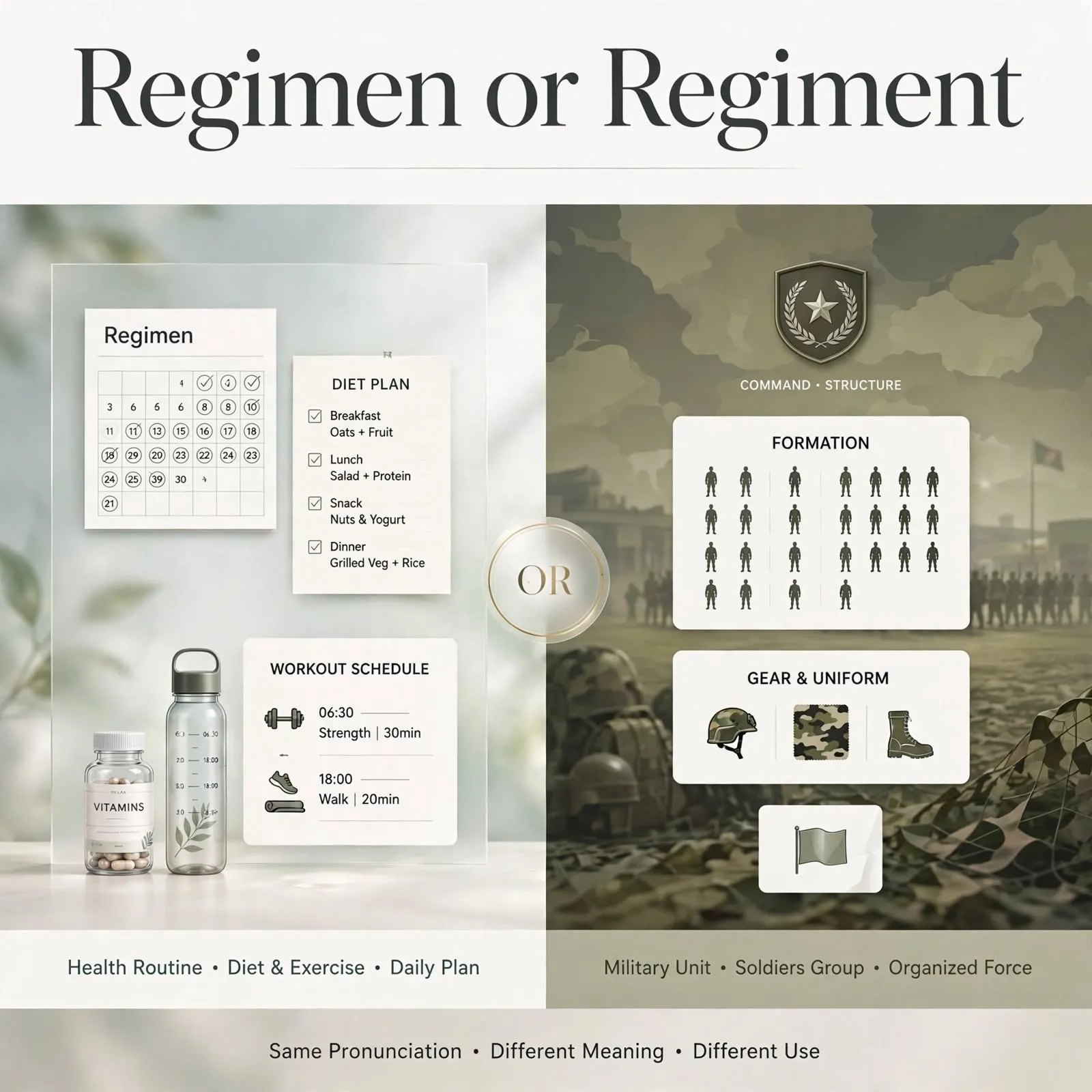
People often search for regimen or regiment because they want to spell the right word in a school task, work email, health plan, or story. One small letter can change the meaning of a sentence. If you write “my skin care regiment,” readers may still know what you mean, but “my skin care regimen” is the correct choice. If you write about soldiers, regiment is the right word.
The easy way to remember the difference is this: a regimen is a routine, while a regiment is a military group. Once you learn this simple rule, you can use both words with more care.
Pronunciation
The words sound very much alike, but the last part is different.
| Word | US pronunciation | UK pronunciation |
| Regimen | /ˈredʒ.ə.mən/ | /ˈredʒ.ɪ.mən/ |
| Regiment | /ˈredʒ.ə.mənt/ | /ˈredʒ.ɪ.mənt/ |
In simple sounds:
- Regimen: REJ-uh-muhn in the US; REJ-i-muhn in the UK.
- Regiment: REJ-uh-muhnt in the US; REJ-i-muhnt in the UK.
The main clue is the final t in regiment. You can hear it at the end. The word regimen has no final t. These pronunciations follow the entries in the Cambridge Dictionary.
Now, let’s look at the main differences and see how to use each word in daily life.
Difference Between Regimen and Regiment
1. Meaning
A regimen is a set plan or routine. A regiment is a group of soldiers.
- Regimen: I follow a daily exercise regimen.
- Regiment: The regiment moved to a new camp.
2. Main use
We often use regimen for health, skin care, food, or exercise. We often use regiment when we talk about the army.
- Regimen: My doctor gave me a new care regimen.
- Regiment: The regiment trained for the next mission.
3. Type of noun
A regimen names a plan or course of action. A regiment names a group of people, usually soldiers.
- Regimen: Her sleep regimen helps her rest well.
- Regiment: The regiment marched past the gate.
4. Number or group
A regimen is a set of steps to follow. A regiment is a group made up of many people.
- Regimen: His morning regimen has four steps.
- Regiment: The regiment has many soldiers.
5. Common setting
You may hear regimen in health care, fitness, and beauty. You may hear regiment in army stories, history, and news.
- Regimen: She changed her hair care regimen.
- Regiment: The book tells the story of an army regiment.
6. Common words used with it
Words such as daily, strict, exercise, and skin care often go with regimen. Words such as army, infantry, and military often go with regiment.
- Regimen: He follows a strict exercise regimen.
- Regiment: The infantry regiment reached the town.
7. Main purpose
A regimen helps someone follow a plan to reach a goal. A regiment is an organized military unit.
- Regimen: Her study regimen helps her prepare for exams.
- Regiment: The regiment protects its assigned area.
8. Use outside the army
Regimen is used for many kinds of routines. Regiment can also mean a very large number of people or things, often in a playful way.
- Regimen: The coach made a new training regimen.
- Regiment: A whole regiment of fans waited outside.
9. Effect on the sentence
Using the wrong word can make a sentence sound odd or change its meaning.
- Correct: I follow a skin care regimen.
- Correct: He served in an army regiment.
10. Easy memory tip
Think of regimen as a routine. Think of regiment as a group of soldiers.
- Regimen: My bedtime regimen helps me sleep.
- Regiment: The regiment stood in line.
Nature and Behaviour of Regimen and Regiment
Regimen
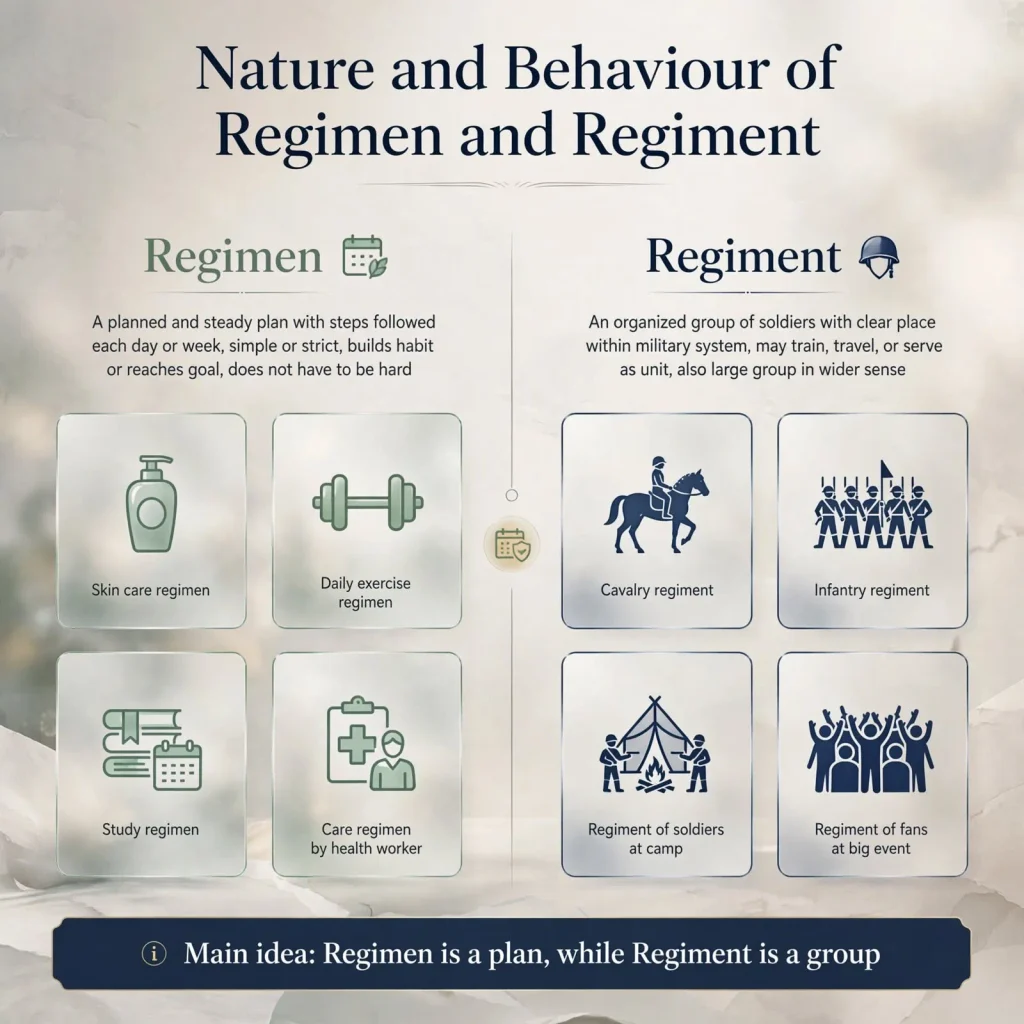
A regimen is planned and steady. It often has steps that a person follows each day or week. The plan may be simple or strict. It can help a person build a habit or reach a goal.
Examples include:
- A skin care regimen
- A daily exercise regimen
- A study regimen
- A care regimen set by a health worker
A regimen does not have to be hard. Even a short plan can be a regimen if you follow it in a steady way.
Regiment
A regiment is an organized group of soldiers. It has a clear place within a military system. It may train, travel, or serve as a unit. The word can also be used in a wider sense to describe a large group.
Examples include:
- A cavalry regiment
- An infantry regiment
- A regiment of soldiers at a camp
- A regiment of fans at a big event
The main idea is simple: a regimen is a plan, while a regiment is a group.
Read more about:https://syntexra.com/joint-or-blunt/
Why People Get Confused About Regimen and Regiment
These words look and sound alike. Both start with regim-. They also come from old words linked to rule, guidance, and order. This shared history may help explain why they seem so close.
The last few letters make the key difference:
- Regimen ends in -men.
- Regiment ends in -ment.
People may also hear the words in fast speech and miss the final t in regiment. Spell-check tools may not catch the error because both words are real English words.
To avoid confusion, ask yourself one quick question: Am I talking about a plan or a group? If you mean a plan, use regimen. If you mean soldiers, use regiment.
Comparison Table
| Feature | Regimen | Regiment |
| Main meaning | A plan or routine | A group of soldiers |
| Word type | Noun | Noun |
| Common use | Health, exercise, skin care, study | Army, military history, large groups |
| Common phrase | Daily regimen | Army regiment |
| Main idea | Steps to follow | People in an organized unit |
| Example | She follows a sleep regimen. | The regiment left the camp. |
| Similarity | Both are nouns and share a similar spelling | Both are nouns and share a similar spelling |
The Origin of Regimen and Regiment
Both words have roots in old words linked to rule and guidance. But their uses became different over time.
Origin of regimen
Regimen entered English around the 1400s. It came through Old French from the Latin word regimen. That Latin word meant rule, guidance, or direction. In English, regimen came to mean a set course of action, especially one linked to health, food, and exercise.
Today, you may see it in phrases such as fitness regimen, skin care regimen, and daily regimen.
Origin of regiment
Regiment also came into English in the Middle Ages. It passed through French and came from a Latin form linked to rule or order. Over time, it became the name for an organized military unit.
Today, the word is most often used for groups of soldiers. It may also describe a very large group of people or things.
Although the words share a distant root, their modern meanings are not the same.
British vs American English
The main difference between regimen and regiment is the meaning, not the spelling. Both words are spelled the same in British and American English.
The pronunciation can change a little. In US English, the middle vowel often sounds like “uh.” In UK English, it often sounds closer to the short “i” in “sit.”
Examples:
- US English: I follow a skin care regimen.
- UK English: I follow a skin care regimen.
- US English: The regiment arrived today.
- UK English: The regiment arrived today.
The spelling stays the same in both places. The meaning also stays the same. In global English, use regimen for a plan and regiment for a military unit.
Which One Should You Use?
The right word depends on what you want to say.
In the US
Use regimen for a plan related to health, fitness, or daily habits. Use regiment for an army unit.
- My doctor suggested a new exercise regimen.
- The regiment took part in the parade.
In the UK
Follow the same rule. The words have the same basic meanings in British English.
- She follows a simple skin care regimen.
- The regiment returned from training.
In global English
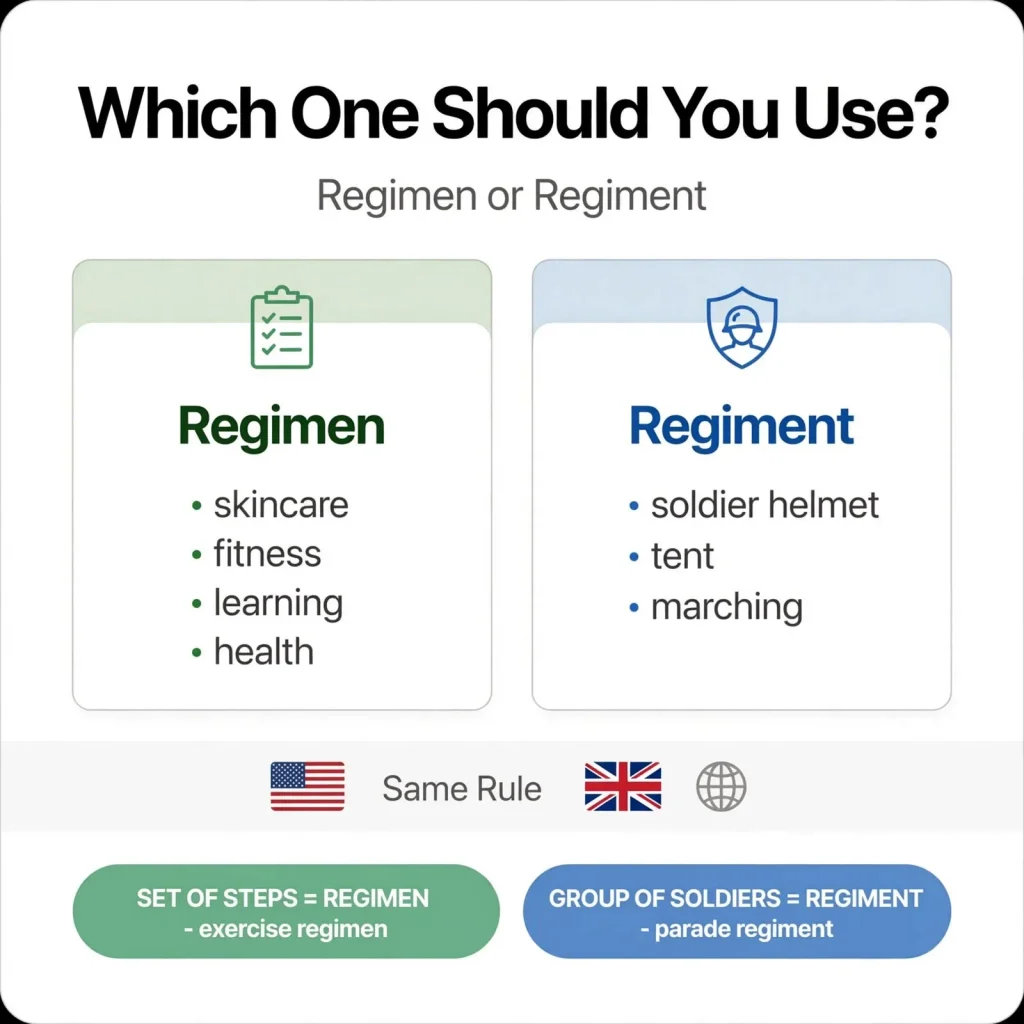
The same rule works in most English-speaking settings. Check the meaning of your sentence before you choose the word. If you mean a set of steps, choose regimen. If you mean a group of soldiers, choose regiment.
Common Mistakes
Here are common errors and their correct forms.
– Wrong: I started a new skin care regiment.
Right: I started a new skin care regimen.
– Wrong: The regimen marched across the field.
Right: The regiment marched across the field.
– Wrong: My fitness regiment is easy to follow.
Right: My fitness regimen is easy to follow.
– Wrong: He joined a military regimen.
Right: He joined a military regiment.
– Wrong: The doctor gave me a new regiment of care.
Right: The doctor gave me a new care regimen.
– Wrong: I follow a regiment for better sleep.
Right: I follow a regimen for better sleep.
Remember that both words are correct English words. The mistake happens when you use the right word in the wrong place.
Everyday Usage Examples
These examples show how the two words can appear in daily writing.
In emails
Regimen:
“Hi Sam, I have started a new exercise regimen. I will try to follow it each morning.”
Regiment:
“Hello, the report includes the history of the regiment and its work.”
On social media
Regimen:
“My new morning regimen starts with a short walk and a healthy breakfast.”
Regiment:
“I just read a story about a regiment that served many years ago.”
In news
Regimen:
“The athlete changed her training regimen before the big race.”
Regiment:
“The regiment took part in a public event.”
In formal writing
Regimen:
“The care plan includes a daily exercise regimen.”
Regiment:
“The report describes the regiment’s role during the war.”
In each case, the meaning tells you which word to use.
Usage Trends
Both words are used around the world, but they appear in different settings.
Regimen is common in writing about health, exercise, beauty, and care. For example, people may talk about a sleep regimen or a daily fitness regimen.
Regiment is common in military writing, history books, and reports about armed forces. It can also be used in a wider sense to mean a large group.
The use of each word depends on the topic. A health blog is more likely to use regimen. A book about soldiers is more likely to use regiment. Search tools such as Google Books Ngram Viewer can show how words appear in books over time, but they do not show every use of a word in daily speech.
The best way to learn these words is to read them in full sentences. This helps you connect each word with its correct meaning.
Metaphors and Similes
A metaphor describes one thing as another. A simile compares two things using words such as like or as.
These words can also help create clear images in writing.
Regimen in figurative language
A regimen can stand for order, habit, or steady effort.
– Metaphor: “Her morning regimen is the anchor of her day.”
This means her routine helps her stay steady.
– Simile: “He followed his study regimen like a clock.”
This means he studied at set times.
Regiment in figurative language
A regiment can stand for a large group or a strong sense of order.
– Metaphor: “A regiment of fans filled the street.”
This means a very large crowd filled the street.
– Simile: “The workers moved like a regiment.”
This means they moved in an organized way.
These are creative examples, not fixed phrases. In normal writing, use the literal meaning when you need to be clear.
Connotative Meaning
A word can have a direct meaning and also create a feeling in the reader. This feeling is called its connotation.
Regimen
Positive meaning: A regimen can suggest care, effort, and good habits.
Example: “Her daily regimen helps her feel ready for the day.”
Negative meaning: It can suggest rules that feel too strict.
Example: “He found the new regimen hard to follow.”
Neutral meaning: It can simply mean a set plan.
Example: “The care regimen has three steps.”
Regiment
Positive meaning: A regiment can suggest teamwork, courage, and service.
Example: “The regiment worked together during the crisis.”
Negative meaning: It may suggest strict control or a lack of freedom.
Example: “The school day felt like a regiment of fixed tasks.”
Neutral meaning: It can name a military unit without adding praise or blame.
Example: “The regiment arrived at the base.”
The feeling depends on the sentence and the context. Neither word is always positive or negative.
Idioms and Proverbs
There are no widely used everyday idioms that depend on the exact words regimen or regiment. However, related phrases can help explain their meanings.
“Stick to a routine”
This means to keep following a plan.
Example: “I stick to my morning routine before work.”
This idea is close to a daily regimen.
“Keep in line”
This means to follow rules or behave as expected.
Example: “The coach asked the team to keep in line.”
This phrase may fit a story about strict order, but it does not mean regiment.
“Practice makes perfect”
This well-known saying means that regular practice can help you improve.
Example: “She follows a study regimen because practice makes perfect.”
These phrases are useful in daily English. Just remember that they are not direct replacements for regimen or regiment.
Literature and Movies
Books and films often show routines, military groups, or strict systems. These themes can help you understand the two words.
Literature
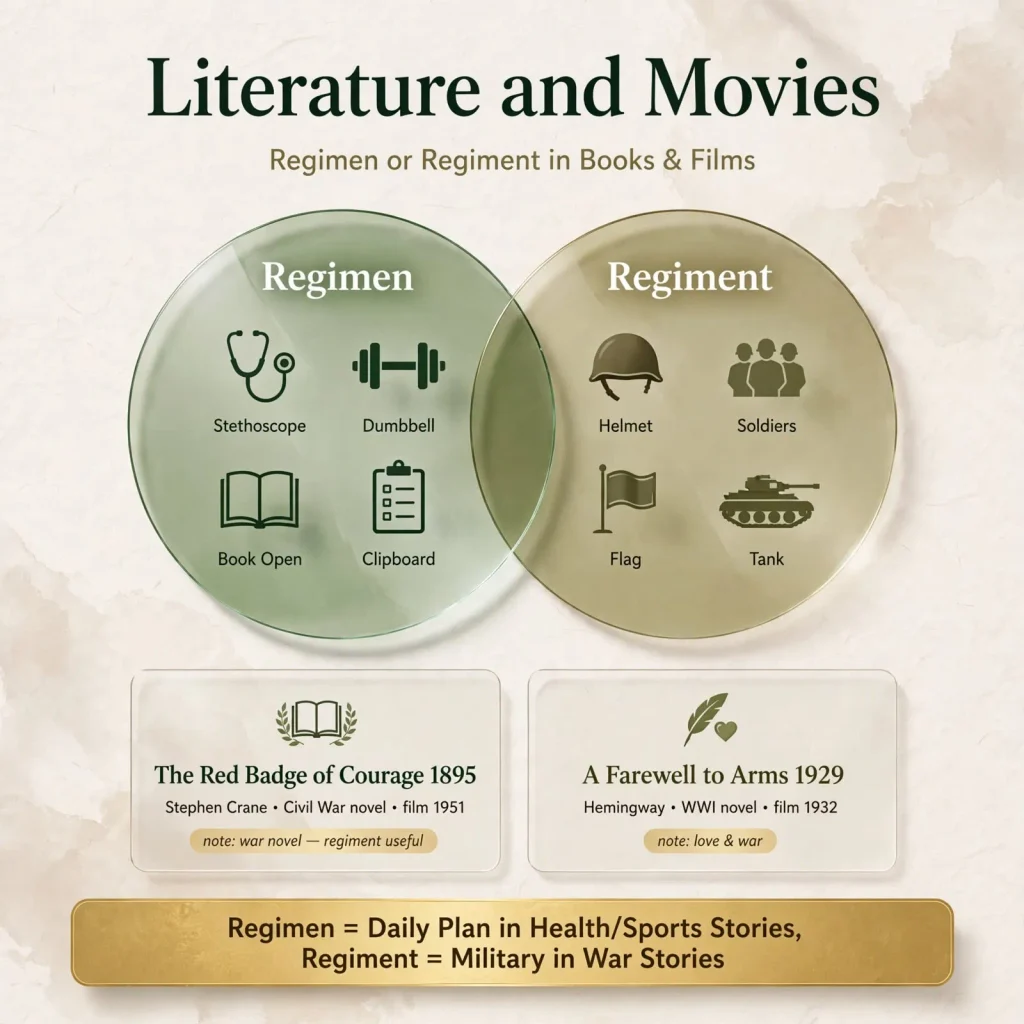
- ** The Red Badge of Courage — Stephen Crane, 1895.** This war novel follows a young soldier during the American Civil War. It offers a clear setting for learning words about soldiers and military life.
- ** A Farewell to Arms — Ernest Hemingway, 1929.** This novel tells a story set during World War I. It explores war, love, and loss.
These works provide a military setting where the word regiment may be useful. They are not books about the word itself.
For regimen, think of stories about athletes, doctors, or people who follow strict daily plans. A writer may use the word to describe a character’s habits or care plan.
Movies
- ** The Red Badge of Courage (1951, United States).** This film is based on Stephen Crane’s war novel.
- ** A Farewell to Arms (1932, United States).** This film is based on Hemingway’s novel and is set during World War I.
These films show military life and the role of soldiers. They can help readers connect regiment with its military meaning. In health or sports stories, a character’s regimen may refer to a plan for training, rest, or care.
Why This Difference Matters
Using the right word helps you share your ideas clearly. It also helps readers trust your writing.
If you write about health, the word regimen may be important. A reader needs to know that you mean a plan or routine. If you write about soldiers, regiment helps readers understand that you mean a military group.
This difference matters for English learners, too. Both words look alike, so it is easy to mix them up. Learning their meanings can help you spell better and write with more care.
The difference also matters in school work, news reports, emails, and books. One wrong word may confuse a reader or change the meaning of a sentence.
A simple check can help you avoid this mistake. Ask yourself what the sentence is about. Is it about a routine or a group of soldiers? That one question can help you choose the right word.
Usefulness in Daily Life
You may use regimen when you talk about your health, work, or daily habits. For example, you might follow a study regimen before an exam or a skin care regimen each night.
You may use regiment when you read a history book, watch a war film, or discuss military news. You may also see it used to describe a very large group.
Here are two easy ways to remember the words:
- Regimen = routine. Both relate to a plan you follow.
- Regiment = military group. Think of soldiers standing or moving together.
You do not need to learn a long rule. Just learn the main meaning of each word and read the full sentence before you use it.
Situational Preference
Choose regimen when you talk about a set plan. Use it for exercise, skin care, sleep, study, or health care. For example, “I follow a daily study regimen.” Choose regiment when you mean a military unit. For example, “The regiment returned to its base.” In a story, regiment can also mean a very large group. The rules are the same in the US, the UK, and most global English settings. If you are unsure, ask: “Is this a routine or a group?” That quick check will help you choose the right word.
Quick Answers
1. What is the main difference between regimen and regiment?
A regimen is a plan or routine. A regiment is a group of soldiers.
2. Is it a skin care regimen or a skin care regiment?
The correct phrase is skin care regimen. It means a set of steps you follow to care for your skin.
3. Is it an exercise regimen or an exercise regiment?
The correct phrase is exercise regimen. It means a planned set of exercises.
4. Can regiment mean a large group?
Yes. Regiment can mean a large group of people or things, often in a figurative way. For example, “A regiment of fans waited outside.”
5. Do regimen and regiment sound the same?
They sound very similar, but regiment has a final t sound. The middle vowel may also sound a little different in US and UK English.
6. Are the spellings different in British and American English?
No. Both words have the same spelling in British and American English. Their meanings also stay the same.
7. What is an easy way to remember the difference?
Think of regimen = routine and regiment = group of soldiers. This simple rule will help you use each word correctly.
Conclusion
Regimen or Regiment? These words look alike but have different meanings. A regimen is a plan or routine for health, exercise, skin care, or study. A regiment is a group of soldiers. To remember the difference, think of regimen as a routine and regiment as a military group. Both words have the same spelling in American and British English. Use the right word to make your writing clear and avoid common mistakes.

Eman Sarfraz is a professional content writer, researcher, and English language specialist with strong expertise in English grammar, vocabulary, word meanings, synonyms, and antonyms. I creates well-researched, accurate, and easy-to-understand content that helps readers master English concepts and communicate with greater confidence.









2 thoughts on “Regimen or Regiment: What’s the Difference?”