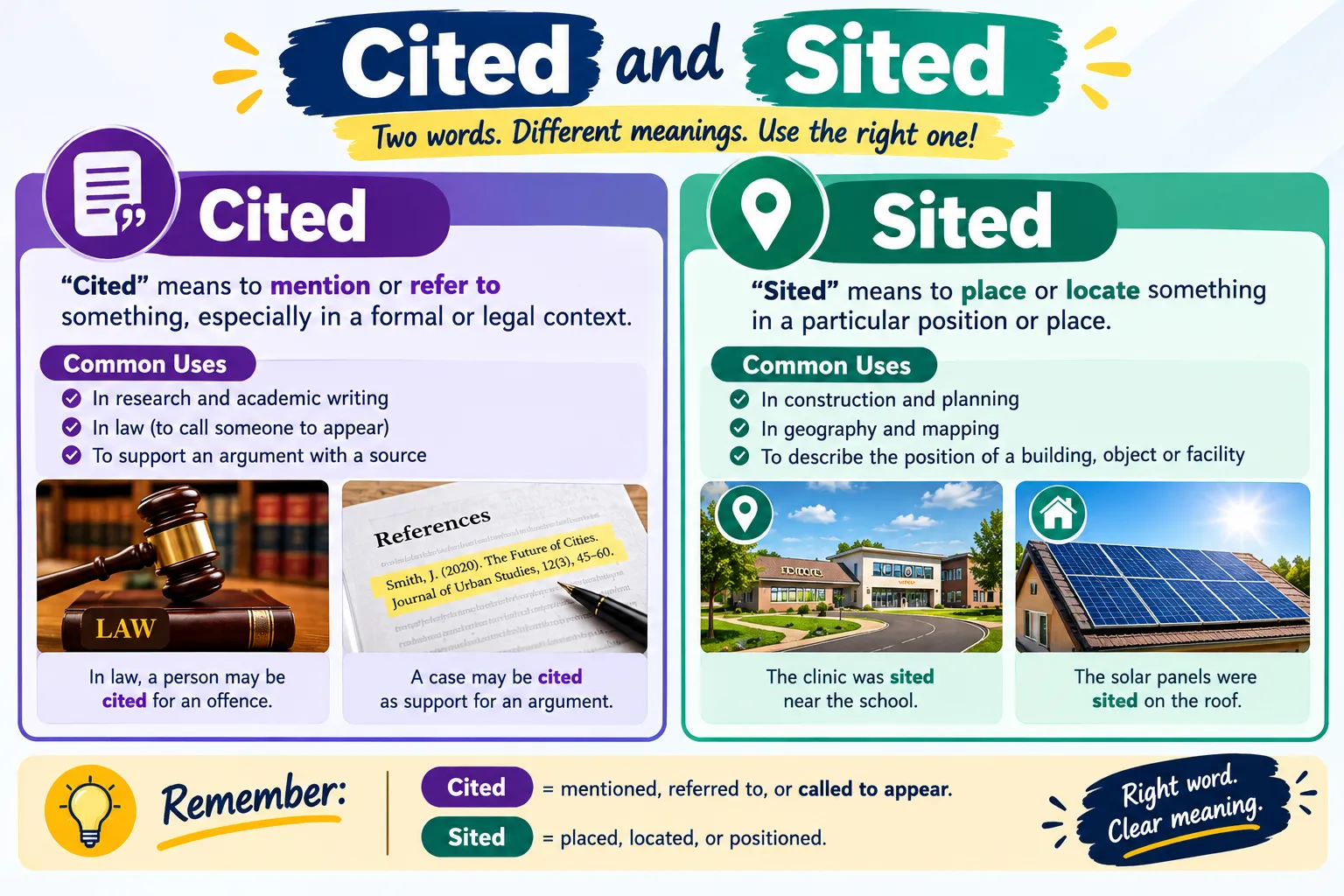
Cited means mentioned or used as a source, while sited means placed in a particular location.
Imagine you are writing a school report about climate change. You use facts from a science book to support your ideas. You have cited the book. Now, imagine a company plans to build a new factory near a river. The company sited the factory near the river. Both words are correct, but they have different meanings.
The words cited and sited often confuse English learners. They sound the same, but their spelling and use are different. Cited comes from the verb cite, which means to mention a source, give proof, or name something as a reason. Sited comes from the verb site, which means to place or locate something in a particular spot.
People search for cited or sited because both words can sound alike in speech. This makes it hard to choose the right spelling when writing. The difference matters in schoolwork, business reports, news stories, and daily messages. One simple rule can help: use cited when talking about information or sources. Use sited when talking about a place or location.
Pronunciation of Cited and Sited
Both words have the same standard pronunciation in American and British English.
| Word | US pronunciation | UK pronunciation |
|---|---|---|
| Cited | /ˈsaɪ.tɪd/ | /ˈsaɪ.tɪd/ |
| Sited | /ˈsaɪ.tɪd/ | /ˈsaɪ.tɪd/ |
Both words sound like “sigh-tid.” They are homophones because they sound the same but have different meanings and spellings.
Also read more about:https://syntexra.com/regimen-or-regiment/
A Quick Guide Before We Begin
The easiest way to remember the difference is to look at the base word.
- Cite → Cited: Mention a source, fact, reason, or example.
- Site → Sited: Place or locate something somewhere.
Now, let us look at ten clear differences and learn how to use both words correctly.
Difference Between Cited and Sited
1. Meaning
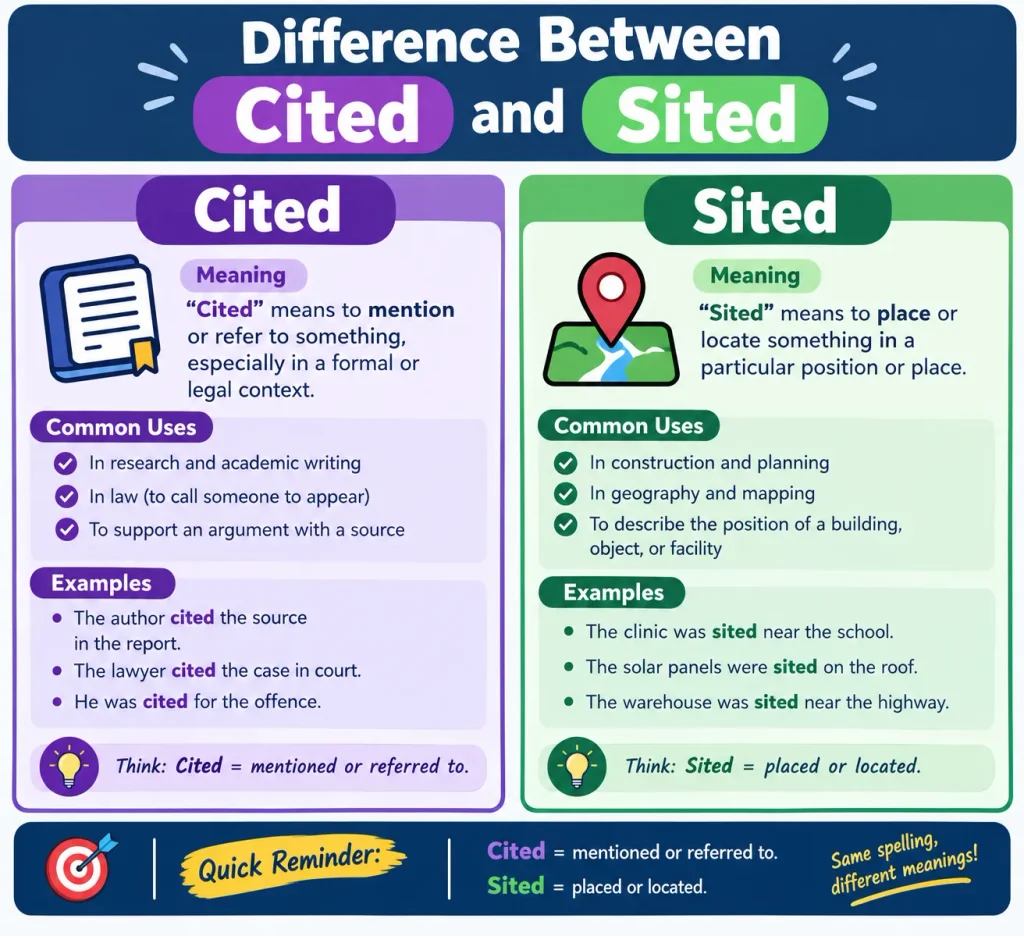
Cited means mentioned or referred to something. Sited means placed or located something in a particular spot.
Examples of cited:
- The writer cited a famous book.
- She cited two reasons for her choice.
Examples of sited:
- The town planners sited the school near a park.
- The company sited the factory outside the city.
2. Base Word
Cited comes from cite. Sited comes from site.
Examples of cited:
- He cited the report in his essay.
- The lawyer cited an older case.
Examples of sited:
- They sited the office near the station.
- The team sited the new building on higher ground.
3. Main Purpose
Cited explains where information came from or why someone makes a claim, while sited explains where someone places something.
Examples of cited:
- The student cited a science book.
- The report cited rising costs as a problem.
Examples of sited:
- The developers sited the hospital near the town.
- The company sited the wind farm on open land.
4. Common Use
Cited is common in schoolwork, research, law, and news. People often use “sited” in planning, building, and design.
Examples of cited:
- The student cited three studies.
- The news report cited official figures.
Examples of sited:
- The planners sited the homes along the road.
- The authorities sited the new airport away from homes.
5. Type of Information
Cited often refers to words, facts, studies, or reasons. Sited usually refers to a place or the position of something.
Examples of cited:
- She cited a study about sleep.
- He cited safety as his main concern.
Examples of sited:
- The planners sited the clinic near the school.
- The workers sited the solar panels on the roof.
6. Grammar
Both words are the past tense and past participle forms of verbs. They can appear in active and passive sentences.
Examples of cited:
- The author cited the source.
- The author cited the source in the report.
Examples of sited:
- The company sited its office downtown.
- The company sited the office downtown.
7. Questions They Answer
Cited often answers questions such as “What source?” or “What reason?” Sited often answers “Where?”
Examples of cited:
- Which book did she cite? She cited a history book.
- Why did he leave? He cited a family reason.
Examples of sited:
- Where was the school sited? Near the park.
- Where was the factory sited? Outside the town.
8. Common Subjects
Cited often appears with writers, researchers, lawyers, and reports. Sited often appears with buildings, roads, factories, and other structures.
Examples of cited:
- The researcher cited new evidence.
- The lawyer cited a legal rule.
Examples of sited:
- The engineers sited the tower on a hill.
- The company sited the warehouse near the highway.
9. Related Words
Cited is related to citation. Sited is related to site, a word for a place or location.
Examples of cited:
- Add a citation for the quote you cited.
- The article cited the author’s research.
Examples of sited:
- The architects sited the building near the river.
- The team chose a site for the new school.
10. What Happens If You Choose the Wrong Word?
Using the wrong word can change the meaning of a sentence. Readers may misunderstand your point.
Examples of cited:
- Correct: The student cited the book.
- Incorrect for this meaning: The student sited the book.
Examples of sited:
- Correct: The planners sited the factory near the river.
- Incorrect for this meaning: The planners cited the factory near the river.
Nature and Behaviour of Cited and Sited

Cited
Cited is the past tense of cite. It often appears when someone shares information from another source. Writers use it to show where facts, ideas, or quotes came from.
It can also mean that someone gave a reason for an action.In law, authorities may cite a person for an offence, or lawyers may cite a case to support an argument.
Examples:
- The report cited a lack of funds.
- The teacher cited the book in her lesson.
Sited
Sited is the past tense of site when site is used as a verb. It means to place or locate something in a particular position.
This word is useful when people discuss buildings, roads, offices, factories, or other projects. It can also describe where something has been placed for a clear purpose.
Examples:
- The new school was sited near the library.
- The company sited its office close to the airport.
Why People Confuse Cited and Sited
The main reason is pronunciation. Both words sound the same in standard American and British English. When people hear them, they cannot tell which spelling is correct without knowing the meaning.
Their spellings also differ by only one letter. This makes typing mistakes easy, especially when people write quickly.
Another reason is that both words can appear in formal writing. A news story may say that a report cited new facts. A planning report may say that a building was sited near a road.
Here is a simple way to remember them:
- Cited = source or reason.
- Sited = place or position.
Comparison Table
| Feature | Cited | Sited |
|---|---|---|
| Base word | Cite | Site |
| Main meaning | Mention or refer to | Place or locate |
| Pronunciation | /ˈsaɪtɪd/ | /ˈsaɪtɪd/ |
| Grammar | Past tense or past participle | Past tense or past participle |
| Common setting | School, research, law | Building, planning, design |
| Related noun | Citation | Site |
| Main question | What source or reason? | Where? |
| Example | She cited the study. | The building was sited nearby. |
| Correct use | He cited a report. | They sited the office downtown. |
Both words are correct English. The difference is their meaning, not their pronunciation.
The Origin of Cited and Sited
The two words have different histories.
The word cite comes from the Latin word citare, which meant to call or summon. Over time, it developed meanings linked to referring to a person, text, or idea. Today, writers cite sources to support their work. The word citation comes from the same word family.
The word site comes from the Latin word situs, which refers to position or location. It entered English through French. At first, site was mainly used as a noun for a place. Later, it also became a verb meaning to place something in a chosen location.
This history helps explain why the words have different meanings“Cite” means to refer to information, while “site” refers to a place or location.
British vs American English
There is no major difference between American and British English in the use of cited and sited. Both forms have the same spelling and meaning in both varieties.
| Feature | American English | British English |
|---|---|---|
| Cited | Correct | Correct |
| Sited | Correct | Correct |
| Pronunciation | Same standard pronunciation | Same standard pronunciation |
| Meaning of cited | Referenced or mentioned | Referenced or mentioned |
| Meaning of sited | Placed or located | Placed or located |
Examples in American English:
- The report cited new safety rules.
- The new school was sited near the park.
Examples in British English:
- The report cited new safety rules.
- The new school was sited near the park.
Which One Should You Use?
Use cited when you talk about sources, facts, reasons, or examples. It is the right choice for essays, reports, research papers, and legal writing when you refer to information.
Use “sited” when you describe where someone places or builds something.It often appears in planning documents, building projects, and discussions about land.
For American readers, British readers, and people who use global English, the rule stays the same. There is no need to change the spelling based on the country.
Ask yourself one simple question: Am I talking about information or location?
If you mean a source or reason, choose cited. If you mean a place or position, choose sited.
Common Mistakes
Here are common mistakes and the correct forms.
- Incorrect: The student sited three books in her essay.Correct: The student cited three books in her essay.
- Incorrect: The company cited the factory near the river.
- Correct: The company sited the factory near the river.
- Incorrect: The writer sited a study to support the claim.Correct: The writer cited a study to support the claim.
- Incorrect: The planners cited the new hospital outside the town.
- Correct: The planners sited the new hospital outside the town.
- Incorrect: The report sited a lack of money as the main reason.Correct: The report cited a lack of money as the main reason.
A useful tip is to replace the word with a simpler one. If “mentioned” fits, use cited. If “placed” fits, use sited.
Everyday Usage Examples
In Emails
Cited:
- I cited the report in my email.
- The manager cited a delay as the reason for the change.
Sited:
- The new office will be sited near our main branch.
- The project team has sited the equipment beside the entrance.
On Social Media
Cited:
- The post cited a study about healthy sleep.
- She cited the source in her comment.
Sited:
- The new café is sited near the town square.
- The event stage was sited beside the main entrance.
In News
Cited:
- Officials cited safety concerns as a reason for the closure.
- The article cited figures from a recent report.
Sited:
- City planners sited the new station outside the city centre.
- The company sited the factory away from homes.
In Formal Writing
Cited:
- The researcher cited several sources to support the claim.
- The court cited an earlier decision.
Sited:
- The building was carefully sited to reduce noise.
- The solar farm was sited on suitable land.
Usage Trends
Writers often use “cited” to refer to facts, studies, reports, and reasons. It is common in schoolwork, news, research, and legal writing.
Sited is more specific. People often use “sited” when they discuss where to place buildings, roads, factories, or other projects.
Both words remain useful in modern English. Their use depends on the topic, not on a change in spelling rules. Without a reliable, specific data set, it is better not to claim exact usage percentages or predict which word will become more common.
Metaphors and Similes
Cited and sited do not have common metaphorical meanings of their own. However, they can appear in sentences that use figures of speech.
Examples with Cited
- She cited the past as a mirror for the future.
- He cited the storm as a picture of the team’s struggle.
In these examples, the phrases “mirror for the future” and “picture of the team’s struggle” are figurative. Cited still means mentioned.
Examples with Sited
- The cottage was sited like a jewel on the green hill.
- The tower was sited like a guard over the town.
Connotative Meaning
Connotation is the feeling or idea a word may suggest beyond its basic meaning.
Cited
Positive: Cited can suggest careful research and strong evidence.
Example: The writer cited trusted sources to support her ideas.
Negative: In some settings, cited can suggest a warning or legal trouble.
Example: The driver was cited for breaking a traffic rule.
Neutral: Cited can simply mean mentioned.
Example: The report cited three main causes.
Sited
Positive: Sited can suggest careful planning and a good location.
Example: Planners chose a good site for the school near a park.
Negative: “Sited” can suggest poor planning when someone chooses a bad location.
Example: The company sited the factory too close to nearby homes.
Neutral: Sited can simply describe a location.
Example: The office was sited beside the main road.
Idioms and Proverbs
People rarely use “cited” or “sited” in common idioms or proverbs. However, related expressions can help you understand their use.
Related to Cited
“Give credit where credit is due.”
Meaning: Recognize the person who deserves praise or recognition.
Example: When you use another writer’s idea, cite the source and give credit where credit is due.
“Put it in writing.”
Meaning: Record something in written form.
Example: The manager cited the agreement and asked the team to put it in writing.
Related to Sited
“Location, location, location.”
Meaning: A place can be very important, especially when choosing a home or business site.
Example: The owners chose a busy street because location, location, location matters to their business.
Literature and Movies
Cited and sited are useful words when discussing books, films, and other creative works. They do not have a special meaning in one literary genre. Their use depends on the sentence.
Literature
- In research about Pride and Prejudice by Jane Austen, published in 1813, a writer may have cited a passage from the novel.
- In a history book, an author may have cited a letter or diary as evidence.
- In a story about a new town, a writer may describe where planners sited a school.
Movies
- In a documentary, a narrator may have cited facts from a report.
- In a film about a construction project, a team may have sited a building near a river.
- In a review of a historical movie, a writer may have cited a scene as an example of strong acting.
The words do not belong to a specific book or film. They describe actions that may appear in writing about many kinds of stories and movies.
Why This Difference Matters
Choosing the correct word helps readers understand your message. A small spelling mistake can change the meaning of a sentence.
In school, students need to cite books and websites when they use facts from them. If they write sited instead, the sentence may not express the intended meaning.
At work, people may discuss where to place offices, roads, or other buildings. In this case, sited is often the right word. Using cited instead can confuse readers.
The difference also matters in news reports, research papers, and formal documents. Clear writing helps people trust the information they read.
Both words sound the same, so spell-check tools may not catch every mistake. The best way to avoid errors is to understand the meaning and check the sentence before sharing it.
Usefulness in Daily Life
You can use cited and sited in many everyday situations.
When writing an essay, use cited to show where you found your facts.
While sending a work email, use cited to explain the source of a claim or reason.
When talking about buildings, offices, or public places, use sited to explain where something is located. For example, planners may site a new clinic near a busy road so people can reach it more easily.
You may also see these words in news stories, reports, and online articles. Knowing the difference helps you read more carefully and write with confidence.
A simple habit can help: pause and ask whether you mean “mentioned” or “placed.” That quick check can prevent many spelling errors.
Situational Preference
Choose cited when you are writing an essay, research paper, report, email, or news story that refers to a source or gives a reason. For example, “The writer cited a recent study.”Choose “sited” when you describe where someone places a building, factory, school, or other structure. For example, “The town planners sited the school near the park.” In American English, British English, and global English, the same rule applies. Neither word is better in every situation. The best word is the one that matches your meaning. If you are unsure, replace cited with “mentioned” or sited with “placed.” The sentence should still make sense.
Possible Questions
1. What is the main difference between cited and sited?
Cited means mentioned or referred to a source, fact, or reason. Sited means placed or located something in a particular place.
2. Are cited and sited pronounced the same?
Yes. Both are usually pronounced /ˈsaɪtɪd/ in American and British English.
3. Is cited a correct English word?
Yes. Cited is the past tense and past participle of cite. People often use “cited” to refer to a source or give a reason.
4. “sited” is a correct English word?
Yes. Sited is the past tense and past participle of site when site means to place or locate something.
5. Should I use cited or sited in an essay?
Use cited when you refer to a book, article, study, or other source. For example, “The student cited a book about history.”
6. “sited” can be used for a building?
Yes. Sited describes where someone places or builds a building. For example, “The town planners sited the new school near the library.”
7. What is an easy way to remember cited or sited?
“Remember that cite relates to citations and sources, while site refers to a place.” Use cited for references and sited for locations.
Conclusion
Cited and sited sound the same, but they have different meanings. Learning this small difference can make your English writing clearer and more accurate.Use cited when you talk about a source, fact, quote, example, or reason. For example, “The student cited a science book.” The word is common in essays, research papers, news stories, and legal writing.Use sited when you talk about placing or locating something in a particular place.“The town planners sited the new school near the park.” You may see this word in building plans, business reports, and discussions about land.The good news is that the rule is the same in American and British English. You do not need to learn two different spellings or pronunciations.When you are unsure, try replacing the word. If “mentioned” fits, choose cited. If “placed” fits, choose sited. This simple trick can help you avoid common mistakes in schoolwork, emails, and everyday writing.

Eman Sarfraz is a professional content writer, researcher, and English language specialist with strong expertise in English grammar, vocabulary, word meanings, synonyms, and antonyms. I creates well-researched, accurate, and easy-to-understand content that helps readers master English concepts and communicate with greater confidence.












1 thought on “Cited or Sited: Meaning, Differences, Pronunciation, and Examples”