
Customize is the US spelling. Customise is the UK spelling. Both words mean the same thing: to change something the way you like.
Have you ever changed the look of your phone? Maybe you picked a new photo or changed the colors. You made the phone your own. You customized it!
In the UK, people may write customised instead. The meaning stays the same.
So, should you write customize or customise? It can be hard to know. You may see both words when you read books, visit websites, or shop online.
The good news is that both words are right. You do not need to learn two meanings. You only need to know which spelling to use.
If you write for people in the US, use customize. If you write for people in the UK who use the -ise style, use customise.
Let’s look at both words with easy rules and examples.
How to Say Customize and Customise
Both words sound almost the same.
| Word | US Sound | UK Sound |
|---|---|---|
| Customize | KUS-tuh-myze | KUS-tuh-myze |
| Customise | KUS-tuh-myze | KUS-tuh-myze |
Say the words out loud. You will hear little or no change in the sound.
Examples:
- I can customize my phone.
- I can customise my phone.
Both lines mean the same thing.
Difference Between Customize and Customise
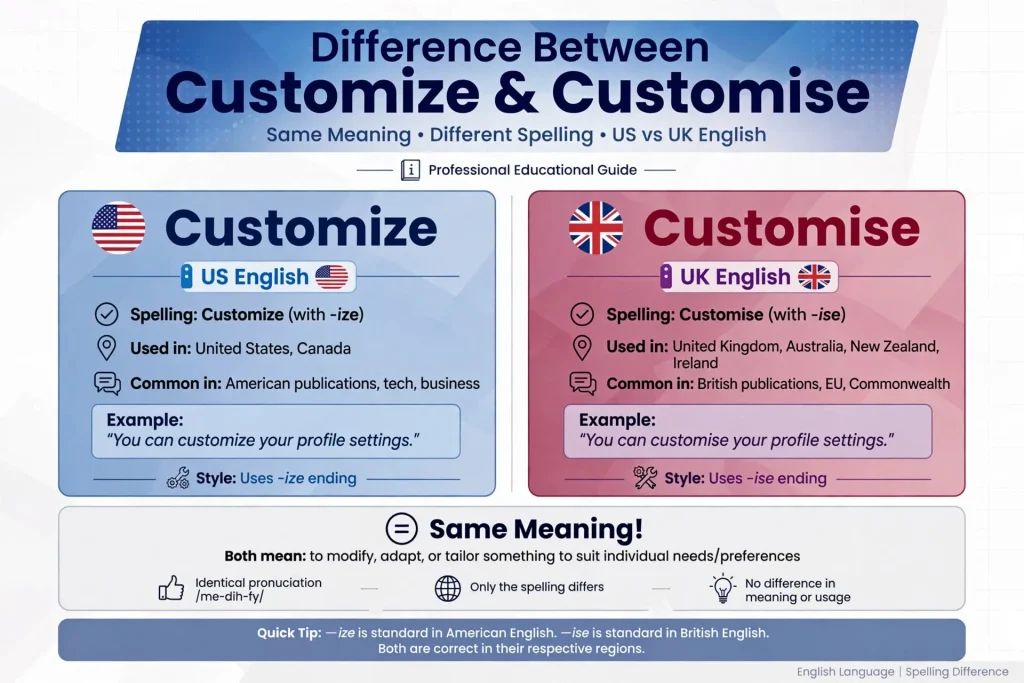
There are 10 simple things to know about these words.
1. US and UK Spelling
People in the US often write customize. People in the UK often write customise.
Examples:
- I want to customize my room.
- I want to customise my room.
2. The Last Letters
One word ends in -ize. The other ends in -ise.
Examples:
- We customize our bags.
- We customise our bags.
3. The Meaning
Both words mean to change something to suit your needs.
Examples:
- I can customize my bike.
- I can customise my bike.
4. The Sound
Both words sound the same to most English speakers.
Examples:
- Please customize the app.
- Please customise the app.
5. The Past Form
Use customized in US English. Use customised in UK English that follows the -ise style.
Examples:
- I customized my bag.
- I customised my bag.
6. The -ing Form
The US form is customizing. The UK -ise form is customising.
Examples:
- She is customizing her phone.
- She is customising her phone.
7. The Noun Form
The noun means the act of making changes to suit a person.
Examples:
- Customization helps me choose what I like.
- Customisation helps me choose what I like.
8. At Work
People use both words at work. They may change a plan, a file, or a product.
Examples:
- We customize each order.
- We customise each order.
9. On a Phone or Computer
You may see either spelling in an app or on a website.
Examples:
- Customize your screen.
- Customise your screen.
10. Writing for Many People
Both words are easy to understand. But it is best to pick one spelling and keep using it.
Examples:
- Our team can customize your page.
- Our team can customise your page.
Also read more about:https://syntexra.com/regimen-or-regiment/
Nature and Use of Customize and Customise
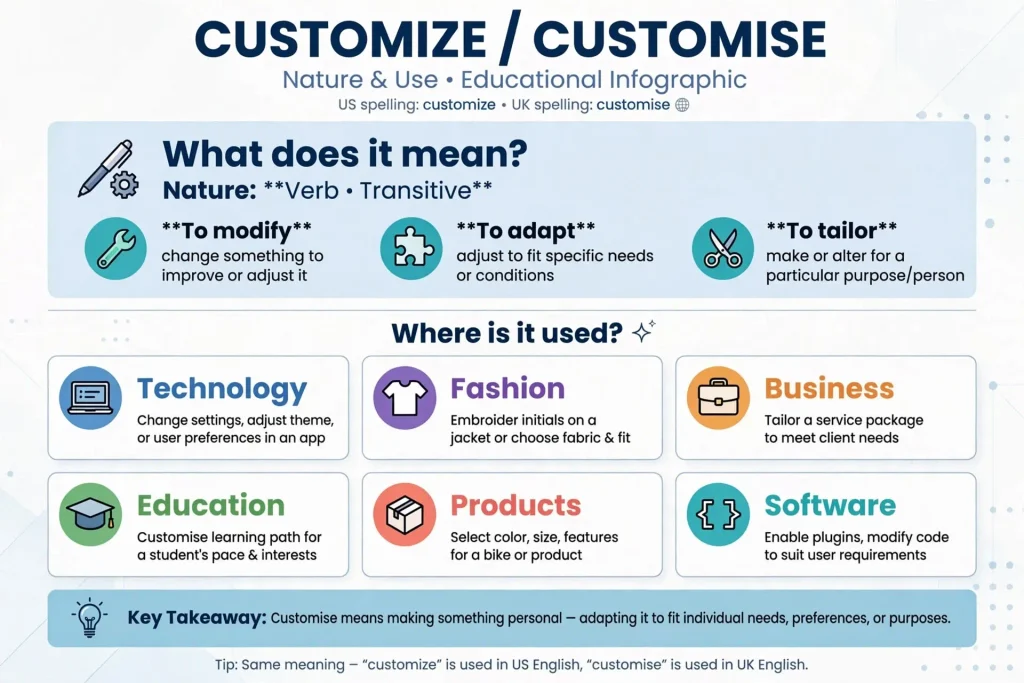
Customize
Customize is an action word. It means to change something so it works or looks the way you want.
You can customize many things.
Examples:
- I customize my phone.
- She customizes her bike.
- We customize our web page.
You can change the color, size, look, or parts of something.
Customise
Customise means the same thing. It is often used in UK English.
Examples:
- I customise my phone.
- She customises her bike.
- We customise our web page.
Both words help us talk about making things our own.
Why Do People Mix Up These Words?
English has many words with two spellings.
For example:
- Color and colour
- Favorite and favourite
- Organize and organise
- Customize and customise
One spelling is common in the US. Another is common in the UK.
This can make people think one word is wrong. But that is not true.
You may see customize on an American website. You may see customise on a British website. Both are fine.
The best way to avoid mistakes is to pick one style. Then use it in all your writing.
Comparison Table
| Feature | Customize | Customise |
|---|---|---|
| Common in | US English | UK English |
| Meaning | Change to suit your needs | Change to suit your needs |
| Sound | KUS-tuh-myze | KUS-tuh-myze |
| Past form | Customized | Customised |
| -ing form | Customizing | Customising |
| Noun | Customization | Customisation |
| Correct? | Yes | Yes |
The two words mean the same thing. The main change is in the spelling.
The Origin of Customize or Customise
The word comes from custom. A custom can be a way people do things. It can also relate to what a person likes or needs.
Over time, people began using customize to talk about making things fit a buyer’s needs.
For example, a shop may let you pick the color of a bag. You can also add your name to it. You are customizing the bag.
The US spelling often uses -ize. Many UK writers use -ise.
That is why both customize and customise are used today.
The words have the same meaning. Their spelling comes from different writing styles.
British vs American English
US and UK English have some spelling changes.
Here are a few common ones.
| US English | UK English |
|---|---|
| Customize | Customise |
| Color | Colour |
| Favorite | Favourite |
| Organize | Organise |
| Realize | Realise |
| Customized | Customised |
US writers often use customize. Many UK writers use customise.
But not all UK writers use -ise. Some UK style guides also use -ize.
If your school or job has a spelling guide, follow it. If not, pick one style and stay with it.
Which One Should You Use?
The best choice depends on who will read your words.
For People in the US
Use customize if you write for US readers.
Example: You can customize your phone.
For People in the UK
Use customise if your readers follow the UK -ise style.
Example: You can customise your phone.
For People Around the World
Both words are easy to understand. Pick one and use it in the same way each time.
If you write for a company, check its spelling rules first.
The main goal is to make your writing clear and easy to read.
Common Mistakes
Here are some mistakes to avoid.
Mistake 1: Saying One Word Is Wrong
Wrong: Customise is always wrong.
Right: Both spellings are correct.
Mistake 2: Mixing Both Styles
Not good: We customize your page and offer customisation tools.
US style: We customize your page and offer customization tools.
UK -ise style: We customise your page and offer customisation tools.
Mistake 3: Using the Wrong Past Form
US: I customized my phone.
UK: I customised my phone.
Mistake 4: Using the Wrong -ing Form
US: I am customizing my page.
UK: I am customising my page.
Mistake 5: Giving the Words Different Meanings
Wrong: Customize means to change. Customise means to fix.
Right: Both words mean to change something to suit your needs.
Mistake 6: Forgetting Who Will Read It
Use the spelling your readers know best. This makes your writing feel more natural to them.
Mistake 7: Changing the Spelling
Do not switch between the two forms without a reason. Pick one style and use it in the whole article.
Everyday Usage Examples
You may see these words in many places.
In Emails
US English
Hi Sam,
You can customize your account at any time. Let us know if you need help.
Thanks,
Alex
UK English
Hi Sam,
You can customise your account at any time. Let us know if you need help.
Thanks,
Alex
On Social Media
- US: I customized my phone today.
- UK: I customised my phone today.
In the News
- US: The shop will customize its service for each buyer.
- UK: The shop will customise its service for each buyer.
At Work
- US: We can customize this report.
- UK: We can customise this report.
When Shopping
- US: You can customize this mug with your name.
- UK: You can customise this mug with your name.
At School
- US: The teacher can customize the lesson.
- UK: The teacher can customise the lesson.
These examples show how both words work in daily life.
Usage Trends
People use customize a lot in the US. Many UK writers use customise.
You may see these words on phones, apps, shops, and websites.
For example, you can change the look of your phone. You can pick a color for your shoes. You can also add your name to a gift.
These are all ways to customize something.
The internet lets people from many countries read the same page. So, you may see both spellings online.
Neither spelling is wrong. The choice depends on the writer and the readers.
Metaphors and Similes
These words do not have special meanings as metaphors or similes. But we can use the idea of making something our own in a fun way.
Metaphors
A metaphor describes one thing as another.
- Customize your path: Choose what you want to do in life.
- Customize your future: Make choices for your future.
- Customize your learning: Learn in a way that suits you.
These are creative ways to talk about making your own choices.
Similes
A simile compares two things. It often uses like or as.
- My new room fits me like a glove.
- My app is like a room I can set up my way.
Connotative Meaning
A word can bring a feeling or idea to mind. This is called connotation.
Customize and customise have the same meaning. The spelling does not change the feeling of the word.
Positive Meaning
The word can show choice and freedom.
Example: I can customize my study plan.
This means I can choose what works for me.
Negative Meaning
The word can sometimes suggest extra work.
Example: I had to customize every setting before using the app.
This may sound like a hard or slow task.
Neutral Meaning
The word can just tell us what someone does.
Example: We customize each order for the buyer.
This gives simple facts. It does not show a good or bad feeling.
Idioms and Proverbs
There are no common idioms made from customize or customise. But some English sayings share a similar idea.
Fit Like a Glove
This means something fits very well.
Example: My new jacket fits like a glove.
Made to Measure
This means something is made to fit a person.
Example: He bought a made-to-measure suit.
Suit Yourself
This means you can make your own choice.
Example: You can change the desk as you like. Suit yourself.
One Size Does Not Fit All
This means one thing may not work for everyone.
Example: We make plans for each child because one size does not fit all.
These sayings are about fit and choice. They are not rules for spelling customize or customise.
Literature and Movies
Books and films often show people making choices and doing things their own way. These ideas are linked to the meaning of customization.
A Book: The Giver
- Writer: Lois Lowry
- Year: 1993
- Type: Young adult fiction
The Giver is about a world where many parts of life are controlled. It makes readers think about choice and freedom.
The book is not about the spelling of customize or customise. It is an example of a story about personal choice.
A Movie: The Lego Movie
- Year: 2014
- Type: Animated comedy
- Countries: United States and Australia
The Lego Movie shows a world made from LEGO pieces. The characters build things and find new ways to use them.
This is linked to the idea of making things your own. But the film does not teach the spelling rule.
Why This Difference Matters
It is useful to know which spelling to use.
As an English learner, this helps you understand why some words look different in other countries.
For students, a teacher may ask you to use one style.
If you have a business, you may want your writing to match your customers.
If you write a blog, using one spelling style helps your pages look neat.
For example, a US website may use customize. A UK website may use customise.
Both are correct. The important thing is to use the right style for your readers.
Usefulness in Daily Life
You can use these words in many parts of life.
- Phone: Customize your home screen.
- Computer: Customise your settings.
- Shopping: Customize a mug with your name.
- Work: Customize a report.
- School: Customise a lesson.
- Travel: Customize your trip.
- Fitness: Customize your workout.
- Website: Customize the page.
- Car: Customise the seats.
- Study: Customize your study plan.
Situational Preference
Use customize when writing for people in the US. Use customise when writing for UK readers who use the -ise style. If you write for people in Canada or Australia, check the spelling guide used by your school, company, or website. If you write a blog for readers around the world, choose one spelling and use it each time. For schoolwork, follow your teacher’s rules. For an app or product, use the spelling shown in its settings. Both words are right. The best choice is the one that fits your readers.
Possible Questions
1. Is customize or customise correct?
Both are correct. Customize is common in the US. Customise is common in the UK.
2. Do both words mean the same thing?
Yes. Both mean to change something to suit your needs.
3. Is customise British English?
Yes, it is widely used in British English, especially in the -ise spelling style.
4. Does Canada use customize or customise?
Both may be seen. Many Canadian writers use customize. Check your style guide to be sure.
5. Is customization or customisation correct?
Both are correct. Customization is common in US English. Customisation is common in UK styles that use -ise.
6. How do you spell customized in the UK?
Writers who use the UK -ise style write customised.
7. Can I use both words in one article?
It is better to pick one spelling and use it throughout your article.
Conclusion
The words customize and customise mean the same thing. Both tell us that something has been changed to suit a person’s needs or likes.The main difference is spelling. People in the US often write customize. Many people in the UK write customise.The same rule applies to other forms of the word. You may see customized and customised, or customizing and customising.If you write for US readers, customize is a good choice. If you write for UK readers who use the -ise style, choose customise.You do not need to worry about the meaning. It stays the same in both forms.When writing a blog, email, or school paper, pick one spelling style and use it from start to end. This helps your writing look clear and neat.

Eman Sarfraz is a professional content writer, researcher, and English language specialist with strong expertise in English grammar, vocabulary, word meanings, synonyms, and antonyms. I creates well-researched, accurate, and easy-to-understand content that helps readers master English concepts and communicate with greater confidence.








1 thought on “Customize or Customise: What Is the Difference?”