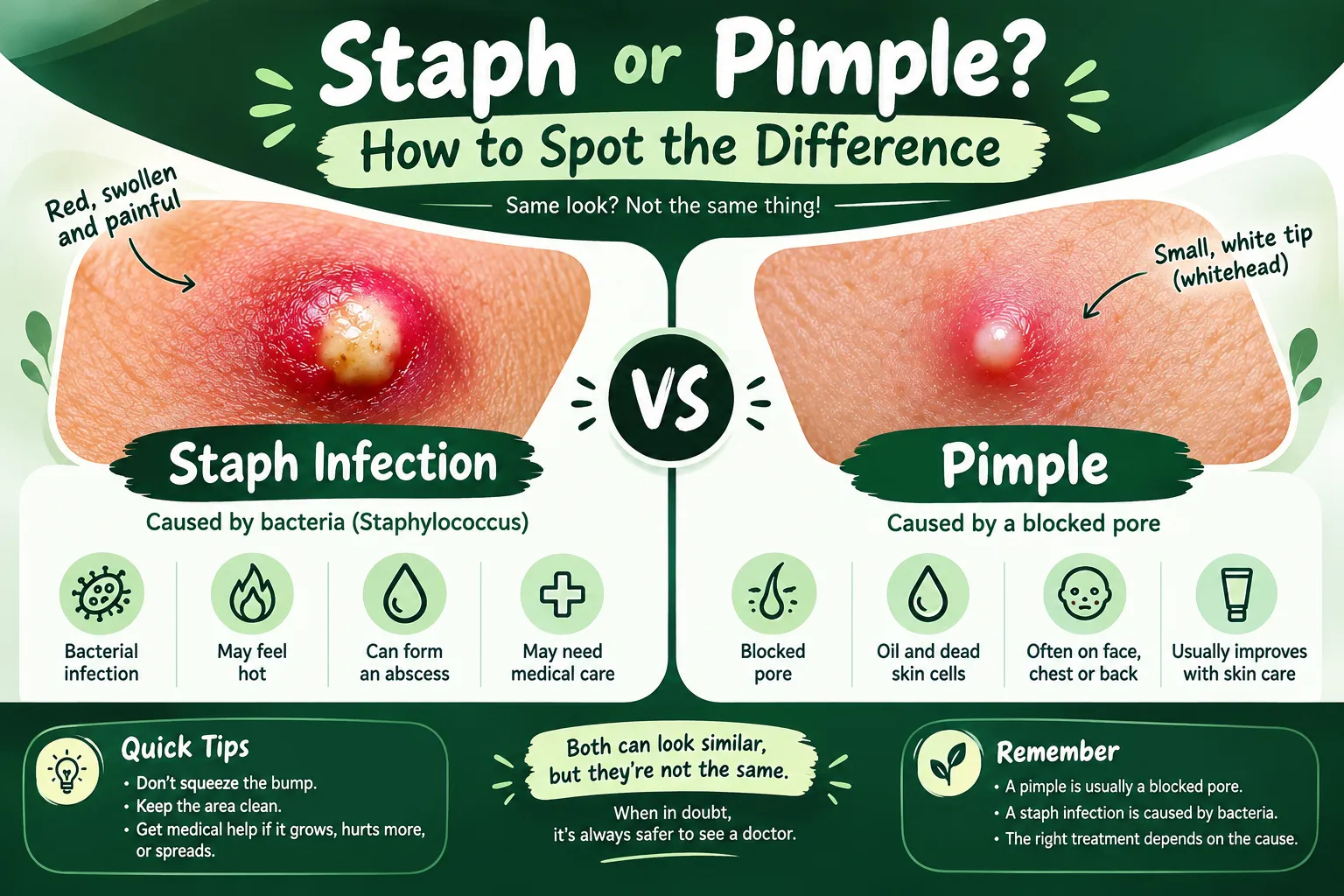
A pimple is usually caused by a blocked pore, while a staph infection happens when certain bacteria infect the skin.
Have you ever noticed a red bump on your face and wondered what it was? At first, it may look like a normal pimple. But after a day or two, it starts to hurt. The area feels warm, and the bump seems to get bigger. That is when you may start asking yourself, is it staph or a pimple?
This is a common concern because both can look very similar. They may cause redness, swelling, pain, and pus. Still, they are not the same thing. A pimple often forms when oil and dead skin block a pore. A staph infection is caused by bacteria called Staphylococcus.
When people search for staph or pimple, they usually want to know what is causing the bump and whether they should worry. The problem is that you cannot always tell by looking at your skin. Some infections look like pimples, while deep pimples can also be painful.
In this guide, we will look at the main differences, common signs, and when it is best to see a doctor.
Pronunciation
Staph
- US English: /stæf/
- UK English: /stæf/
Pimple
- US English: /ˈpɪm.pəl/
- UK English: /ˈpɪm.pəl/
Both words are pronounced almost the same in American and British English.
Now, let’s look at how staph infections and pimples differ in real life.
Also read more about:https://syntexra.com/chevy-or-gmc/
Difference Between Staph and Pimple
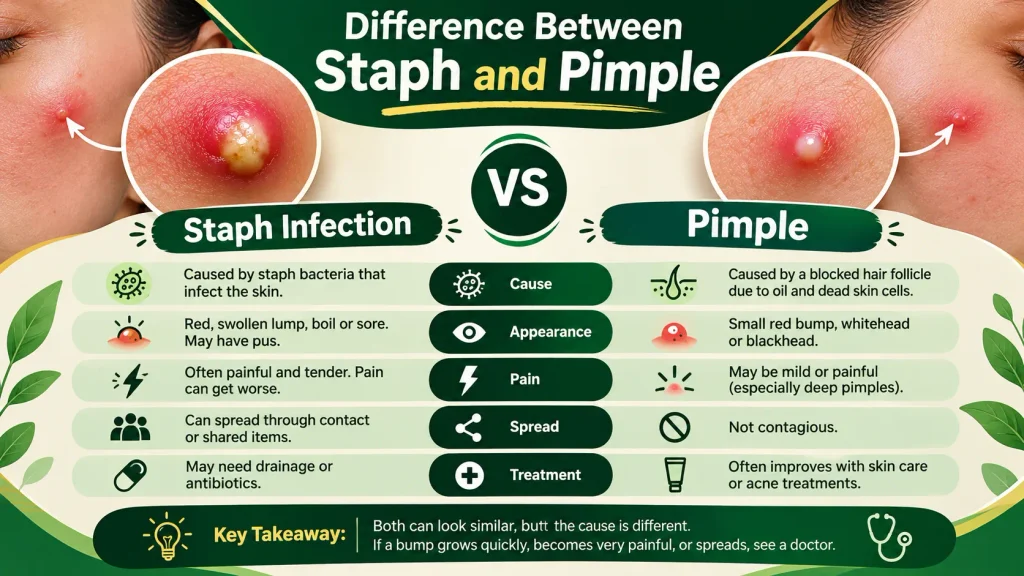
A staph infection and a pimple can look alike at first. However, there are some signs that may help you understand what is happening.
1. The Cause
A pimple usually forms when oil and dead skin cells block a hair follicle. This can lead to swelling and redness.
A staph infection has a different cause. It happens when staph bacteria cause an infection in the skin.
Examples:
- A whitehead appears on your nose after a few days of oily skin.
- A small cut becomes red, swollen, and infected.
2. The Way It Looks
A pimple may look like a small red bump, a whitehead, or a blackhead. Some pimples have a white tip.
A staph infection may look like a red, swollen lump. It can also look like a boil or an open sore.
Examples:
- You notice a small white spot on your chin.
- You see a painful red lump on your leg.
Looks alone cannot tell you which one it is.
3. Pain and Tenderness
Some pimples do not hurt at all. Others, especially deep acne spots, can be very painful.
A staph infection may cause pain that gets worse as the infection grows.
Examples:
- A tiny pimple on your forehead does not hurt.
- A swollen lump on your thigh hurts when you walk.
Pain can happen with both, so it is important to watch for other signs.
4. Warmth and Swelling
A pimple may become red and swollen. This is common when the skin is inflamed.
With a staph infection, the area may feel hot and the redness may spread beyond the bump.
Examples:
- A small acne spot becomes red around the edges.
- A sore becomes hot, swollen, and red over a larger area.
If redness spreads quickly, get medical help.
5. Pus and Drainage
Both pimples and staph infections can contain pus.
A pimple may develop a small white or yellow tip. A staph infection may cause pus to collect in a deeper pocket under the skin.
Examples:
- A white tip appears on a pimple near your mouth.
- A painful lump fills with pus and becomes larger.
Pus does not automatically mean you have a staph infection.
6. How Fast It Grows
Many pimples develop over several days. Some deep pimples can last for weeks.
A skin infection may grow quickly and become more painful over a short time.
Examples:
- A small whitehead slowly becomes a red spot.
- A red lump gets larger and more painful within a day or two.
A fast-growing bump should be checked by a health professional.
7. Where It Appears
Pimples often appear on the face, chest, shoulders, and back. These areas have many oil-producing glands.
A staph infection can develop almost anywhere on the body, especially where the skin is damaged.
Examples:
- Several pimples appear on your forehead.
- A painful sore develops near a cut on your hand.
The location alone does not confirm the cause.
8. Can It Spread?
Ordinary acne is not contagious. You cannot catch a pimple from another person.
Some staph infections can spread through contact with infected skin, wound drainage, or contaminated personal items.
Examples:
- Sharing a handshake does not spread ordinary acne.
- Sharing a towel that has touched an infected wound may spread bacteria.
Do not share towels or razors with someone who has a draining skin infection.
9. Treatment
Mild pimples often improve with gentle skin care and acne products. More severe acne may need prescription treatment.
A staph infection may need medical treatment. Depending on the problem, a doctor may drain an abscess or prescribe antibiotics.
Examples:
- A person uses a suitable acne product for mild pimples.
- A doctor treats a painful skin abscess.
Do not use leftover antibiotics or try to drain a suspected infection yourself.
10. When to See a Doctor
Most small pimples do not need urgent care. However, severe acne can cause pain and scars.
A possible staph infection needs prompt attention if it grows quickly, becomes very painful, or causes spreading redness.
Examples:
- You have deep pimples that keep returning and leave scars.
- A hot, painful skin lump grows larger each day.
Seek urgent medical care if you have a fever with a suspected skin infection or feel very unwell.
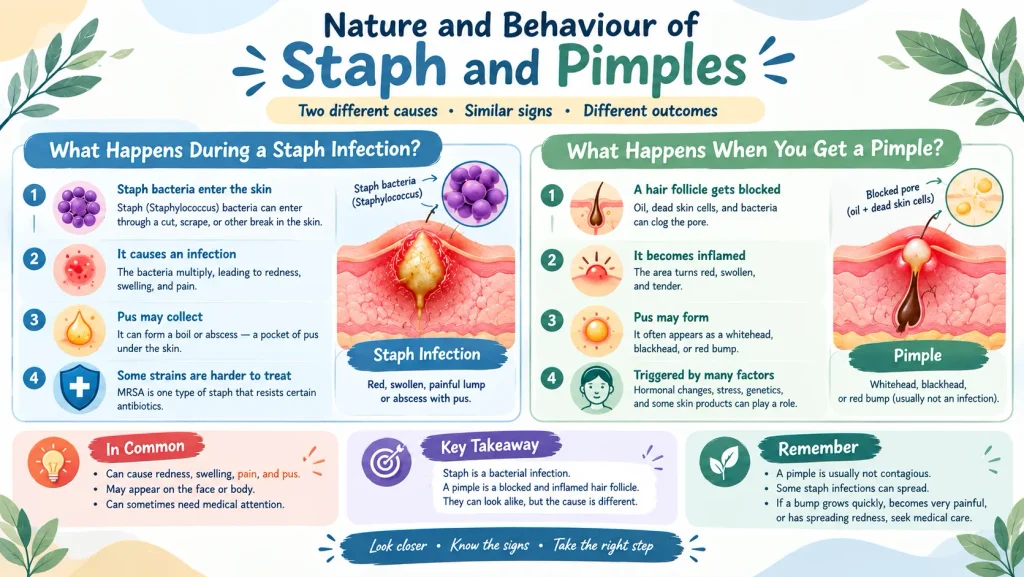
Nature and Behaviour of Staph and Pimples
What Happens During a Staph Infection?
Staph is short for Staphylococcus, a group of bacteria. Many people carry these bacteria on their skin or in their nose without becoming ill.
Problems can start when the bacteria enter the skin through a cut, scrape, or other break. Some staph bacteria cause mild infections. Others can cause more serious illness.
A staph skin infection may begin as a red bump. It can later become swollen, painful, or filled with pus. Some infections form an abscess, which is a pocket of pus under the skin.
MRSA is one type of staph bacteria that resists certain antibiotics. This is one reason proper medical care matters.
What Happens When You Get a Pimple?
A pimple forms when a hair follicle becomes blocked. Oil and dead skin cells build up inside it. The area may then become inflamed.
Hormone changes are a common reason people develop acne. Stress, family history, and some skin products may also play a role.
Pimples often appear during the teen years, but adults can get them too. Some are small and painless. Others form deep under the skin and may hurt for days or weeks.
Gentle skin care can help. Picking or squeezing pimples may increase irritation and raise the risk of scars.
Why People Get Confused About Staph and Pimples
The main reason is simple: both can look almost the same.
A staph infection may start as a small red bump. A pimple can also become red, swollen, and painful. Both may contain pus, so it is easy to mistake one for the other.
People may also judge a bump by where it appears. For example, they may assume that a bump on the face must be acne. But skin infections can happen on the face too.
Online photos can add to the confusion. A picture cannot show how hot the skin feels or how quickly the bump is growing.
The best approach is to watch for changes. If a bump becomes more painful, grows quickly, or has spreading redness, seek medical advice instead of trying to guess.
Comparison Table
| Feature | Staph Infection | Pimple |
|---|---|---|
| Main cause | Staph bacteria infect the skin | A blocked, inflamed hair follicle |
| Appearance | Red lump, sore, or abscess | Whitehead, blackhead, or red bump |
| Pain | May become severe | May be mild or severe |
| Warmth | Skin may feel hot | May feel warm when inflamed |
| Pus | May collect under the skin | May form a small white tip |
| Growth | Can grow quickly | Often develops over several days |
| Location | Any part of the body | Often face, chest, shoulders, and back |
| Spread | Some infections can spread | Ordinary acne is not contagious |
| Treatment | May need drainage or antibiotics | Skin care or acne medicine |
| Main concern | Infection may worsen or spread | Deep acne may cause scars |
What Do They Have in Common?
Both can cause redness, swelling, pain, and pus. Both may appear on the face or body. In some cases, both need medical attention.
The main difference is the cause. A pimple is linked to a blocked and inflamed hair follicle. A staph infection is caused by bacteria infecting the skin.
The Origin of the Words
Where Does the Word “Staph” Come From?
The word “staph” is short for Staphylococcus. The scientific name comes from Greek roots linked to a bunch of grapes and a round shape.
This name describes how these bacteria can appear under a microscope. They often grow in clusters that look like small bunches of grapes.
The term became part of medical language in the 19th century. Today, doctors use “staph” as a short and common way to refer to these bacteria.
Where Does the Word “Pimple” Come From?
The word “pimple” has been used in English for many centuries. It refers to a small bump or swelling on the skin.
Today, the word is common in everyday speech, skin care articles, and discussions about acne.
Although the two words may appear together in online searches, they do not mean the same thing. One refers to bacteria, while the other describes a type of skin spot.
British vs American English
There is little difference between American and British English when it comes to spelling these words.
| Feature | American English | British English |
|---|---|---|
| Spelling | Staph, pimple | Staph, pimple |
| Medical phrase | Staph infection | Staph infection |
| Common everyday word | Pimple | Pimple or spot |
| Example | “I have a pimple.” | “I’ve got a spot.” |
In the US, “pimple” is common in daily speech. In the UK, many people use “spot” for the same kind of skin bump.
Both forms are correct. The choice depends on the audience and the situation.
Which One Should You Use?
Use “pimple” when talking about an ordinary acne spot. Use “staph infection” when referring to an infection caused by staph bacteria.
In the United States, “pimple” is a common everyday term. In the United Kingdom, “spot” is also widely used. For readers around the world, “skin bump” may be useful when the cause is not clear.
If you are writing a health article, avoid calling every red bump a staph infection. A diagnosis may require an examination or a test.
When speaking to a doctor, describe what you can see and feel. Explain when the bump appeared, whether it hurts, and whether it has grown. These details are more helpful than guessing its name.
Common Mistakes
Here are some common mistakes people make when using these terms.
Mistake 1: Calling every pimple a staph infection.
Correct: A pimple does not automatically mean that you have a bacterial skin infection.
Mistake 2: Thinking that all pimples are harmless.
Correct: Most are mild, but deep acne can cause pain and scarring.
Mistake 3: Assuming that pus always means staph.
Correct: Both pimples and some skin infections can contain pus.
Mistake 4: Trying to diagnose a bump from a photo.
Correct: A photo may not show enough detail to identify the cause.
Mistake 5: Squeezing a painful lump to remove the pus.
Correct: Avoid squeezing a suspected infection. Seek medical advice if the lump is painful or growing.
Mistake 6: Using “staph” when you mean “pimple.”
Correct: Use “pimple” for a common acne spot and “staph infection” for an infection caused by staph bacteria.
Everyday Usage Examples
In Emails
If you need to explain a skin problem to a clinic, you could write:
“I have a red bump on my skin that has become more painful. Could I book an appointment to have it checked?”
This describes the problem without guessing what caused it.
On Social Media
Here are two natural examples:
- “I have a small pimple on my chin. What skin care tips have worked for you?”
- “My skin bump is growing and feels warm, so I am getting it checked.”
Avoid telling people that a bump is definitely staph based on its appearance alone.
In News Reports
A health report might say:
“Doctors advise people to seek care when a skin infection causes spreading redness or severe pain.”
Another example is:
“Some staph bacteria can spread through contact with infected skin or shared personal items.”
In Formal Writing
In a health article, you might write:
“Acne can cause pimples on the face, chest, shoulders, and back.”
Or:
“A suspected staph infection may require medical assessment and treatment.”
The right word makes the message easier to understand.
Usage Trends
The words “staph” and “pimple” appear in different types of online content.
People often use “pimple” when searching for skin care tips, acne products, or ways to reduce breakouts. The word is common in beauty blogs and everyday conversations.
“Staph” is more closely linked to health information. People may search for it when they notice a painful bump or worry about a possible infection.
The phrase “staph or pimple” brings these two concerns together. People want to know whether a bump is a normal skin spot or something that needs medical care.
Search habits can vary by country and over time. Without current search data, it is not possible to say which term is growing faster.
For SEO, include related phrases where they fit naturally. Examples include “staph infection symptoms,” “pimple vs. staph,” and “painful skin bump.” The goal is to answer the reader’s question, not repeat the same keyword in every paragraph.
Metaphors and Similes

These words are mainly used in health discussions. Still, they can appear in simple figures of speech.
Examples Using “Pimple”
- “The pimple stood out like a tiny red dot.”
- “That small pimple was a bump in the road to clear skin.”
The first example compares the pimple to a dot. The second uses a common phrase to describe a small problem.
Examples Using “Staph”
Staph does not have a common figurative meaning. It usually refers to bacteria.
- “The infection spread like a fire.” This simile describes how quickly it spread.
- “The sore was a warning light.” This metaphor suggests that the body needs attention.
Connotative Meaning
Words can create feelings as well as share facts. The meaning often depends on the sentence.
Positive Meaning
Neither word is usually positive on its own. However, the sentence can suggest relief or hope.
- “The pimple healed, and her skin began to clear.”
- “The doctor found the cause of the skin problem, and the patient felt relieved.”
Negative Meaning
Both words can be linked to worry.
- “The painful pimple made him feel upset about his appearance.”
- “The suspected staph infection caused concern because the redness was spreading.”
Neutral Meaning
In medical writing, both words can be neutral.
- “The patient has a pimple on the cheek.”
- “The test found staph bacteria in the sample.”
The words themselves are not always positive or negative. The facts and the context shape their meaning.
Idioms and Proverbs
There are no widely used English idioms that directly mean “staph or pimple.” However, a few common sayings can fit discussions about skin health.
Better safe than sorry
“The bump was growing, so she called her doctor. Better safe than sorry.”
An ounce of prevention is worth a pound of cure
“Keeping a wound clean can help reduce the risk of infection. An ounce of prevention is worth a pound of cure.”
Don’t judge a book by its cover
“The bump looked like a pimple, but its cause was not clear. Don’t judge a book by its cover.”
These sayings can make writing feel more natural, but they should not replace clear medical facts.
Literature and Movies
Books and movies often explore health, self-image, and the way people treat others because of their appearance. These themes connect to skin problems, even when the story is not about acne or staph.
Literature
The Skin I’m In — Sharon G. Flake, 1998
This young adult novel explores self-image, bullying, and confidence. It can help readers think about how appearance affects the way people feel.
Wonder — R. J. Palacio, 2012
This children’s novel explores kindness, acceptance, and life with a visible facial difference. It offers a way to discuss how people react to differences in appearance.
Neither book is a medical guide to staph or pimples.
Movies
Wonder (2017, United States)
This family drama follows a boy with a facial difference as he starts school. It explores friendship, bullying, and acceptance.
The Doctor (1991, United States)
This drama follows a doctor who gains a new view of patient care after facing illness himself. It explores empathy and the patient experience.
These works can help readers discuss the social side of health and appearance.
Why This Difference Matters
Knowing the difference between staph and a pimple can help you explain a skin problem more clearly.
For English learners, the words are useful examples of how two terms can describe different things. “Pimple” refers to a skin spot. “Staph” refers to bacteria that can cause an infection.
For patients, clear language can make a visit to the doctor more useful. Instead of saying, “I think I have staph,” you can explain that the bump is red, warm, painful, or growing. This gives the doctor more useful information.
The difference also matters for public health. Some staph infections can spread, while ordinary acne is not contagious. Knowing this can help people avoid false claims and take sensible steps to protect themselves and others.
Most importantly, do not rely on appearance alone. A pimple and a skin infection can look alike. If the bump grows quickly, becomes very painful, or has spreading redness, seek medical care.
Usefulness in Daily Life
This knowledge can help in many everyday situations.
- At home: Watch for changes in size, pain, and redness.
- At school: Use the right words when talking about acne or infection.
- At work: Explain your symptoms clearly if you need medical care.
- At a clinic: Tell the doctor when the bump appeared and how it has changed.
- Online: Check reliable health information instead of trusting every photo or post.
- In writing: Use “pimple” for an ordinary acne spot and “staph infection” for a suspected or confirmed infection.
Situational Preference
Use “pimple” when you talk about a small acne spot in daily life or in a skin care article. Use “staph infection” when discussing a bacterial infection, a medical test, or a doctor’s diagnosis. In the US, “pimple” is common. In the UK, people may also say “spot.” For global readers, use simple terms such as “skin bump” when the cause is unknown. If you are unsure, describe what you see instead of guessing. A bump that grows quickly, feels hot, becomes very painful, or has spreading redness needs medical attention.
Possible Questions
1. How can I tell if it is staph or a pimple?
You cannot always tell by looking. A staph infection may cause a warm, painful bump that grows or spreads. A pimple is often linked to a blocked pore. A health professional can assess the cause.
2. Can a staph infection look like a pimple?
Yes. Some staph skin infections begin as red bumps that look like pimples. They may later become painful, swollen, or filled with pus.
3. Should I pop a bump if I think it is staph?
No. Do not pop or squeeze a suspected infection. This may worsen the problem or spread bacteria. Seek medical advice if the bump is painful or growing.
4. Are pimples caused by staph bacteria?
A pimple does not mean you have a staph infection. Acne develops through blocked follicles, oil, and inflammation. The cause is not the same as that of a staph skin infection.
5. Is a staph skin infection contagious?
Some staph infections can spread through direct contact with infected skin or wound drainage. Shared towels, clothing, and equipment may also spread bacteria. Avoid sharing personal items and follow wound-care advice.
6. When should I see a doctor?
Seek prompt care if the bump grows quickly, becomes very painful or hot, or has spreading redness. Get urgent help if you have a fever with a suspected skin infection or feel very unwell.
7. Can a doctor confirm whether a bump is staph?
A doctor can examine the skin and decide whether testing is needed. A sample of pus or other material may help identify the bacteria. Not every skin bump needs a test.
Conclusion
Staph and pimples can look alike, but they are not the same. A pimple usually forms when a hair follicle becomes blocked by oil and dead skin cells. A staph infection happens when staph bacteria infect the skin.Both can cause redness, swelling, pain, and pus. This is why it can be hard to tell them apart at home. Some staph infections grow quickly or cause spreading redness. Deep pimples can also hurt, so no single sign can tell you the cause for sure.If you notice a new skin bump, watch how it changes. Do not squeeze it or try to drain it yourself. If it grows fast, feels hot, becomes very painful, or has spreading redness, seek medical care. A fever or feeling very unwell makes prompt care even more important.When writing about these problems, use “pimple” for an ordinary acne spot and “staph infection” for an infection caused by staph bacteria. If you do not know the cause, describe the signs instead. Clear language helps people understand the issue, ask better questions, and make safer choices.

Eman Sarfraz is a professional content writer, researcher, and English language specialist with strong expertise in English grammar, vocabulary, word meanings, synonyms, and antonyms. I creates well-researched, accurate, and easy-to-understand content that helps readers master English concepts and communicate with greater confidence.