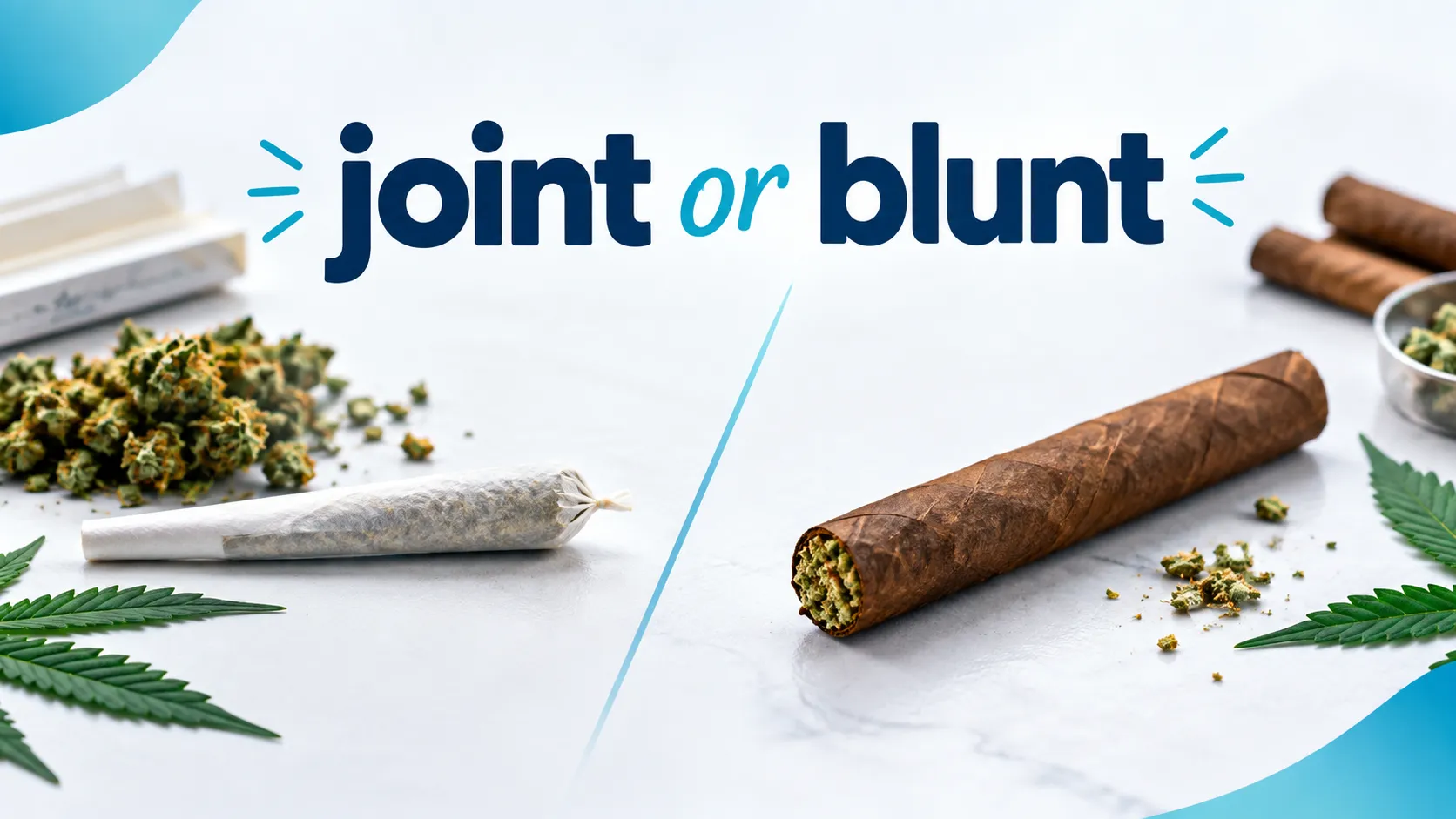
A joint and a blunt can both hold cannabis, but they are not made in the same way.
Imagine two friends talking about cannabis. One says, “Let’s roll a joint.” The other says, “I thought you meant a blunt.” They may be talking about something similar, but the words are not the same.
A joint is usually cannabis rolled in thin smoking paper. A blunt is usually cannabis rolled in a cigar or tobacco-leaf wrap. The wrap is the main difference.
People often search for joint or blunt because both words can mean a rolled cannabis product. The words can also change meaning based on the situation. For example, joint can mean a place where two things meet, or it can mean something shared by two people.
The question joint or blunt is common because the two terms are used in similar talks. But they have different meanings and forms.
In this guide, we will explain the difference in simple English. We will also look at their meanings, history, common use, and examples.
Pronunciation
Joint
US: /dʒɔɪnt/
UK: /dʒɔɪnt/
Easy sound:
joynt
Blunt
US: /blʌnt/
UK: /blʌnt/
Easy sound:
blunt
The pronunciation is almost the same in both US and UK English.
A Quick Look Before We Start
A simple way to remember the main difference is:
Joint = usually paper
Blunt = usually a cigar-style or tobacco-leaf wrap
Now let us look at the two words more closely.
Difference Between Joint and Blunt
1. The Main Meaning
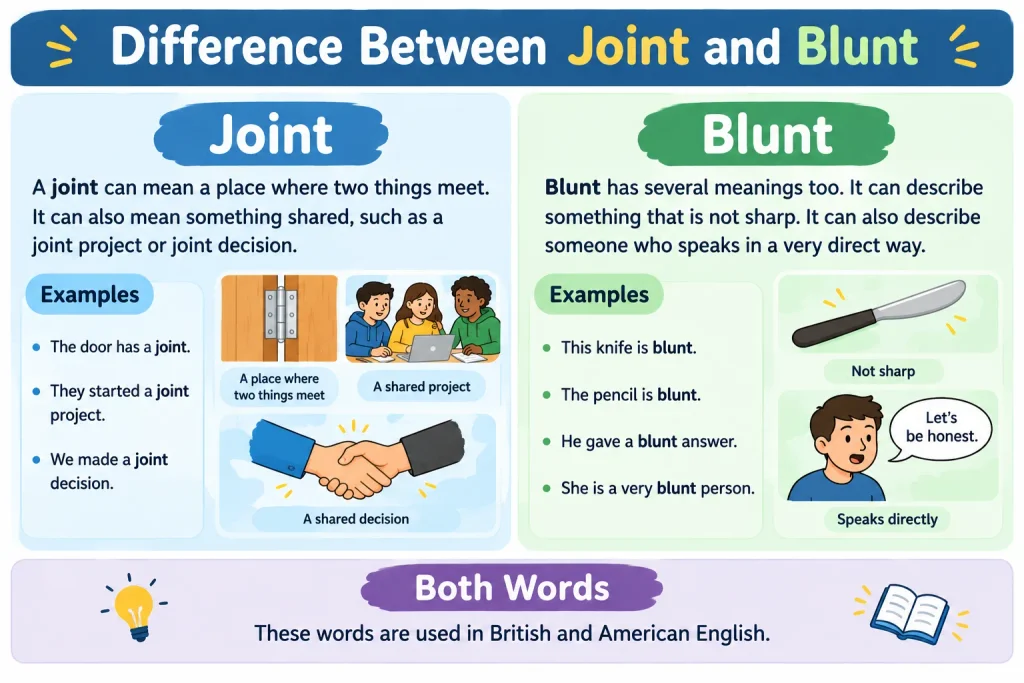
A joint can have many meanings. In cannabis talk, it means cannabis rolled in smoking paper.
A blunt usually means cannabis rolled in a cigar-style wrap.
Examples:
- He saw a joint on the table.
- They were talking about a blunt.
2. The Wrap
A joint is usually made with thin rolling paper.
A blunt is usually made with a cigar or tobacco-leaf wrap.
Examples:
- The joint was rolled in paper.
- The blunt had a cigar-style wrap.
3. The Word Joint Has More Meanings
Joint is not only a cannabis word.
It can mean a place where two things meet.
Examples:
- The pipe has a loose joint.
- The two boards meet at the joint.
4. Blunt Has Other Meanings Too
Blunt can describe something that is not sharp.
It can also describe a person who speaks in a very direct way.
Examples:
- The knife is blunt.
- She was blunt about her opinion.
5. The Words Are Not Always About Cannabis
The word joint is used in normal English all the time.
The word blunt is also very common outside this topic.
Examples:
- They made a joint plan.
- His answer was very blunt.
6. The Look Can Be Different
A joint is often slim because rolling paper is thin.
A blunt can look thicker because its wrap is often heavier.
Examples:
- The joint looked thin.
- The blunt looked thicker.
7. Tobacco Can Be Part of a Blunt
Traditional blunt wraps can come from cigars or tobacco products.
A joint is normally rolled in paper made for smoking.
Examples:
- A blunt may have a tobacco-based wrap.
- A joint normally uses rolling paper.
8. The Terms Are Used in Different Ways
People may use joint as a general word for a rolled cannabis product.
Blunt is a more specific word.
Examples:
- “He rolled a joint.”
- “He rolled a blunt.”
9. Joint Is a Common English Word
You can use joint in many normal phrases.
Examples:
- They opened a joint bank account.
- We made a joint decision.
Here, joint has nothing to do with cannabis.
10. Blunt Can Describe Speech
The word blunt can describe a person who speaks very directly.
Examples:
- He was blunt with his answer.
- She gave me a blunt reply.
Also read more about:https://syntexra.com/occured-or-occurred/
Nature and Behaviour of Joint and Blunt

Joint
In cannabis-related use, a joint is a rolled form made with paper.
But the word has many other meanings. It can describe something shared by two or more people.
Example:
They started a joint project.
Here, joint means shared.
It can also mean a meeting point:
The joint between the two pipes was weak.
Blunt
Blunt has several common meanings.
It can describe something that is not sharp:
The pencil is blunt.
It can also describe direct speech:
He was blunt with me.
In cannabis-related language, it can refer to cannabis rolled in a cigar-style wrap.
Why People Get Confused About Joint and Blunt
The main reason is that both words can be used for rolled cannabis products.
People may hear one word and think it means the other.
There is also a lot of informal language around cannabis. Different people may use these words in slightly different ways.
The easiest way to remember the basic difference is to look at the wrap.
Joint: usually paper.
Blunt: usually a cigar-style or tobacco-leaf wrap.
Also remember that joint and blunt have other meanings in everyday English.
Comparison Table
| Feature | Joint | Blunt |
|---|---|---|
| Common cannabis meaning | Rolled cannabis | Cannabis in a cigar-style wrap |
| Usual wrap | Rolling paper | Cigar-style or tobacco-leaf wrap |
| General English meaning | Yes | Yes |
| Can mean a meeting point | Yes | No |
| Can describe speech | No | Yes |
| Can mean shared | Yes | No |
| Common word | Yes | Yes |
| Used in informal speech | Yes | Yes |
| British English | Used | Used |
| American English | Used | Used |
The Origin of Joint and Blunt
Origin of Joint
The word joint is very old.
It comes from an old French word linked to the idea of things being joined together. The word later became part of English.
Today, joint has many meanings.
It can mean:
- A place where things meet
- Something shared
- A business shared by people
- A rolled cannabis product
Origin of Blunt
The word blunt is also old.
It has long been used to describe something that is not sharp.
Example:
A blunt knife
Over time, the word also became linked with direct speech.
In modern slang, blunt is also used for a cigar-style cannabis product.
British vs American English
The spelling is the same in British and American English.
British English
Joint
Blunt
American English
Joint
Blunt
The words may be more common in some informal US settings, especially when people talk about cannabis.
Examples:
- He used the word joint in a casual talk.
- The word blunt appeared in the conversation.
Which One Should You Use?
Use the word that matches your meaning.
When you mean a place where two things meet, use joint.
If you mean something shared, joint can also work.
When you mean a person who speaks in a very direct way, use blunt.
If you are talking about cannabis, the terms have different meanings based mainly on the type of wrap.
Common Mistakes
Mistake 1
Wrong: The knife has a joint edge.
Correct: The knife has a blunt edge.
Mistake 2
Wrong: He was joint about the problem.
Correct: He was blunt about the problem.
Mistake 3
Wrong: They made a blunt decision together.
Correct: They made a joint decision together.
Mistake 4
Wrong: The two pipes have a blunt.
Correct: The two pipes have a joint.
Mistake 5
Using joint and blunt as if they always mean the same thing.
They do not.
Their meaning changes with the context.
Everyday Usage Examples
In an Email
We made a joint plan for the new project.
Here, joint means shared.
On Social Media
He was very blunt in his post.
Here, blunt means very direct.
In News
The two groups made a joint statement.
Here, joint means shared.
In Formal Writing
The companies issued a joint report.
Again, joint means done together.
In Daily Speech
The knife is blunt.
Here, blunt means not sharp.
In Cannabis-Related Talk
Both joint and blunt may be used as informal terms for rolled cannabis products, but the two terms can refer to different types of wraps.
Usage Trends
Both words are common in modern English.
Joint is much broader. You can find it in business, science, health, sports, and daily speech.
For example:
- joint project
- joint effort
- joint pain
- joint account
- joint decision
Blunt is also common.
It is often used when talking about:
- Sharp objects
- Direct speech
- Honest opinions
- Informal slang
Metaphors and Similes
Joint as a Metaphor
The team was the joint that held the project together.
Here, joint is used to suggest a connection.
Blunt as a Metaphor
His words were as blunt as a hammer.
This means his words were very direct.
Another Example
Her answer was like a blunt arrow.
This suggests that her answer was direct and clear.
Connotative Meaning
The two words can create different feelings.
Joint
Joint often has a neutral meaning.
Examples:
- joint project
- joint effort
- joint decision
These phrases often sound normal and neutral.
Blunt
Blunt can be neutral or negative.
Example:
He was blunt about the problem.
This can mean he was honest and direct.
But it can also suggest that he was too direct.
In Cannabis Talk
Both words may carry an informal meaning when used for cannabis. The feeling can depend on the speaker, setting, and culture.
Idioms and Proverbs
Join Forces
This means to work together.
The two teams joined forces to solve the problem.
Meet at the Joint
This is not a common standard idiom for general English, so it is better not to use it as a fixed phrase.
Blunt Truth
This means a very direct truth.
He told me the blunt truth.
To Be Blunt
This means to speak in a very direct way.
To be blunt, I do not agree with the plan.
Literature and Movies
Literature
The Old Man and the Sea by Ernest Hemingway was published in 1952. It is a short literary novel about an old fisherman and his struggle at sea.
Hemingway is known for simple and direct writing. This makes blunt an interesting word when talking about a very direct style.
Movies
The Big Lebowski was released in 1998 in the United States. It is a comedy film by Joel and Ethan Coen.
The film uses a lot of informal American speech and slang. Words like joint and blunt may appear in discussions about informal language and culture.
Why This Difference Matters
These two words can mean very different things.
If you use joint when you mean blunt, your reader may get confused.
The same is true in the other direction.
The word joint is especially important because it has many meanings. It can talk about body parts, business, projects, places where things meet, and informal slang.
The word blunt also has more than one meaning. It can describe a knife, a pencil, a direct person, or informal slang.
Learning the context helps you choose the right word.
Usefulness in Daily Life
You may see joint much more often than you expect.
Examples include:
- Joint project
- Joint effort
- Joint account
- Joint decision
- Joint pain
- Joint meeting
You may also hear blunt in daily talks.
For example:
He was blunt with me.
The knife is blunt.
Knowing these meanings can help you understand emails, news, books, movies, and everyday speech.
Situational Preference
Use joint when you mean something shared or connected. For example, say joint project when two groups work together. Use joint for a place where two things meet, too. Use blunt when you mean something is not sharp, or when someone speaks in a very direct way. In cannabis-related talk, the words can describe different rolled products, so context matters. If you are writing for a general audience, avoid slang when a clear word can say the same thing. Always check the sentence before choosing between joint and blunt.
Possible Questions
What is the main difference between a joint and a blunt?
In cannabis-related use, a joint is usually rolled in paper, while a blunt is usually made with a cigar-style or tobacco-leaf wrap.
Can joint have other meanings?
Yes. Joint can mean a place where things meet. It can also mean something shared.
What does blunt mean in normal English?
Blunt can mean not sharp. It can also mean very direct when talking about a person’s words.
Are joint and blunt the same thing?
Not always. In cannabis slang, they can refer to similar products, but the type of wrap can be different.
Is joint British or American English?
It is used in both British and American English.
Is blunt British or American English?
It is also used in both forms of English.
Can I use joint in formal writing?
Yes. Joint is a normal English word and is common in formal writing.
For example:
The two companies released a joint statement.
Conclusion
Joint and blunt are two common English words, but they do not always mean the same thing.In cannabis-related slang, a joint usually means cannabis rolled in paper. A blunt usually means cannabis rolled in a cigar-style or tobacco-leaf wrap. The wrap is one of the main differences between them.But there is more to these words.Joint has many everyday meanings.A joint can mean a place where two things meet. It can also mean something shared, such as a joint project or joint decision. Blunt has several meanings too. It can describe something that is not sharp. It can also describe someone who speaks in a very direct way. These words are used in British and American English. The meaning depends on the sentence and the situation.The best way to learn these words is to look at the words around them. Context usually tells you what joint or blunt means.

Eman Sarfraz is a professional content writer, researcher, and English language specialist with strong expertise in English grammar, vocabulary, word meanings, synonyms, and antonyms. I creates well-researched, accurate, and easy-to-understand content that helps readers master English concepts and communicate with greater confidence.









1 thought on “Joint or Blunt: What Is the Difference?”