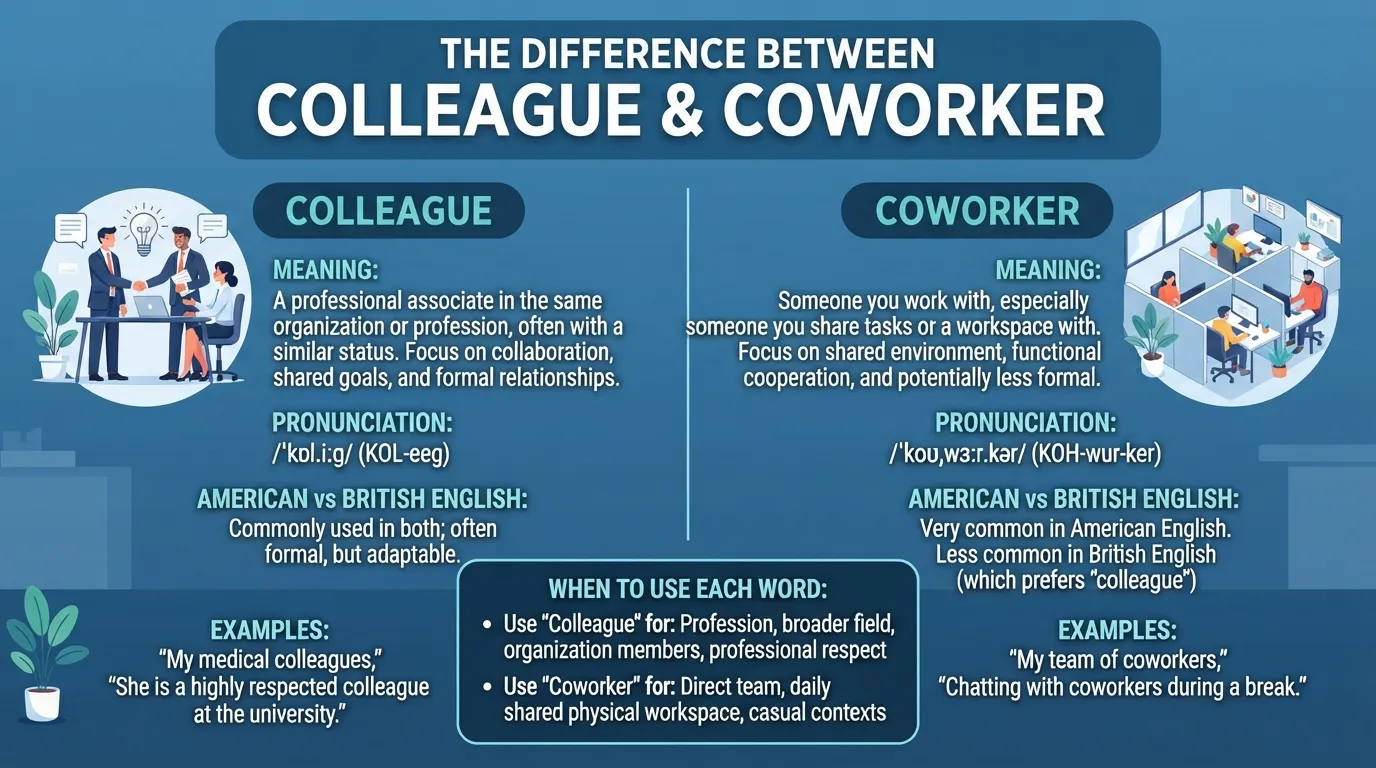
A colleague and a coworker are both people you work with. The main difference is simple: coworker usually means a person who works at the same place as you. Colleague can have a wider meaning.Imagine you start a new job. You meet Sara on your first day. She works in the same office as you. Sara is your coworker. She is also your colleague.
People often ask about colleague or coworker because both words talk about people at work. The words can mean the same thing in many cases. But they can also have a small difference. A colleague can be someone in the same job or work field, even if that person works for another company. A coworker usually works at the same company or place.So, colleague or coworker? The best word depends on the situation. This guide will make the difference easy to understand.
Colleague or Coworker Pronunciation
Colleague
- US: /ˈkɑː.liːɡ/
- UK: /ˈkɒl.iːɡ/
It sounds like KOL-eeg.
Coworker
- US: /ˈkoʊˌwɝː.kɚ/
- UK: /ˈkəʊˌwɜː.kə/
It sounds like KOH-wur-ker.
Now, let us look at the main difference between these two words.
Difference Between Colleague or Coworker
1. Basic Meaning
A coworker is a person who works with you, often at the same company.
A colleague is a person you work with. It can also mean a person in the same job or work field.
Examples:
- Tom is my coworker at the office.
- Lisa is my colleague in the sales field.
2. Same Company
Coworker often means someone who works for the same company.
Colleague does not always mean the same company.
Examples:
- Ali is my coworker at ABC Ltd.
- Sara is my colleague, but she works for another company.
3. Work Field
Colleague can be used for people in the same work field.
Coworker is more about working at the same place.
Examples:
- Doctors can call other doctors their colleagues.
- The people in my office are my coworkers.
4. Formal Use
Colleague can sound more formal and professional.
Coworker often sounds more natural in daily talk.
Examples:
- I spoke with my colleague about the report.
- I had lunch with my coworker.
5. US English
Coworker is very common in American English.
Examples:
- My coworker helped me today.
- I met my coworkers after work.
6. UK English
In British English, colleague is very common. Co-worker is also used.
Examples:
- My colleague sent me an email.
- I spoke with my co-worker.
7. Work Relationship
A coworker is usually someone who works with you.
A colleague can be a person who shares your work field.
Examples:
- John is my coworker in the office.
- Mary is my colleague in teaching.
8. Daily Speech
People often use coworker in simple daily talk, especially in the US.
Examples:
- My coworker is on vacation.
- I talked to my coworker today.
9. Professional Speech
Colleague is common in work emails, talks, and other professional settings.
Examples:
- I asked my colleague for help.
- My colleague checked the report.
10. Can One Person Be Both?
Yes. A person can be both your coworker and your colleague.
Examples:
- My doctor friend is my colleague, and we work at the same hospital.
- Jane is my colleague and coworker at the school.
Also read more about:https://syntexra.com/phuket-or-krabi/
Nature and Behaviour of Colleague
A colleague usually has a professional meaning.
It can sound polite and respectful. It is often used when people talk about their work field.
Examples:
- My colleague gave me good advice.
- I met an old colleague at the event.
Nature and Behaviour of Coworker
A coworker usually means a person who works at the same company or place.
It is very common in daily American English.
Examples:
- My coworker sits next to me.
- I had coffee with my coworker.
Why People Get Confused
The words are confusing because they often mean the same thing.
For example, a person who works in your office can be both your coworker and your colleague.
There is also a wider use of colleague. You can call someone a colleague even when that person works for another company but has the same type of job.
So, the simple rule is:
Coworker = usually the same workplace.
Colleague = often a wider work connection.
Colleague vs Coworker Comparison Table
| Point | Colleague | Coworker |
| Main idea | Person you work with | Person who works with you |
| Same company | Not always | Usually yes |
| Same job field | Often | Not needed |
| Professional use | Very common | Common too |
| Daily US use | Common | Very common |
| UK use | Very common | Co-worker is common |
| Can be both? | Yes | Yes |
| Meaning | Wider in some cases | More direct |
The Origin of Colleague and Coworker
The word colleague is very old and comes from French and Latin words related to a person who works with another person. The word coworker is made from co- and worker, where co- means with or together. So, a coworker is simply a person who works with you.
British vs American English
Both words are used in British and American English.
But there is a small spelling difference.
In American English, coworker is very common.
In British English, co-worker is also common.
Colleague is common in both types of English.
Examples:
- US: My coworker helped me.
- UK: My colleague helped me.
- UK: My co-worker helped me.
Which One Should You Use?

In American English
Use coworker when you mean someone at the same workplace.
Example:
My coworker is very helpful.
In British English
Colleague is a very common choice.
Example:
My colleague is very helpful.
You can also use co-worker.
For Global English
Colleague is a safe choice in many work settings.
Common Mistakes
Mistake 1: Thinking the words are always different
They can have the same meaning.
Correct:
My colleague helped me.
My coworker helped me.
Both can be correct.
Mistake 2: Thinking a colleague must work at your company
Not always.
A colleague can work in the same field but at another company.
Mistake 3: Thinking coworker means the same job
Not always.
Two coworkers can have very different jobs.
Example:
A manager and a designer can be coworkers.
Mistake 4: Thinking coworker is wrong in British English
It is not wrong.
Co-worker is also used in British English.
Everyday Usage Examples
In Emails
I will ask my colleague for the details.
My coworker will send the file.
On Social Media
Had lunch with my coworkers today.
Great to meet old colleagues again.
In News
News stories may use colleague when talking about people in the same work field.
In Formal Writing
Colleague can sound polite and professional.
Example:
I would like to thank my colleagues for their help.
Usage Trends
Both words are common today.
Coworker is very common in American English.
Colleague is also common and is often used in professional talk.
The choice can depend on the country, workplace, and speaker.
There is no need to worry too much. In many cases, both words are understood.
Metaphors and Similes
These words are not often used in strong metaphors.
But we can use simple comparisons.
Colleague:
A good colleague is like a good team player.
This means the person helps the team.
Coworker:
A good coworker is like a helpful neighbor.
This means the person is near you and helps when needed.
Connotative Meaning
Colleague can sound professional, polite, and respectful.
Coworker can sound simple, friendly, and direct.
But these feelings are not fixed.
The meaning can change with the sentence.
For example:
She is my trusted colleague.
This sounds professional.
My coworker made me laugh today.
This sounds more casual.
Idioms and Proverbs
There are no major idioms that use only colleague or coworker.
But English has many work phrases.
For example:
- team player — a person who works well with others
- work together — to do a job with other people
- lend a hand — to help someone
- pull together — to work as a team
Literature and Movies

Workplace stories often show colleagues and coworkers.
The Devil Wears Prada
Year: 2006
Country: United States
Type: Workplace comedy-drama
The movie shows people working together in a fashion magazine.
Office Space
Year: 1999
Country: United States
Type: Workplace comedy
The movie shows office workers and their daily problems.
These stories help us understand how people work together, talk to each other, and build work relationships.
Why This Difference Matters
Knowing the difference helps you choose the right word.
If you talk about a person at your company, coworker is often a clear choice.
If you talk about someone in your work field, colleague can be better.
This can help you write better emails and speak more clearly.
But remember that the two words overlap. You do not need to worry if you use one in a case where the other could also work.
Usefulness in Daily Life
You may use these words at work, school, or in social talk.
For example, you may say:
My coworker is on leave.
Or:
I met an old colleague.
These simple words help you talk about people in your work life.
They are useful in emails, chats, meetings, and daily talks.
Situational Preference
Use coworker when you want to point to a person who works at the same place as you. It is very common in American English.Use colleague when you want a more professional word or when the person may be in the same work field but not at the same company.
For example:
two teachers at different schools can be colleagues. Two people in the same office can be coworkers. They can also be both colleagues and coworkers.
Possible Questions
1. What is the main difference between a colleague and a coworker?
A coworker usually works at the same company or place. A colleague can have a wider work meaning.
2. Can a colleague be a coworker?
Yes. A person can be both.
3. Is colleague more formal than coworker?
Often, yes. Colleague can sound more professional. But both words are correct.
4. Is coworker American English?
Yes. Coworker is very common in American English.
5. Is co-worker British English?
Co-worker is common in British English. But other forms can also be seen.
6. Can I use colleague in an email?
Yes. It is a very good word for work emails.
7. Which word is better?
Neither word is always better. Use coworker for a same-workplace meaning. Use colleague for a wider or more professional work meaning.
Conclusion
So, colleague or coworker? Both words describe people connected to your work. The main difference is how wide the meaning is.A coworker usually works at the same company or place as you. A colleague can also mean someone in the same work field, even if that person works somewhere else.
For example
two teachers at the same school can be coworkers and colleagues. Two teachers at different schools can still be colleagues. This shows why colleague can have a wider meaning.
In American English, coworker is very common. In British English, colleague is very common, and co-worker is also used.
The easiest rule to remember is:
Coworker = usually same workplace.
Colleague = wider work connection.

Eman Sarfraz is a professional content writer, researcher, and English language specialist with strong expertise in English grammar, vocabulary, word meanings, synonyms, and antonyms. I creates well-researched, accurate, and easy-to-understand content that helps readers master English concepts and communicate with greater confidence.










1 thought on “Colleague or Coworker: What Is the Difference?”