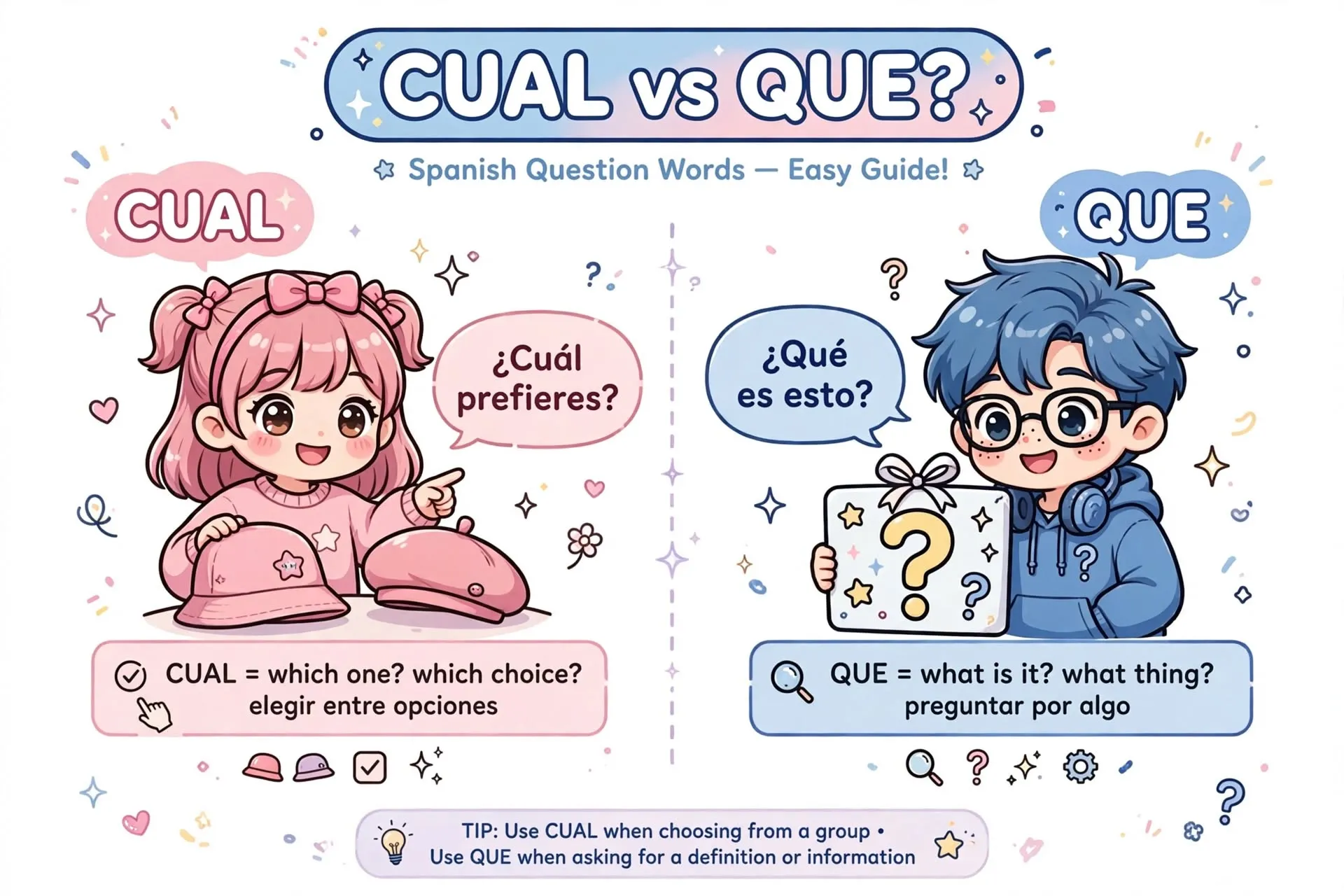
In Spanish, cuál means “which” or “what,” and qué means “what” or “which” in many questions. The right word depends on the sentence.
Imagine you are learning Spanish. You want to ask a friend about their name. You may say, “¿Qué es tu nombre?” But this is not the usual way to ask. A better question is “¿Cuál es tu nombre?” In everyday Spanish, people often say, “¿Cómo te llamas?” too.
Now think about another question. You want to know what a word means. You can ask, “¿Qué significa esta palabra?” Here, qué is the right choice.
This is why many learners search for cual or que. Both words are used in Spanish questions. They can seem alike, but they do not always mean the same thing. The spelling also matters. Cuál has an accent mark, and qué has one too.
In this guide, you will learn when to use cuál and qué. You will see easy rules, short examples, and common mistakes. By the end, you will feel more sure when you ask questions in Spanish.
Pronunciation
These words are Spanish words. Their sounds do not change between US and UK English.
- Cuál
- US: /kwal/
- UK: /kwal/
- Easy sound: “kwahl”
- Qué
- US: /keɪ/ is not the Spanish sound; Spanish uses /ke/
- UK: /keɪ/ is not the Spanish sound; Spanish uses /ke/
- Easy sound: “keh”
Say cuál like “kwahl.” Say qué like “keh.” The Spanish letter q sounds like a hard k here.
Also read more about:https://syntexra.com/dysfunction-or-disfunction/
Difference Between Cual and Que
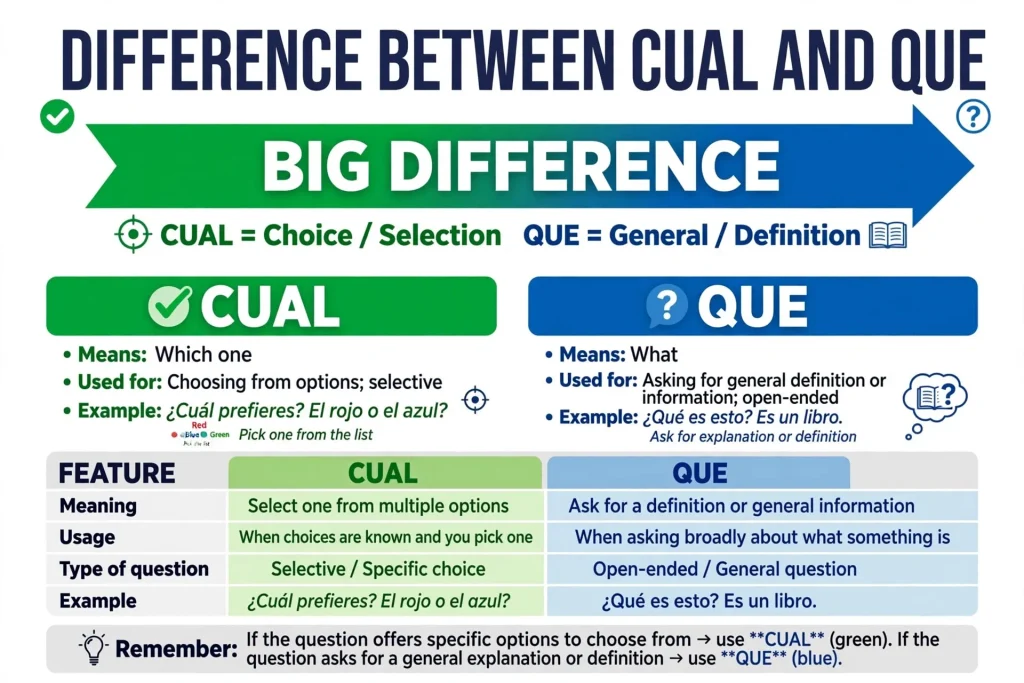
1. Basic Meaning
Cuál often means “which” or “what.” Qué often means “what.”
- Example 1: ¿Cuál quieres? — Which one do you want?
- Example 2: ¿Qué quieres? — What do you want?
2. Asking About a Choice
Use cuál when you ask someone to choose from things.
- Example 1: ¿Cuál prefieres? — Which one do you prefer?
- Example 2: ¿Cuál es tu color favorito? — What is your favorite color?
3. Asking for a Meaning
Use qué to ask what something means.
- Example 1: ¿Qué significa esto? — What does this mean?
- Example 2: ¿Qué quiere decir esta palabra? — What does this word mean?
4. Asking About a Thing
Use qué to ask about a thing or idea.
- Example 1: ¿Qué es eso? — What is that?
- Example 2: ¿Qué es un perro? — What is a dog?
5. Asking for Information
Use qué when you want to know more about something.
- Example 1: ¿Qué pasó? — What happened?
- Example 2: ¿Qué haces? — What are you doing?
6. Asking Which Person or Thing
Use cuál to ask which person or thing someone means.
- Example 1: ¿Cuál es tu libro? — Which one is your book?
- Example 2: ¿Cuál de estos es tuyo? — Which of these is yours?
7. Asking About a Name
Spanish often uses cuál in questions about a name.
- Example 1: ¿Cuál es tu nombre? — What is your name?
- Example 2: ¿Cuál es tu apellido? — What is your last name?
A common and natural way to ask someone’s name is also “¿Cómo te llamas?”
8. Before a Noun
Use qué before a noun to ask what kind or type of thing it is.
- Example 1: ¿Qué libro lees? — What book are you reading?
- Example 2: ¿Qué comida te gusta? — What food do you like?
9. Grammar in Questions
Both words can be used in questions. The word you choose depends on what you want to ask.
- Example 1: ¿Qué quieres comer? — What do you want to eat?
- Example 2: ¿Cuál quieres comer? — Which one do you want to eat?
The second question works when you are choosing from known options, such as foods on a menu.
10. Accent Marks
In questions, both words use an accent mark: cuál and qué. Without the accent, cual and que can have other uses in Spanish.
- Example 1: ¿Cuál es tu casa? — Which one is your house?
- Example 2: ¿Qué es tu casa? — What is your house?
The second sentence may sound odd in many situations. A better question depends on what you want to know.
Nature and Behaviour of Cual and Que
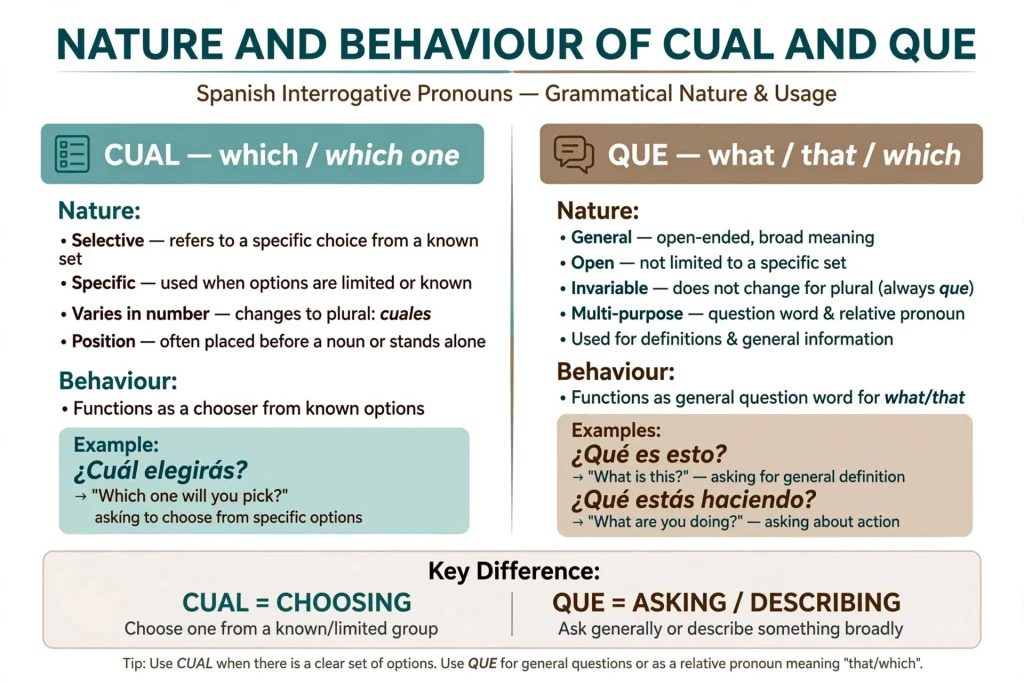
Nature and Behaviour of Cuál
Cuál is a question word. It helps you ask which person or thing you mean. It often points to a choice.
Examples:
- ¿Cuál quieres? — Which one do you want?
- ¿Cuál es tu favorito? — Which one is your favorite?
Nature and Behaviour of Qué
Qué is also a question word. It helps you ask about things, actions, facts, or meanings.
Examples:
- ¿Qué haces? — What are you doing?
- ¿Qué significa esto? — What does this mean?
Both words help you ask questions. The key is to choose the word that fits the meaning.
Why People Get Confused About Cual and Que
People get confused because both words can be translated as “what” in English. But Spanish uses them in different ways.
For example:
- ¿Qué es esto? — What is this?
- ¿Cuál es tu favorito? — Which one is your favorite?
English speakers may use “what” for both questions. Spanish often needs a different word.
Another source of confusion is the accent mark. In questions, write cuál and qué. In other sentences, cual and que may appear without accents.
The best way to learn is to read short examples and practice asking questions.
Comparison Table
| Feature | Cuál | Qué |
|---|---|---|
| Main meaning | Which or what | What |
| Main use | Ask about a choice | Ask about a thing or idea |
| Example | ¿Cuál quieres? | ¿Qué quieres? |
| English meaning | Which one do you want? | What do you want? |
| Before a noun | Usually not used directly before a noun | Often used before a noun |
| Asking about meaning | Not the usual choice | ¿Qué significa? |
| Accent in questions | Cuál | Qué |
| Used in Spanish | Yes | Yes |
Both are common Spanish question words. They are not always interchangeable.
The Origin of Cual and Que
Spanish grew from Latin. Many Spanish words came from Latin words used long ago.
Qué is linked to the Latin word quid, which means “what” or “which thing.”
Cuál is linked to the Latin word qualis, which means “of what kind” or “which.”
Over time, both words became part of everyday Spanish. Today, people use them in questions and other types of sentences.
Their old roots help explain why the words have different jobs. Qué often asks about a thing or fact. Cuál often asks someone to pick or name a choice.
British vs American English
British and American English do not use cuál and qué as English words. They are Spanish words.
The main difference is in the English translation. In both US and UK English, qué often means “what.” Cuál often means “which” or “what,” based on the sentence.
Examples:
- Spanish: ¿Qué es esto?
English: What is this? - Spanish: ¿Cuál prefieres?
English: Which one do you prefer?
The Spanish rules stay the same for learners in the US and UK.
Which One Should You Use?
Use qué when you want to ask what something is, what happened, or what someone is doing.
Use cuál when you want to ask which person or thing someone means. It is often used when there is a choice.
In the US, UK, or any other country, these Spanish rules are the same. Your location does not change the correct word.
Try to learn each word with a short question. For example, remember “¿Qué es esto?” and “¿Cuál quieres?” These simple patterns can help you speak with more care.
Common Mistakes
Here are common mistakes and how to fix them.
- Wrong: ¿Que es esto?
Right: ¿Qué es esto? - Wrong: ¿Cual quieres?
Right: ¿Cuál quieres? - Wrong: ¿Qué de estos prefieres?
Right: ¿Cuál de estos prefieres? - Wrong: ¿Cuál significa esta palabra?
Right: ¿Qué significa esta palabra? - Wrong: Using qué for every question.
Right: Use cuál when asking which one.
Everyday Usage Examples
Emails
- ¿Qué necesita? — What do you need?
- ¿Cuál es su nombre? — What is your name?
Social Media
- ¿Qué pasó? — What happened?
- ¿Cuál te gusta más? — Which one do you like more?
News
- ¿Qué ocurrió hoy? — What happened today?
- ¿Cuál fue el resultado? — What was the result?
Formal Writing
- ¿Qué significa este término? — What does this term mean?
- ¿Cuál es la mejor opción? — Which is the best option?
These examples show how both words can be used in daily life.
Usage Trends
Qué and cuál are common words in Spanish. Learners meet them early because they are used in many questions.
People search for “cual or que” when they want to speak Spanish well. They may be learning at school, using a language app, or talking with Spanish speakers.
Online lessons often teach these words with simple questions. Practice helps learners see the difference. It is also useful to learn the full sentence, not just the English meaning.
There is no single rule that fits every English translation. The sentence tells you which Spanish word to use.
Metaphors and Similes
Cuál and qué do not have special metaphorical meanings on their own. But we can use simple comparisons to help remember their roles.
- Qué is like a door that opens a question about a thing.
- Cuál is like a finger that points to one choice.
- Qué works like a key that helps you ask for facts.
- Cuál works like a sign that helps you pick one item.
Connotative Meaning
The words qué and cuál are usually neutral. They do not have a good or bad feeling by themselves.
Positive Meaning
A question can sound kind or helpful.
Example: ¿Qué necesitas? — What do you need?
Negative Meaning
A question can sound upset when said in an angry voice.
Example: ¿Qué hiciste? — What did you do?
Neutral Meaning
A question can simply ask for information.
Example: ¿Cuál es tu libro? — Which one is your book?
The tone of voice and the situation can change how a question feels.
Idioms and Proverbs
There are no common Spanish sayings built only around cuál or qué. But both words can appear in common questions.
- ¿Qué tal? — How are things?
- Example: ¿Qué tal tu día? — How was your day?
- ¿Qué pasa? — What is happening?
- Example: ¿Qué pasa aquí? — What is happening here?
- ¿Cuál es el problema? — What is the problem?
- Example: ¿Cuál es el problema con la tarea? — What is the problem with the homework?
Literature and Movies
Spanish question words appear in books, plays, and films because people use them every day.
Literature
Don Quixote by Miguel de Cervantes was first published in 1605. It is a famous Spanish novel. Like other Spanish writing, it uses words to ask questions and share ideas.
Movies
The Book of Life (2014, USA) is an animated film with Mexican culture and Spanish words. It can help learners hear Spanish in a story.
Roma (2018, Mexico) is a film by Alfonso Cuarón. It uses Spanish in daily talks between people.
These works are examples of Spanish in books and films. They are not special stories about the words cuál and qué.
Why This Difference Matters
Knowing the difference between cuál and qué helps you ask clear questions in Spanish. It can help you at school, while travelling, or when talking with friends.
If you use the wrong word, people may still understand you. But the sentence may sound odd. Learning the right word can help you speak more naturally.
It is also useful for reading. You can understand questions in books, signs, lessons, and messages.
Usefulness in Daily Life
You can use these words in many daily talks.
- Ask what something is: ¿Qué es esto?
- Ask what someone wants: ¿Qué quieres?
- Ask which one they like: ¿Cuál te gusta?
- Ask which one they choose: ¿Cuál eliges?
- Ask what happened: ¿Qué pasó?
- Ask which is best: ¿Cuál es mejor?
Situational Preference
Use qué when you ask about a thing, an action, or a fact. For example, “¿Qué haces?” means “What are you doing?” Use cuál when you ask someone to choose from a group. For example, “¿Cuál quieres?” means “Which one do you want?” If you are asking about a word’s meaning, use qué: “¿Qué significa?” If you want to know which book a person likes, use cuál: “¿Cuál te gusta?” The sentence and meaning will help you choose the right word.
Possible Questions
1. What is the main difference between cuál and qué?
Qué often means “what.” Cuál often means “which” or “what,” based on the sentence.
2. Does cuál need an accent mark?
Yes, in a direct question, write cuál with an accent mark.
3. Does qué need an accent mark?
Yes, when it is used as a question word, write qué with an accent mark.
4. Can I use cuál and qué in the same way?
Not always. Each word has its own use. The meaning of the sentence helps you choose.
5. How do I ask “What is this?” in Spanish?
Say “¿Qué es esto?”
6. How do I ask “Which one do you want?” in Spanish?
Say “¿Cuál quieres?”
7. Is the rule different in the US and UK?
No. Spanish uses the same rules in both places.
Conclusion
Cuál and qué are useful Spanish question words. Both can mean “what” in English, but they are used differently.
Use qué to ask about things, actions, or facts. For example, “¿Qué es esto?” means “What is this?”
Use cuál to ask someone to choose or identify something. For example, “¿Cuál quieres?” means “Which one do you want?”
Remember to use accent marks in questions: qué and cuál. Practice with short sentences and everyday conversations to learn when to use each word correctly.

Eman Sarfraz is a professional content writer, researcher, and English language specialist with strong expertise in English grammar, vocabulary, word meanings, synonyms, and antonyms. I creates well-researched, accurate, and easy-to-understand content that helps readers master English concepts and communicate with greater confidence.