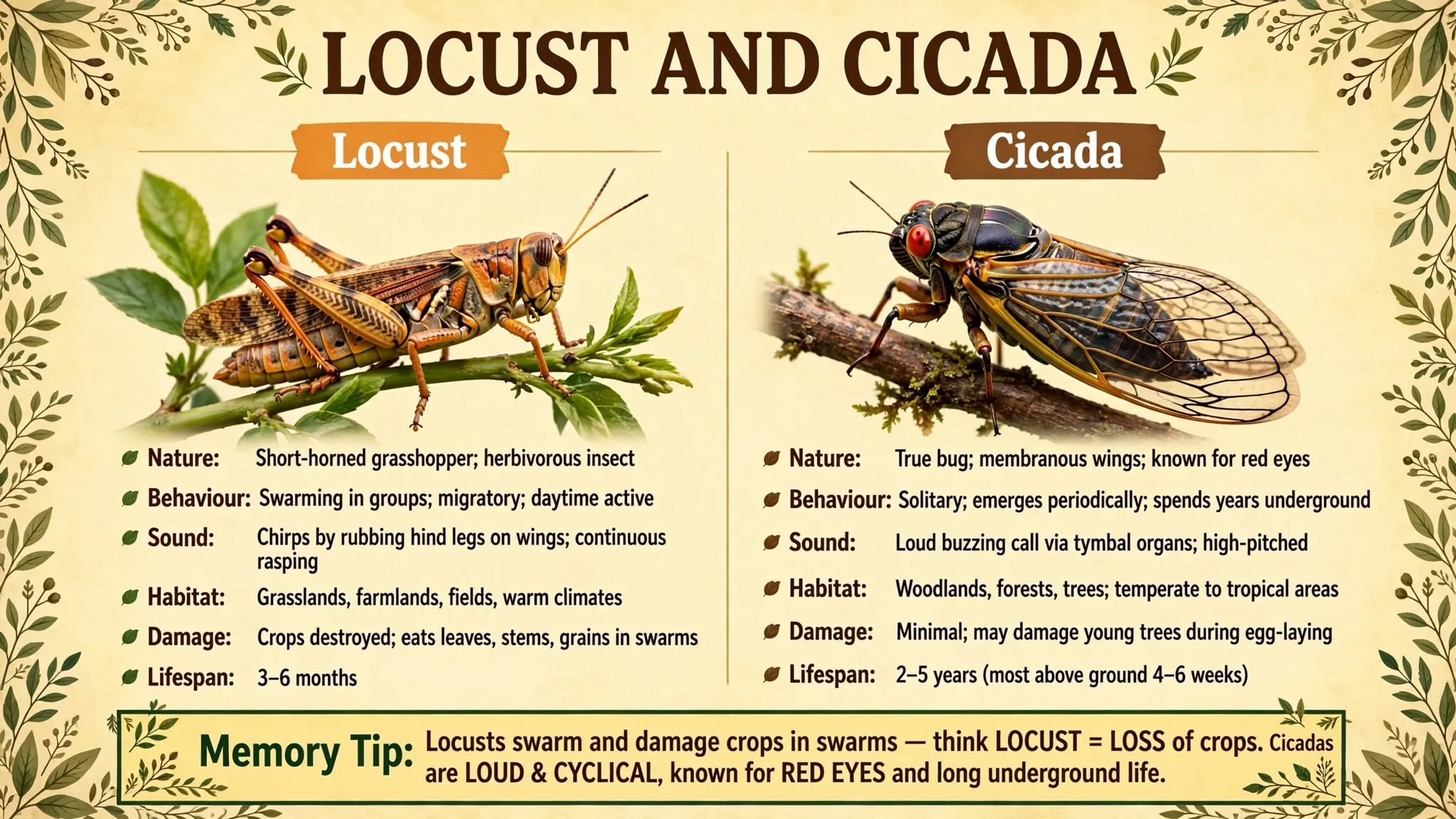
A locust can form large swarms and damage crops. A cicada is known for its loud song and time spent underground.
Imagine sitting in your garden on a hot summer day. You hear a loud buzz in the trees. You may think it is a locust, but it could be a cicada. Later, you see a large insect eating leaves in your garden. That insect may be a locust.
People often search for “locust or cicada” because both insects can be found outdoors. They may look alike at first, but they have different bodies, habits, and ways of life.
A locust is a type of grasshopper. Some locusts can change their behavior and form huge groups. These groups can eat many crops. A cicada is a different insect. It spends much of its life underground as a young insect. When it comes out, it often makes a loud sound.
Knowing the difference helps you name each insect. It can also help you learn about nature, farming, and the sounds you hear outside.
Pronunciation
- Locust
- US: /ˈloʊ.kəst/
- UK: /ˈləʊ.kəst/
- Cicada
- US: /sɪˈkeɪ.də/ or /sɪˈkɑː.də/
- UK: /sɪˈkɑː.də/
Now, let’s look at the main differences between these insects.
Also read more about:https://syntexra.com/perimenopause-or-menopause/
Difference Between Locust and Cicada
1. Type of Insect
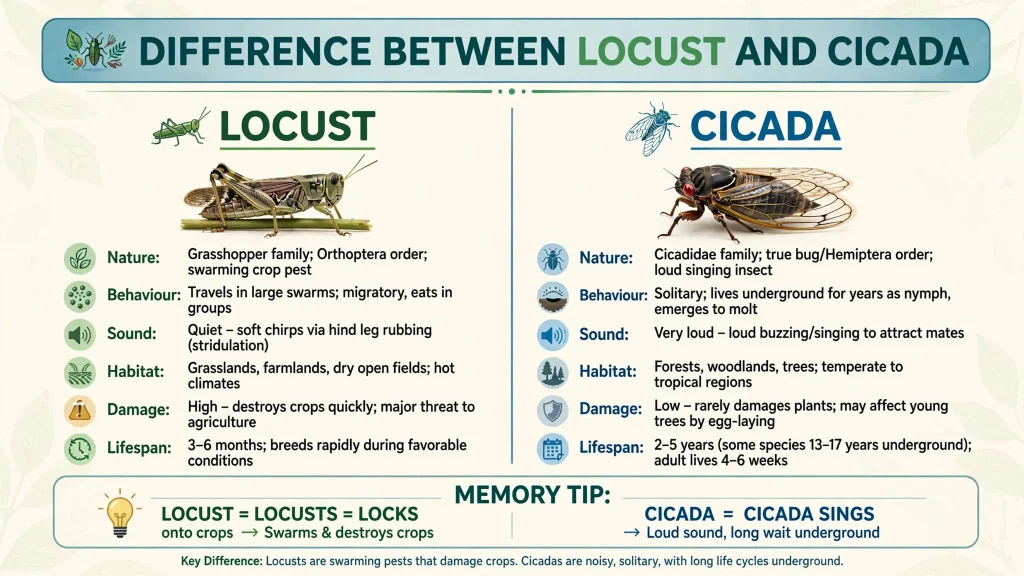
A locust is a type of grasshopper. A cicada belongs to a different group of insects.
Locust examples:
- A desert locust eats plants and grass.
- A locust may gather with many others.
Cicada examples:
- A cicada sits on a tree trunk.
- A cicada sings on a warm summer day.
2. Body Shape
Locusts often have long back legs for jumping. Cicadas have wide bodies and clear wings.
Locust examples:
- A locust jumps across a field.
- A locust has strong back legs.
Cicada examples:
- A cicada rests on tree bark.
- A cicada has clear wings and large eyes.
3. Sound
Cicadas are famous for their loud sounds. Locusts may make sounds too, but they are not known for the same loud summer song.
Locust examples:
- A locust may rub its legs to make a sound.
- A group of locusts may make a soft buzz as they fly.
Cicada examples:
- A cicada sings loudly in a tree.
- Many cicadas can make a whole garden sound noisy.
4. Food
Both insects feed on plants, but they eat in different ways.
Locust examples:
- A locust eats leaves.
- A locust swarm can damage crops.
Cicada examples:
- A young cicada drinks sap from plant roots.
- An adult cicada drinks plant fluids from branches.
5. Life Cycle
Locusts grow from eggs into young insects and then adults. Cicadas also grow from eggs, but their young often live underground.
Locust examples:
- A young locust looks like a small wingless grasshopper.
- A locust grows wings as it gets older.
Cicada examples:
- A young cicada lives in the soil.
- An adult cicada climbs out and sheds its old skin.
6. Time Spent Underground
Locusts usually live above ground. Young cicadas may stay underground for years.
Locust examples:
- A locust feeds in a field.
- A locust moves across grass and crops.
Cicada examples:
- A young cicada feeds on roots underground.
- Some cicadas emerge after many years.
7. Swarms and Groups
Some locusts form huge swarms. Cicadas can also appear in large groups, but they do not form crop-eating swarms in the same way.
Locust examples:
- Desert locusts can fly across large areas.
- A locust swarm can eat crops over a wide area.
Cicada examples:
- Many cicadas may emerge at the same time.
- A group of cicadas may fill trees with sound.
8. Wings and Flight
Both insects have wings as adults. Locusts often fly in search of food. Cicadas usually fly between trees and plants.
Locust examples:
- A locust flies over a farm.
- A locust lands on a crop to feed.
Cicada examples:
- A cicada flies from one tree to another.
- A cicada rests on a branch after flight.
9. Effect on People
Locusts can cause major crop loss when they form large swarms. Cicadas are usually harmless to people, though some can harm young trees when they lay eggs.
Locust examples:
- A locust swarm can harm a farmer’s crops.
- A large swarm can threaten food supplies.
Cicada examples:
- A cicada may make a garden very loud.
- A large group may damage small tree branches.
10. Where You May Find Them
Locusts live in many parts of the world. Cicadas are also found in many regions, often where trees and warm seasons support them.
Locust examples:
- Desert locusts live in parts of Africa and Asia.
- Locusts may feed in grasslands and farm fields.
Cicada examples:
- Cicadas may live in parks and forests.
- Cicadas often appear in gardens during warm weather.
Nature and Behaviour of Locusts and Cicadas
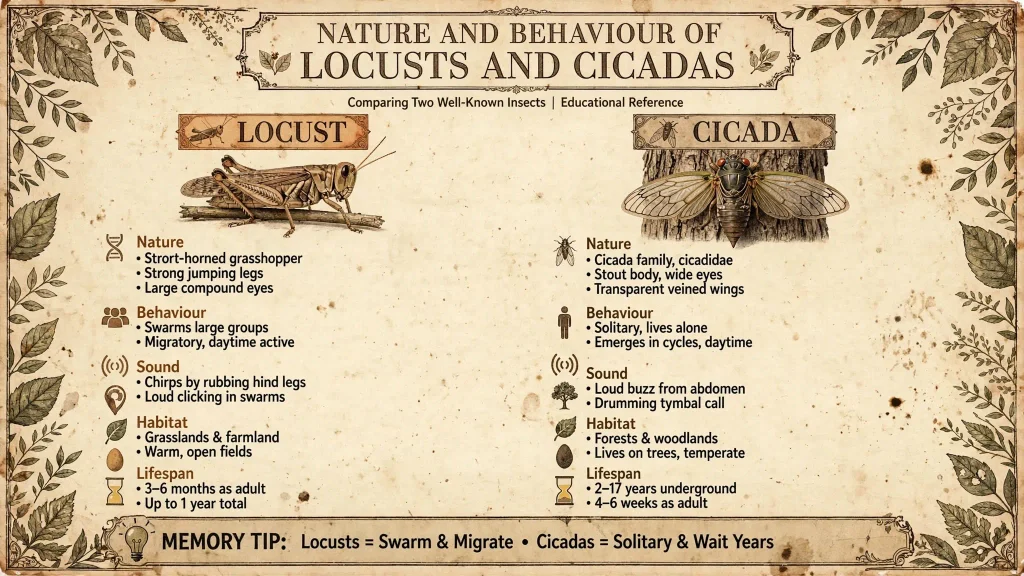
Locusts
Locusts are active plant eaters. Most of the time, they live alone or in small groups. Some kinds can change their behavior when many gather close together.
When this happens, they may form large swarms. These swarms can move across fields and eat many plants. This makes some locusts a serious problem for farmers.
Cicadas
Cicadas spend much of their lives as young insects underground. They feed on fluids from plant roots. When they are ready, they come out and become adults.
Adult cicadas often sit in trees and make loud sounds. These sounds help them find mates. Most cicadas do not bite people or harm them.
Why People Get Confused About Locusts and Cicadas
People may confuse these insects because both have wings and can make sounds. They can also appear in large groups.
But their bodies and habits are different. Locusts look more like grasshoppers. They have strong back legs and can jump. Cicadas have broad bodies, clear wings, and large eyes.
Their effects on nature are also different. Locust swarms can destroy crops. Cicadas are best known for their loud songs and long time underground.
Comparison Table
| Feature | Locust | Cicada |
|---|---|---|
| Insect group | Grasshopper family | Cicada group |
| Main food | Leaves and crops | Plant fluids |
| Sound | May make a light buzz or rasp | Often makes a loud song |
| Young stage | Usually above ground | Often underground |
| Back legs | Long and strong for jumping | Not built for strong jumps |
| Wings | Used for flight | Used for flight |
| Large groups | Can form crop-eating swarms | May emerge in large groups |
| Main concern | Crop damage | Noise and some tree damage |
| Common place | Fields and grasslands | Trees, gardens, and forests |
| Risk to people | Does not usually attack people | Usually harmless to people |
Both insects are part of nature. They just live and act in different ways.
The Origin of the Words
The word locust comes from an old Latin word, locusta. It was used for insects such as locusts and grasshoppers. Locusts have been known for a long time because large swarms can destroy crops.
The word cicada also comes from Latin. It refers to the insect known for its sound. People have noticed cicada songs for thousands of years.
Both insects appear in old stories and records. Locusts are often linked with hunger and crop loss. Cicadas are often linked with summer, heat, and the sounds of nature.
British vs American English
There is no major spelling difference between British and American English for these words. Both use locust and cicada.
| Use | British English | American English |
|---|---|---|
| Insect name | Locust | Locust |
| Insect name | Cicada | Cicada |
| Plural | Locusts | Locusts |
| Plural | Cicadas | Cicadas |
Examples:
- UK: “A locust swarm damaged the crops.”
- US: “A locust swarm damaged the crops.”
- UK: “Cicadas are loud in summer.”
- US: “Cicadas are loud in summer.”
The words are the same in both forms of English.
Which One Should You Use?
Use locust when you mean a grasshopper-like insect that may form large swarms and damage crops.
Use cicada when you mean an insect known for its loud sound and long time spent underground as a young insect.
In the US, UK, and other countries, the names have the same meaning. If you are writing about farming or crop loss, “locust” may be the right word. If you are writing about summer sounds or insects in trees, “cicada” may fit better.
Common Mistakes
Here are some common errors and their fixes.
- Wrong: A cicada is a type of locust.
Right: A cicada is a different kind of insect. - Wrong: All locusts form huge swarms.
Right: Some locusts can form large swarms under the right conditions. - Wrong: Cicadas eat leaves like locusts.
Right: Cicadas feed on plant fluids. - Wrong: Cicadas spend their whole lives in trees.
Right: Many young cicadas live underground. - Wrong: Cicadas are dangerous to people.
Right: Cicadas are usually harmless to people. - Wrong: Locusts and cicadas are the same because both have wings.
Right: Many insects have wings, but they can still be very different.
Everyday Usage Examples
In Emails
- “The locusts have damaged some crops near the farm.”
- “We heard cicadas singing near the trees.”
On Social Media
- “A huge locust swarm has reached the area.”
- “The cicadas are so loud this summer!”
In News
- “Farm workers are watching for locust swarms.”
- “Cicadas have appeared in large numbers this season.”
In Formal Writing
- “Locusts can cause serious crop loss.”
- “Cicadas spend part of their life cycle underground.”
These examples show how to use each word in daily English.
Usage Trends
Both words are used around the world in news, school books, nature guides, and farming reports.
The word locust often appears in news about crop damage and food supply. This is because large swarms can affect farms and local food sources.
The word cicada often appears in reports about wildlife, warm weather, and seasonal insect sounds. Some cicadas also draw attention when many emerge at once.
Both words help people talk about insects and learn how they affect the world around us.
Metaphors and Similes
These insects can also be used to describe other things.
- “They came like a swarm of locusts.” This means a large group arrived and used up many things quickly.
- “The crowd was as loud as cicadas.” This means the crowd made a very loud, steady sound.
- “Locusts swept across the land.” This can describe a group moving quickly and causing damage.
- “The sound rose like a summer chorus of cicadas.” This describes many sounds heard together.
Connotative Meaning
The words can bring different feelings to mind.
Positive Meaning
Cicada: “The song of the cicadas made the summer day feel calm.”
This gives cicadas a peaceful feeling.
Locust: “The locust is a strong and active insect.”
This describes the insect without focusing on harm.
Negative Meaning
Locust: “The locust swarm destroyed the farmer’s crops.”
This gives locusts a harmful meaning.
Cicada: “The cicadas were so loud that we could not sleep.”
This shows how their sound can bother people.
Neutral Meaning
- “A locust landed on a leaf.”
- “A cicada sat on a tree.”
These sentences give simple facts. They do not show good or bad feelings.
Idioms and Proverbs
There are no widely used English idioms that focus only on cicadas. However, locusts appear in phrases and stories about large groups and loss.
- “Like a swarm of locusts” means a group arrives in large numbers and uses up things quickly.
Example: “The guests ate the food like a swarm of locusts.” - “A plague of locusts” means a large number of locusts that cause serious harm.
Example: “The farmer feared a plague of locusts could ruin the crop.”
Cicadas are more often used in poems and descriptions of summer sounds than in common idioms.
Literature and Movies
Literature
- “The Ant and the Grasshopper” by Aesop is an old fable. In some versions and translations, the grasshopper is shown as a cicada. The story teaches a lesson about work and planning.
- The Bible, written over many centuries, mentions locusts in several passages. In these stories, locusts are often linked with crop loss and hardship.
These works show how insects have shaped stories and ideas for a long time.
Movies
- The Beginning of the End (1957, United States) is a science-fiction film about giant grasshoppers that attack a city. The insects are not true locusts in every detail, but the film uses the fear of large insect swarms.
- A Bug’s Life (1998, United States) is an animated film about ants and other insects. It shows how insects live and work together, though it is not a film about cicadas.
These films use insects to tell stories about fear, teamwork, and survival.
Why This Difference Matters
Knowing the difference between a locust and a cicada helps you learn about nature. It also helps you understand news about insects.
Locusts can cause serious harm to crops when they form large swarms. Farmers may need to watch for them and protect their fields.
Cicadas play a different role. Their young feed on plant fluids, and adults provide food for birds and other animals. Their loud sounds are also part of life in many warm places.
Using the right name helps students, farmers, and nature lovers share clear facts. It also helps people know which insect they are seeing or hearing.
Usefulness in Daily Life
You may use these words when you:
- Learn about insects at school.
- Read news about crop damage.
- Visit a farm or garden.
- Hear loud insects in summer.
- Write a report about nature.
- Take photos of insects.
If you see an insect with strong jumping legs in a field, it may be a locust or another grasshopper. If you hear a loud song from a tree, it may be a cicada.
Situational Preference
Use locust when you talk about crop damage, grasshopper-like insects, or large insect swarms. This word is useful in farming news and reports about food supply. Use cicada when you talk about loud summer sounds, insects on trees, or young insects that live underground. This word fits nature guides and stories about warm weather. In school work, use the name that matches the insect’s body and habits. If you are not sure, check a trusted insect guide or ask an expert. The right word makes your writing clear and correct.
Possible Questions
1. What is the main difference between a locust and a cicada?
A locust is a type of grasshopper. A cicada is a different insect known for its loud sound and young stage underground.
2. Can locusts fly?
Yes. Adult locusts have wings and can fly. Some kinds can form large swarms.
3. Why are cicadas so loud?
Male cicadas make loud sounds to attract mates. Many cicadas singing at once can make a lot of noise.
4. Do cicadas eat plants?
Yes. Young cicadas drink fluids from plant roots. Adults drink plant fluids from branches.
5. Are locusts dangerous to people?
Locusts do not usually attack people. Their main danger is the damage large swarms can cause to crops.
6. Are cicadas harmful?
Most cicadas are harmless to people. Some may damage small branches when they lay eggs.
7. Can locusts and cicadas look alike?
They may look alike from far away because both have wings. But their body shape and behavior are different.
Conclusion
Locusts and cicadas are different insects. Locusts are like grasshoppers and can form large swarms that damage crops. Cicadas are known for their loud sounds and life underground.Locusts eat leaves, while cicadas drink plant fluids. Locusts have strong legs for jumping, while cicadas have clear wings and large eyes.Knowing the difference helps you identify these insects and learn about nature. Remember, locusts can harm crops, while cicadas are known for their loud songs.

Eman Sarfraz is a professional content writer, researcher, and English language specialist with strong expertise in English grammar, vocabulary, word meanings, synonyms, and antonyms. I creates well-researched, accurate, and easy-to-understand content that helps readers master English concepts and communicate with greater confidence.