Diesel and gas are two types of fuel. Diesel is often used in trucks, while gas, called petrol in the UK, is common in cars.
Imagine you want to buy a car. You see two cars at the shop. One uses diesel, and the other uses gas. Both can take you to work or school. But they use different fuels. They may also cost different amounts to run.
When people search for diesel or gas, they often want to know which fuel is better. They may want to save money, buy a car, or learn how each fuel works.
Diesel fuel is used in diesel engines. Gas, or gasoline, is used in gas engines. These engines work in different ways. Diesel engines often use less fuel over long trips. Gas cars can cost less to buy and may be quieter.
The best choice depends on how you drive. Think about fuel cost, car price, and how far you travel. These facts can help you choose the right car for your needs.
Pronunciation
- Diesel
- US: /ˈdiːzəl/
- UK: /ˈdiːzəl/
- Gas (gasoline)
- US: /ɡæs/ — gas; /ˈɡæsəliːn/ — gasoline
- UK: /ˈpɛtrəl/ — petrol, the usual word for car fuel
Now, let’s look at the main differences.
Also read more about:https://syntexra.com/conner-or-connor/
Difference Between Diesel and Gas
1. Type of Fuel
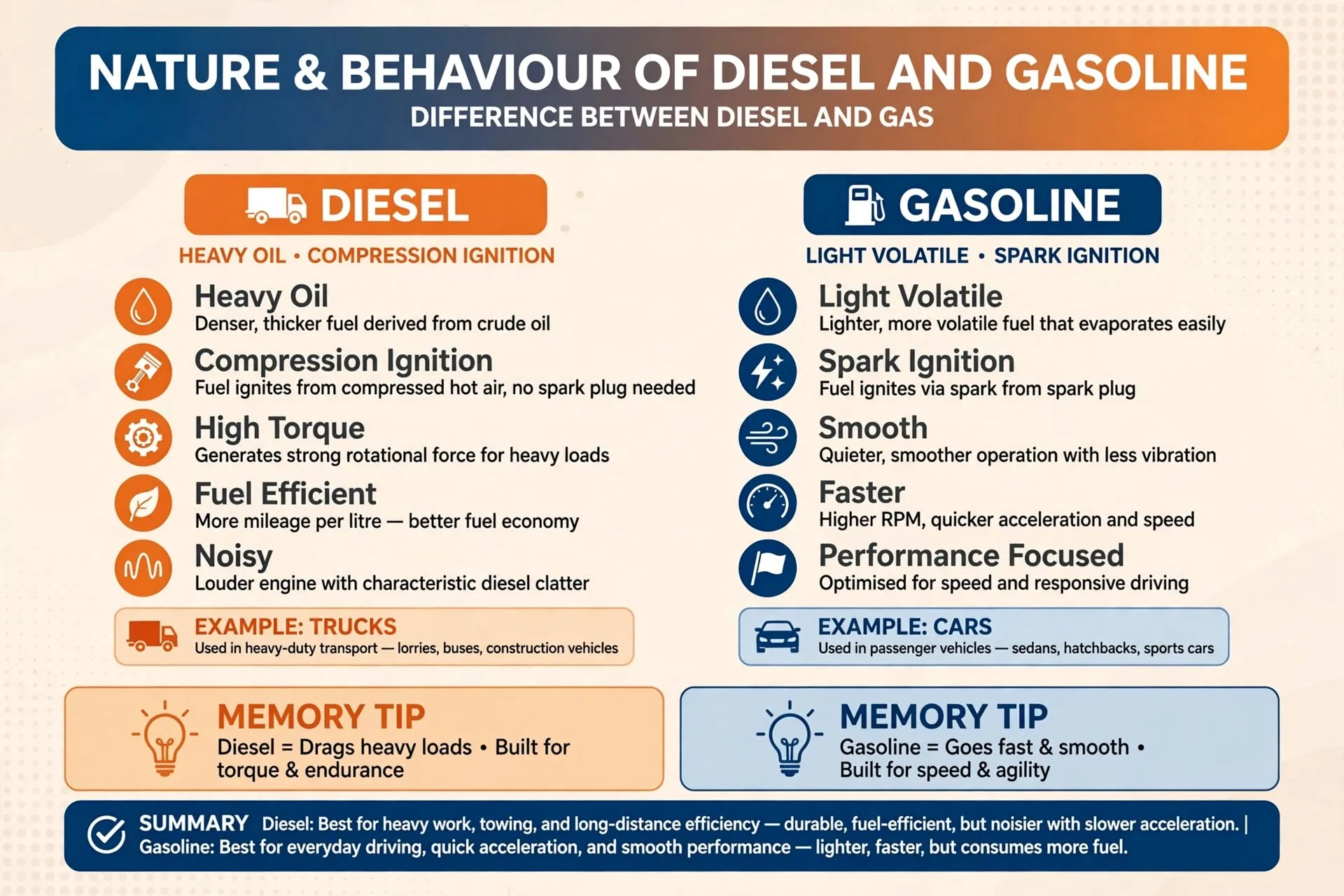
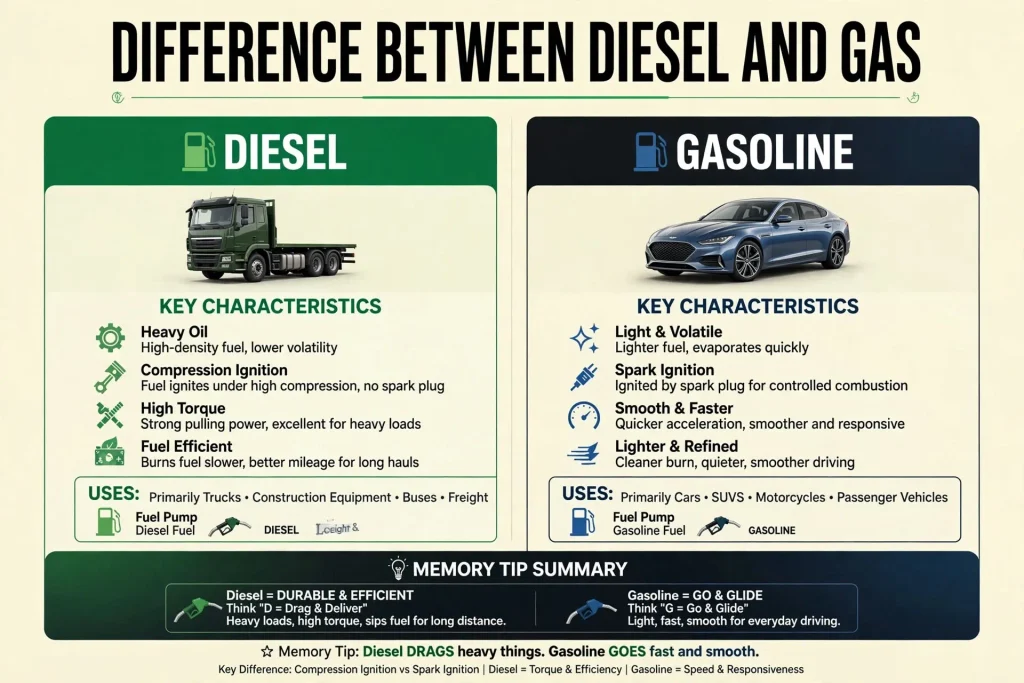
Diesel and gas are fuels for engines. They are made in different ways.
Diesel examples:
- Many large trucks use diesel.
- Some buses use diesel.
Gas examples:
- Many family cars use gas.
- Many small cars use gas.
2. How the Engine Works
Diesel and gas engines burn fuel in different ways.
Diesel examples:
- A diesel engine uses hot, pressed air to light the fuel.
- A diesel truck uses this method to move heavy loads.
Gas examples:
- A gas engine usually uses a spark plug to light the fuel.
- A gas car uses this spark to run its engine.
3. Fuel Use
Diesel engines often use less fuel for the same distance. The result depends on the car and how you drive.
Diesel examples:
- A diesel truck may use less fuel on a long trip.
- A diesel car may travel farther on one tank.
Gas examples:
- A gas car may use more fuel on the same trip.
- A small gas car may still use very little fuel.
4. Cost of Fuel
The price of diesel and gas can change by place and time.
Diesel examples:
- Diesel may cost more per litre at a fuel station.
- Diesel may cost less to use over a long trip if the car saves enough fuel.
Gas examples:
- Gas may cost less per litre in some places.
- A gas car may cost less to run for short trips.
Always compare local fuel prices and fuel use before you choose.
5. Car Price
The price of a car depends on its brand, age, size, and engine.
Diesel examples:
- A new diesel truck may cost a lot.
- A used diesel car may cost less than a new one.
Gas examples:
- A small gas car may have a lower price.
- A used gas car may fit a tight budget.
6. Engine Power
Diesel engines often give strong pulling power at low speeds. This helps with heavy loads.
Diesel examples:
- A diesel truck can pull a heavy trailer.
- A diesel work van can carry tools and goods.
Gas examples:
- A gas car can speed up fast.
- A gas sports car can give strong speed and power.
The result depends on the engine design, not fuel alone.
7. Noise
Diesel engines can make more noise than gas engines. Newer cars may be much quieter.
Diesel examples:
- An older diesel truck may sound loud.
- A diesel bus may make a deep engine sound.
Gas examples:
- A small gas car may run quietly.
- A gas car may make less engine noise at low speed.
8. Care and Repairs
Both types of cars need regular care. Repair costs depend on the model and the fault.
Diesel examples:
- A diesel car needs clean fuel filters.
- Some diesel repairs can cost a lot.
Gas examples:
- A gas car needs oil changes and spark plug care.
- A gas engine may need repair if its spark plugs fail.
9. Air Pollution
Both fuel types cause pollution when burned. The amount and type depend on the engine and its pollution controls.
Diesel examples:
- Diesel engines can make soot and tiny particles.
- Some diesel cars use filters to cut these particles.
Gas examples:
- Gas engines release carbon dioxide.
- Gas engines can also release other harmful gases.
Neither fuel is pollution-free.
10. Best Use
The best fuel depends on the job and the way you drive.
Diesel examples:
- Diesel may suit a truck that carries heavy loads.
- Diesel may suit a driver who takes long trips often.
Gas examples:
- Gas may suit a small car used around town.
- Gas may suit a driver who takes short trips.
Nature and Behaviour of Diesel and Gas
Diesel
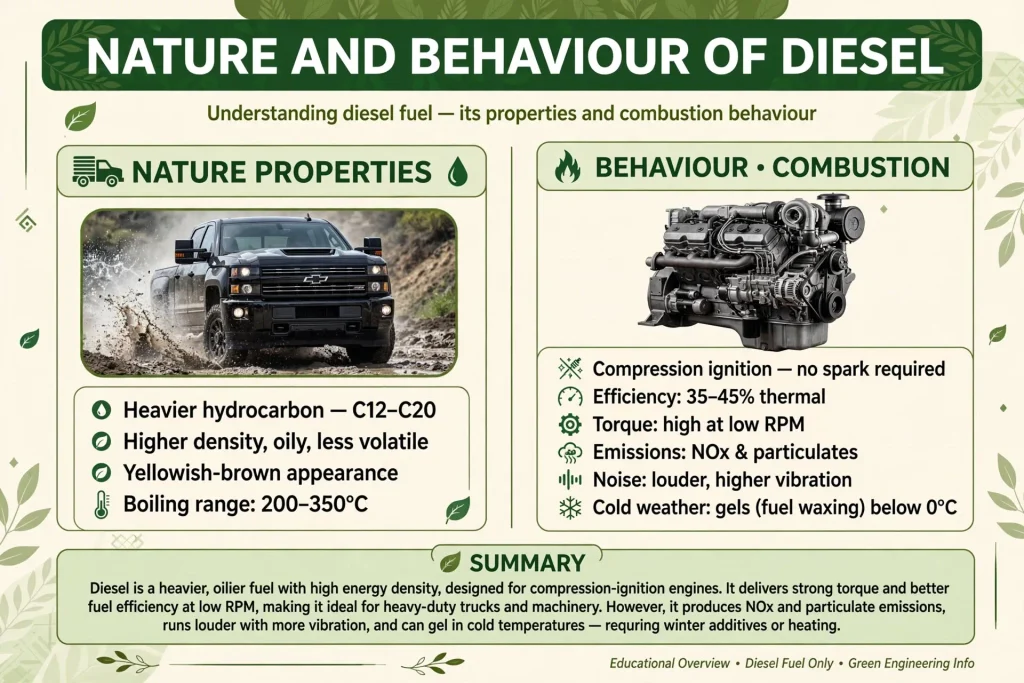
Diesel is common in trucks, buses, and some cars. It can also pull heavy loads with ease.
in ke first word ko change kr ke do They often use less fuel over long trips.
Diesel engines need the right fuel and care. Putting gas in a diesel car can cause serious damage.
Gas
Gasoline is common in cars and small vehicles. Gas engines often run more quietly than diesel engines. Many gas cars are easy to find and buy.
A gas engine needs the correct fuel too. Putting diesel in a gas car can cause problems.
Why People Get Confused About Diesel or Gas
People may think diesel and gas are the same because both fuel cars. But they are not the same fuel.
The words can also cause confusion. In the US, people often say gas when they mean gasoline. In the UK, people usually say petrol.
Both fuels come from oil, but they work in different engines. A car made for gas should not use diesel, and a diesel car should not use gas.
Comparison Table
| Feature | Diesel | Gas (Gasoline) |
|---|---|---|
| Common use | Trucks and some cars | Many cars |
| Engine type | Diesel engine | Gas engine |
| Ignition | Hot, pressed air lights fuel | A spark plug lights fuel |
| Fuel use | Often lower on long trips | Varies by car |
| Noise | Often louder | Often quieter |
| Heavy loads | Often a good fit | Depends on the vehicle |
| Pollution | Can make soot and particles | Makes carbon dioxide and other gases |
| Repair cost | Depends on the model | Depends on the model |
| UK word | Diesel | Petrol |
| US word | Diesel | Gas or gasoline |
Both fuels power engines. The best choice depends on the vehicle and your needs.
The Origin of Diesel and Gas
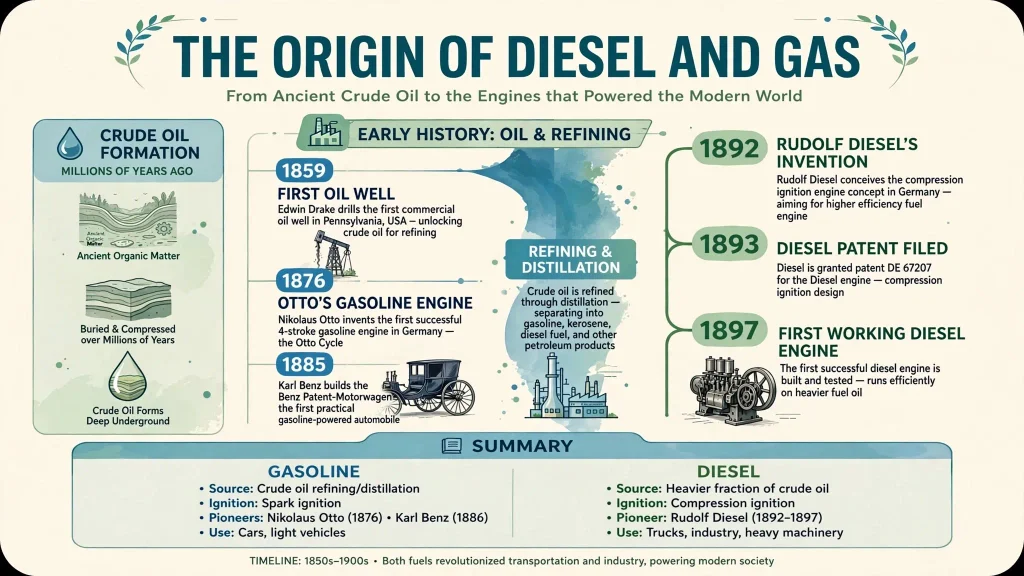
Diesel fuel gets its name from Rudolf Diesel. He made an engine design in the late 1800s. His engine used heat from pressed air to light the fuel.
Gasoline comes from oil. It became a common fuel as cars grew in use in the late 1800s and early 1900s.
Today, diesel and gas power many types of vehicles. New rules and new engine designs aim to cut fuel use and air pollution. Electric cars are also giving drivers another choice.
British vs American English
The main difference is the word used for gasoline.
| Meaning | British English | American English |
|---|---|---|
| Gasoline | Petrol | Gas or gasoline |
| Diesel fuel | Diesel | Diesel |
| Place to buy fuel | Petrol station | Gas station |
| Person who fills the tank | Driver or staff | Driver or staff |
Examples:
- UK: “I need to buy petrol.”
- US: “I need to get gas.”
- UK: “This car runs on diesel.”
- US: “This truck runs on diesel.”
The fuel names may change, but diesel and gasoline are still different fuels.
Which One Should You Use?
In the US, gas is common for many cars. Diesel is common in many trucks and some cars.
In the UK, petrol is the usual word for gasoline. Diesel is called diesel in both places.
For drivers around the world, the best fuel depends on the car. Check the owner’s guide and use only the fuel listed for that car.
If you drive long trips or carry heavy loads, a diesel car may suit you. If you drive short trips in a small car, gas may be a better fit. Compare the full cost before you decide.
Common Mistakes
Here are some common mistakes and how to fix them.
- Wrong: All cars use the same fuel.
Right: Some use gas, while others use diesel. - Wrong: Diesel and gas can be mixed in any car.
Right: Use only the fuel made for your engine. - Wrong: Diesel is always cheaper.
Right: Fuel prices change by place and time. - Wrong: Gas cars are always cheaper to run.
Right: Costs depend on fuel use, price, and repairs. - Wrong: Gas means the same thing in every country.
Right: In the US, gas often means gasoline. In the UK, people say petrol. - Wrong: Diesel cars never cause pollution.
Right: Diesel engines can release harmful gases and tiny particles.
Everyday Usage Examples
In Emails
- “Can you check if the work van uses diesel?”
- “Please fill the car with gas before the trip.”
On Social Media
- “Is a diesel car better for long trips?”
- “Gas prices went up this week.”
In News
- “Diesel prices rose at fuel stations.”
- “Drivers are looking for cars that use less fuel.”
In Formal Writing
- “The vehicle uses a diesel engine.”
- “The car runs on gasoline.”
These examples show how people use the words in daily life.
Usage Trends
Diesel and gas are still used in many countries. Gasoline is common in cars. Diesel is often used in trucks, buses, and work vehicles.
Fuel use changes by country. Prices, taxes, local laws, and the types of cars people buy all play a part. Some places are also moving toward electric cars.
There is no single best fuel for every driver. It is wise to check local prices and rules before buying a car.
Metaphors and Similes
People sometimes use fuel words to talk about energy and effort.
- “He is full of gas.” In some settings, this can mean he has lots of energy, but it can also mean he talks too much.
- “She runs like a well-oiled machine.” This means she works in a smooth and steady way.
- “That plan is running on empty.” This means the plan has little energy or support left.
Connotative Meaning
The words diesel and gas can bring different ideas to mind.
Positive Meaning
“Diesel helps the truck pull a heavy load.”
This shows diesel as useful and strong.
“Gas powers my small car for daily trips.”
This shows gas as handy and easy to use.
Negative Meaning
“The old diesel truck makes a lot of smoke.”
This may give diesel a bad image.
“High gas prices make driving costly.”
This shows a problem with fuel cost.
Neutral Meaning
“The car uses diesel.”
“The car uses gas.”
These are simple facts. They do not say that one fuel is better.
Idioms and Proverbs
There are few common idioms about diesel fuel itself. But some phrases about cars and energy can help explain ideas.
- Running on empty: “I am running on empty after a long day.” This means you feel tired.
- Step on the gas: “We need to step on the gas to finish on time.” This means to work faster.
- In the driver’s seat: “She is in the driver’s seat for this plan.” This means she is in control.
Literature and Movies
Cars and fuel often appear in stories about travel, work, and racing.
Literature
- The Road by Cormac McCarthy (2006) is a post-apocalyptic novel about a father and son on a hard journey. Travel and supplies are key parts of the story.
- Travels with Charley by John Steinbeck (1962) is a travel book about a road trip across the United States.
These books show how travel can shape a story. They are not guides to diesel and gas.
Movies
- Cars (2006, United States) is an animated film about cars and racing.
- Mad Max: Fury Road (2015, Australia and United States) is an action film set in a world where fuel and other supplies are scarce.
These films show why vehicles and fuel can matter in stories.
Why This Difference Matters
Knowing the difference between diesel and gas can help you choose the right car. It can also help you avoid costly mistakes.
Each engine needs the correct fuel. The wrong fuel can damage parts of the engine and fuel system. Repairs may cost a lot.
The choice can also affect your budget. Look at the car price, fuel use, repair costs, and how far you drive. Think about air pollution too.
This knowledge helps drivers make safer and smarter choices.
Usefulness in Daily Life
You can use these facts when you:
- Buy a new or used car.
- Fill up at a fuel station.
- Plan a long road trip.
- Compare the cost of two cars.
- Choose a work truck or van.
- Read news about fuel prices.
Situational Preference
Diesel may be a good choice for people who drive long trips or carry heavy loads. Many diesel engines use less fuel over long distances. But the car may cost more to buy or repair. Gas may be a better fit for people who drive small cars or take short trips. Gas cars can be quieter and may cost less to buy. Still, each car is different. Compare fuel use, local prices, repair costs, and air rules. Most of all, use the fuel listed for your car. The wrong fuel can cause serious damage.
possible Questions
1. What is the main difference between diesel and gas?
They are different fuels. Diesel engines and gas engines use different ways to burn fuel.
2. Is diesel better than gas?
Not always. Diesel may suit long trips and heavy loads. Gas may suit small cars and short trips.
3. Is diesel cheaper than gas?
It depends on local prices and how much fuel the car uses. Check both costs before you buy.
4. Can I put diesel in a gas car?
No. Diesel can harm a gas engine and its fuel system.
5. Can I put gas in a diesel car?
No. Gasoline can damage a diesel engine and its fuel system. If you use the wrong fuel, do not start the engine. Ask for help.
6. Do diesel cars use less fuel?
Many diesel cars use less fuel over long trips. But results vary by car and driving style.
7. What do people in the UK call gas?
They usually call it petrol. Diesel is called diesel.
Conclusion
Diesel and gas are common fuels, but they work in different engines. Diesel suits trucks and long trips, while gas is common in everyday cars.Diesel engines often use less fuel and pull heavy loads well. Gas cars may cost less to buy and run more quietly.Before you choose, compare fuel costs, repairs, and car needs. Always use the right fuel for your car to avoid damage.

Eman Sarfraz is a professional content writer, researcher, and English language specialist with strong expertise in English grammar, vocabulary, word meanings, synonyms, and antonyms. I creates well-researched, accurate, and easy-to-understand content that helps readers master English concepts and communicate with greater confidence.