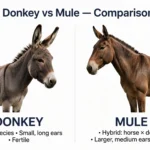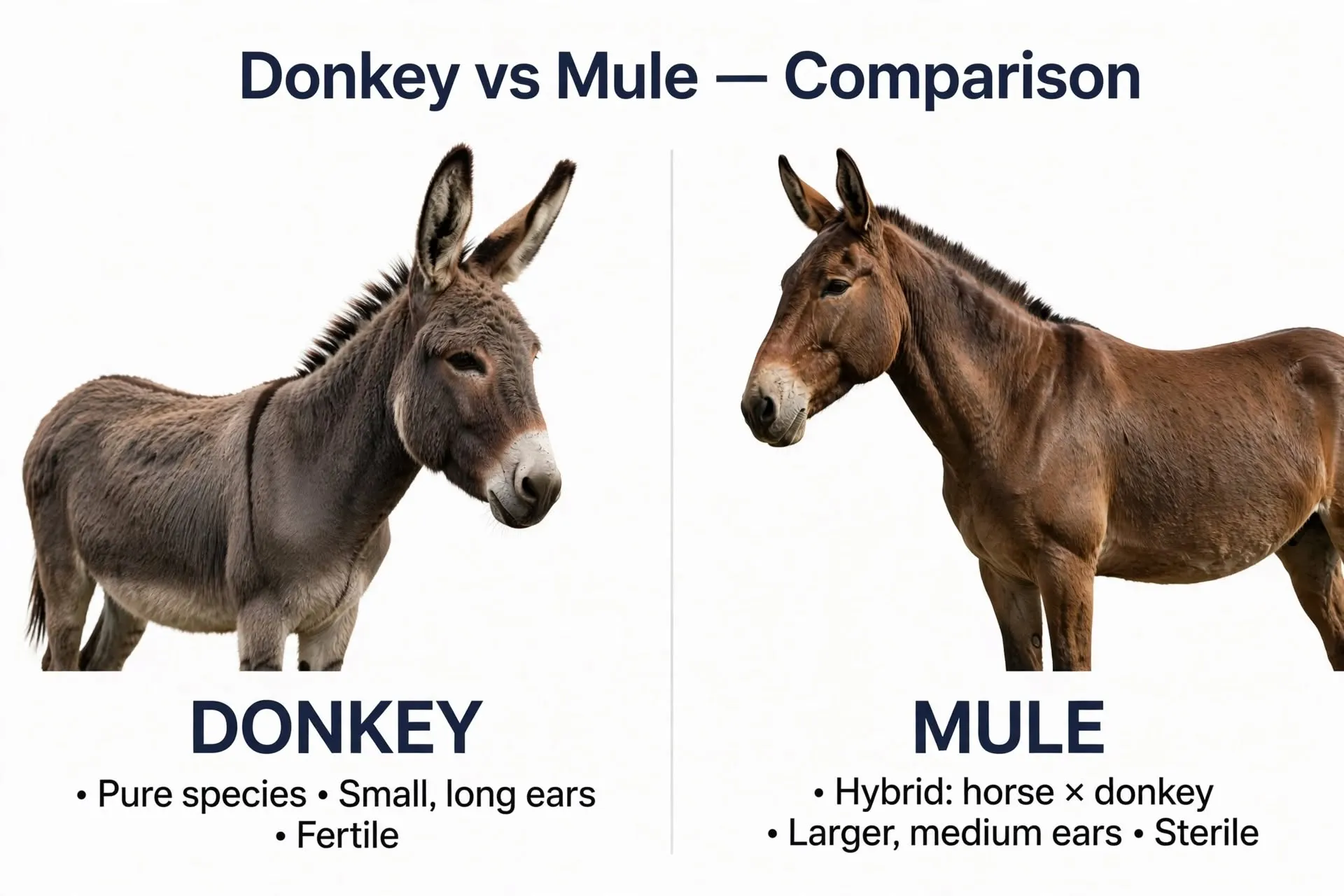
A donkey is an animal. A mule is born from a male donkey and a female horse.
Imagine you visit a farm. You see two animals with long ears and strong legs. They look alike. But one may be a donkey, and the other may be a mule.
Many people mix up these two animals. They search for donkey or mule to learn how to tell them apart.
Both animals help people carry loads. They can walk on rough land. They also need food, water, and good care.
A donkey has long ears and a strong body. It is often careful and alert. A mule gets traits from both a donkey and a horse. It is often strong and good at carrying loads.
In this guide, you will learn the key facts about both animals. You will see how they look, act, and differ. You will also learn about their food, history, and use on farms.
Pronunciation of Donkey and Mule
Both words have the same spelling in US and UK English.
| Word | US Sound | UK Sound |
|---|---|---|
| Donkey | DON-kee | DON-kee |
| Mule | MYOOL | MYOOL |
The first sound in donkey may change a little by accent. The word mule sounds much the same in both places.
Now, let’s see how these animals differ.
Also read more about:https://syntexra.com/accepting-or-excepting/
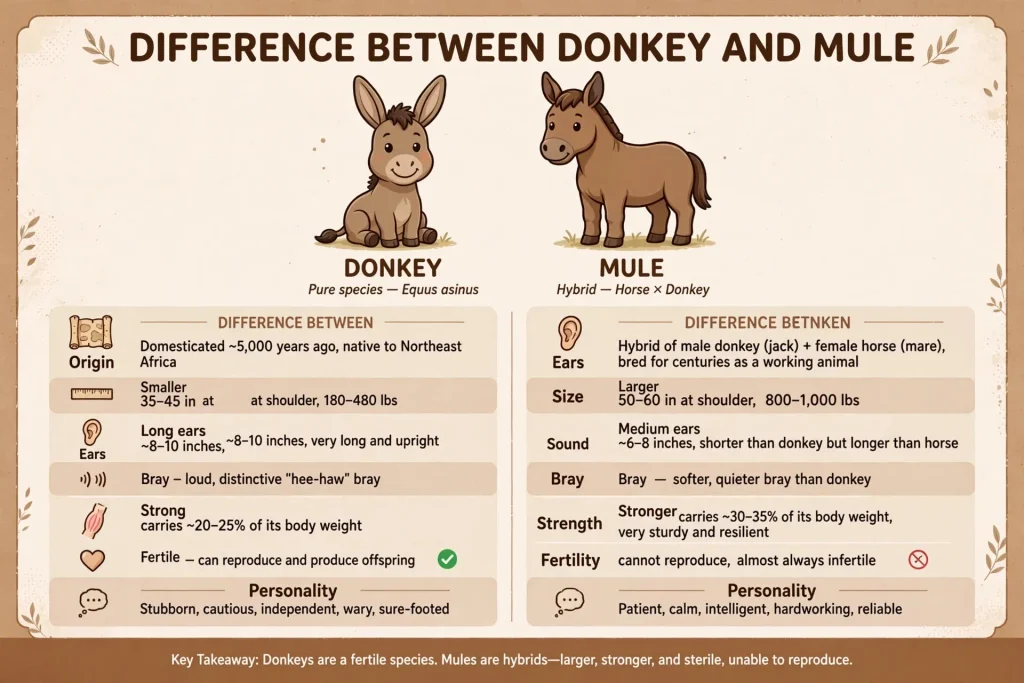
Difference Between Donkey and Mule
1. Birth
A donkey is its own kind of animal. A mule has a donkey father and a horse mother.
- Example 1: A donkey can have a baby donkey.
- Example 2: A mule is born from a donkey and a horse.
2. Body Shape
Donkeys often have short, strong bodies. Mules may be taller and look more like horses.
- Example 1: A small donkey stands by a fence.
- Example 2: A tall mule walks on a hill path.
3. Ears
Donkeys often have very long ears. Mules may have shorter ears.
- Example 1: The donkey moves its long ears.
- Example 2: The mule stands near a gate.
4. Nature
Donkeys can be careful. Mules can be calm and smart. Each animal is different.
- Example 1: A donkey stops when it feels unsafe.
- Example 2: A trained mule walks on a rocky path.
5. Strength
Both animals are strong. Mules are often used to carry heavy loads.
- Example 1: A donkey carries a small bag.
- Example 2: A mule carries bags up a hill.
6. Babies
Donkeys can have young. Most mules cannot have babies.
- Example 1: Two donkeys may have a baby.
- Example 2: A mule will not usually have young.
7. Sounds
Donkeys make a loud sound called a bray. Mules may bray or make sounds like horses.
- Example 1: The donkey brays in the field.
- Example 2: The mule calls out near the barn.
8. Food
Both animals eat grass and hay. They also need clean water.
- Example 1: The donkey eats hay.
- Example 2: The mule eats grass.
9. Life Span
Both animals can live for many years. Good food and care help them stay well.
- Example 1: A donkey lives on a farm for many years.
- Example 2: A mule works for years with good care.
10. Work
Donkeys help on farms. Mules often carry loads and help people on rough paths.
- Example 1: A donkey carries farm tools.
- Example 2: A mule carries bags on a trail.
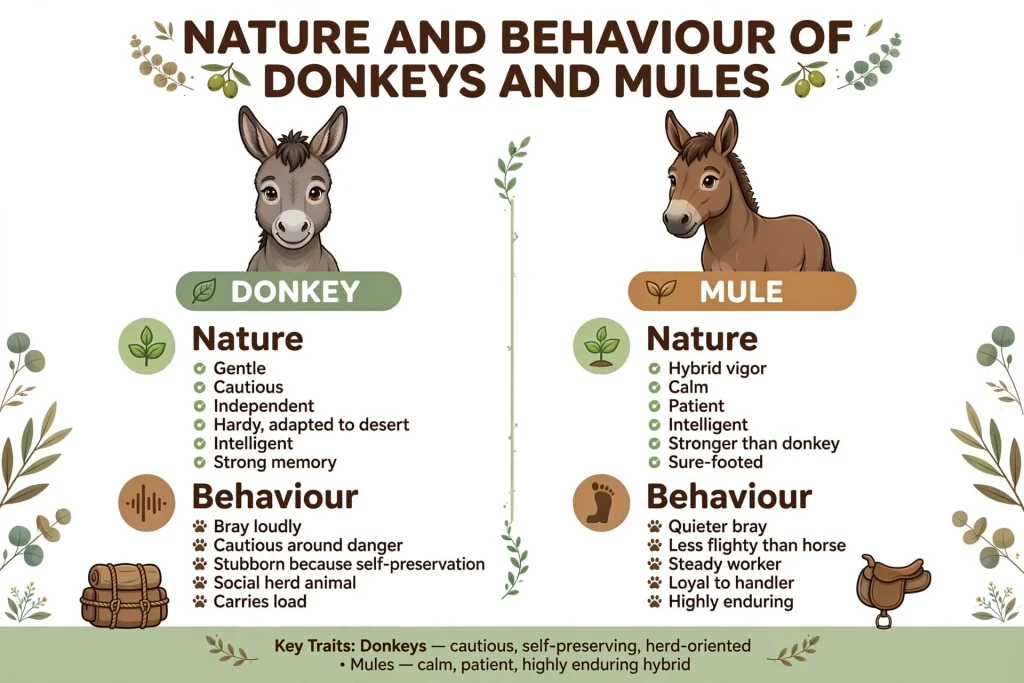
Nature and Behaviour of Donkeys and Mules
Donkey Behaviour
Donkeys are alert and careful. They may stop when they feel scared. This can look like stubbornness, but the donkey may be checking for danger.
Donkeys can bond with people and other animals. They need food, water, shelter, and space to move.
Mule Behaviour
Mules can be smart and strong. Many can walk well on rough ground. They can learn tasks with kind and calm training.
A mule may stop if it feels unsafe. Good care and training help it feel safe.
Why People Get Confused About Donkeys and Mules
Donkeys and mules can look alike. Both may have long ears and strong legs. Their coats can also be the same color.
But they are not the same animal.
A donkey is its own kind of animal. A mule is born from a male donkey and a female horse.
Some people think a mule is just a big donkey. This is not true.
The key fact is simple: a donkey is a species, but a mule is a hybrid.
Comparison Table
| Feature | Donkey | Mule |
|---|---|---|
| Birth | A donkey species | Donkey father, horse mother |
| Ears | Often very long | Often shorter |
| Body | Often short and strong | Often taller |
| Nature | Careful and alert | Often calm and smart |
| Strength | Strong for its size | Often strong for its size |
| Babies | Can have young | Most cannot have young |
| Sound | Bray | Bray or horse-like call |
| Food | Grass and hay | Grass and hay |
| Work | Farm work and loads | Riding and carrying loads |
| Life | Can live for many years | Can live for many years |
Both animals need good care. Both can help people with farm work.
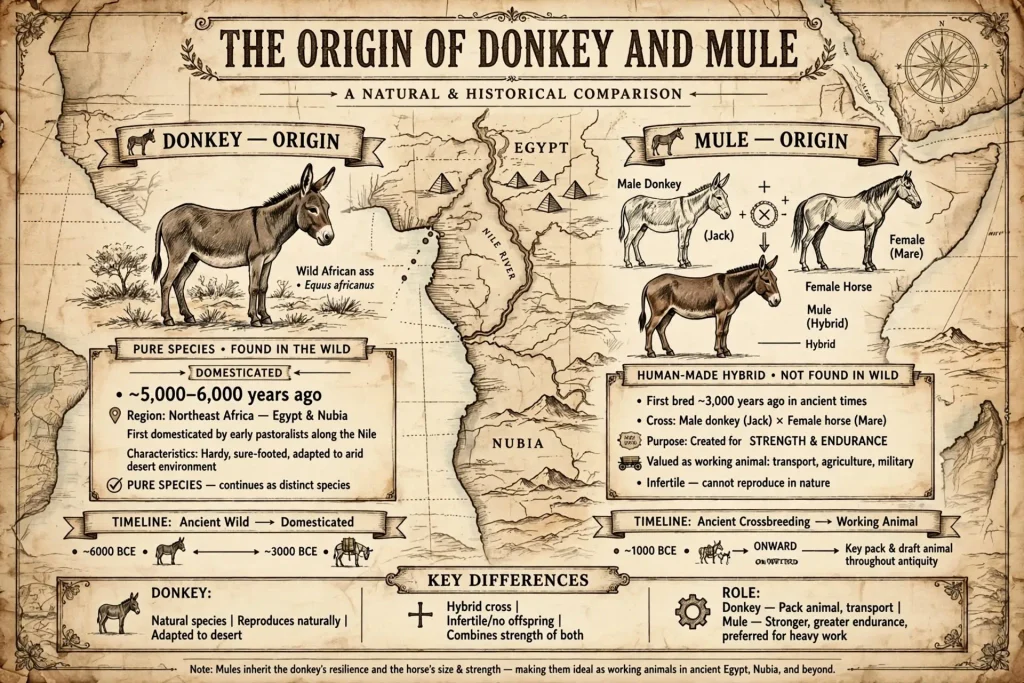
The Origin of Donkey and Mule
The Origin of Donkeys
Donkeys have helped people for thousands of years. They came from the African wild ass.
People used donkeys to carry goods and help on farms. They could walk on land where large animals had trouble moving.
Donkeys became common in many parts of the world.
The Origin of Mules
People have used mules for a very long time. They bred horses and donkeys to get useful traits from both animals.
Mules helped carry bags, pull carts, and move goods. They were useful on farms and rough paths.
Both animals played a big part in human life.
British vs American English
The words donkey and mule are the same in US and UK English. Their spelling does not change.
| Point | US English | UK English |
|---|---|---|
| Spelling | Donkey | Donkey |
| Spelling | Mule | Mule |
| Meaning | Same | Same |
| Example | The donkey eats hay. | The donkey eats hay. |
| Example | The mule walks fast. | The mule walks fast. |
The sound of donkey may change by accent. But the word stays the same.
Use donkey for a donkey. Use mule for a donkey-horse hybrid.
Which One Should You Use?
Use the word that names the right animal.
- In the US: Write donkey or mule.
- In the UK: Use the same words.
- For global readers: Explain what a mule is.
- For schoolwork: Say that a mule has a donkey father and a horse mother.
- For farm work: Use the right name when you talk about care or breeding.
Common Mistakes
Here are some common mistakes and the right facts.
- Mistake: A mule is a big donkey.
Correct: A mule is a mix of a donkey and a horse. - Mistake: All mules can have babies.
Correct: Most mules cannot have young. - Mistake: All donkeys are stubborn.
Correct: A donkey may stop because it feels unsafe. - Mistake: Donkeys and mules eat very different foods.
Correct: Both can eat grass and hay. - Mistake: All mules look like horses.
Correct: Mules can look like both parent animals. - Mistake: The words change in UK English.
Correct: Both words have the same spelling in the UK and US.
Everyday Usage Examples
We use these words in daily life, school, and work.
In Emails
“Hello, we have a donkey and a mule on our farm. Can you share tips on their care?”
On Social Media
“Can you tell which animal is the donkey and which is the mule?”
In News
“Farmers use donkeys and mules to carry goods.”
In Formal Writing
“A donkey is an animal species. A mule is born from a male donkey and a female horse.”
These short lines help people learn the right use of each word.
Usage Trends
People around the world use the words donkey and mule.
The word donkey often appears in searches about farm care, food, and animal facts. The word mule often appears in searches about riding, work, and animal types.
Both animals also appear in books, films, and jokes. People may use these words to talk about hard work or stubborn acts.
Search trends can change over time. Farmers may search for care tips. Students may search for facts about animals.
Metaphors and Similes
A metaphor says one thing is another. A simile uses words like as or like to compare two things.
Donkey
- Metaphor: “He is a donkey.” This can mean he acts in a silly way.
- Simile: “She is as strong as a donkey.” This means she is very strong.
- Metaphor: “The donkey is the heart of the farm.” This means the animal is very useful.
Mule
- Metaphor: “He is a mule at work.” This means he works very hard.
- Simile: “She is as steady as a mule.” This means she stays calm.
- Metaphor: “The mule is a hill worker.” This shows its role in carrying loads.
Connotative Meaning
Words can have feelings linked to them. These feelings may be good, bad, or neutral.
Positive Meaning
A donkey can stand for hard work and strength.
Example: “The donkey worked all day.”
A mule can stand for trust and strength.
Example: “The mule helped carry the bags.”
Negative Meaning
People may use donkey to call someone foolish.
Example: “He called his friend a donkey.”
People may use stubborn as a mule for someone who will not change their mind.
Example: “He was stubborn as a mule.”
Neutral Meaning
The words can simply name animals.
- “The donkey eats grass.”
- “The mule stands by the gate.”
Idioms and Proverbs
Some common English phrases use these animal names.
Stubborn as a Mule
This means a person will not change their mind.
Example: “He was stubborn as a mule.”
Donkey’s Years
In British English, this means a very long time.
Example: “I have not seen her for donkey’s years.”
Work Like a Mule
This means to work very hard.
Example: “She worked like a mule all day.”
Make an Ass of Yourself
This means to act in a way that makes you look foolish.
Example: “He made an ass of himself at the party.”
These phrases are common in daily speech. Some may sound rude, so use them with care.
Literature and Movies
Donkeys appear in books and films. They often show kindness, hard work, and friendship.
Literature
Platero and I (1914)
- Writer: Juan Ramón Jiménez
- Type: Prose poetry
This book tells stories about a gentle donkey named Platero. It shares ideas about nature and friendship.
Movies
Shrek (2001)
- Country: United States
- Type: Animated comedy
Donkey is a funny and loyal character. He helps Shrek during his journey.
Au Hasard Balthazar (1966)
- Country: France
- Type: Drama
This film tells the story of a donkey. It shows both kindness and cruelty in human life.
These books and films help people learn how animals are shown in stories.
Why This Difference Matters
Knowing the difference between a donkey and a mule helps people use the right words.
It is useful for students, farmers, and animal lovers. It also helps people learn about animal care.
Donkeys and mules may need different care based on their health, size, and work. Knowing the animal can help you ask a vet the right questions.
The difference also matters in science. A donkey is a species. A mule is a hybrid. Most mules cannot have young.
Using the right words also makes writing clear. Readers can tell which animal you mean.
Usefulness in Daily Life
Knowing these animals can help in many ways.
- On a farm: Learn how to care for each animal.
- At a zoo: Know which animal you see.
- At school: Explain the key facts.
- At a vet: Give the right details about an animal.
- While reading: Understand stories about donkeys and mules.
- While traveling: Learn about animals used to carry loads.
- In writing: Use the right word in a report or email.
For example, a student may need to explain what a mule is. A farmer may need to tell a vet which animal is sick.
Situational Preference
Neither animal is best for every job. The right choice depends on the task and the animal’s health and training. A donkey may suit a small farm or serve as a companion. A mule may suit riding or carrying bags on rough paths. But not every animal can do every task. Think about its size, needs, and skills. Ask an animal expert before you choose one for farm work or riding. Good food, safe shelter, and kind care matter for both animals.
Possible Questions
1. What is the main difference between a donkey and a mule?
A donkey is its own kind of animal. A mule is born from a male donkey and a female horse.
2. Is a mule a donkey or a horse?
A mule is not a pure donkey or a pure horse. It has traits from both.
3. Can a mule have babies?
Most mules cannot have babies. Very rare cases of female mules giving birth have been reported.
4. Which is stronger, a donkey or a mule?
Mules are often strong for their size. But strength depends on the animal and its training.
5. Are donkeys more stubborn than mules?
Not always. Both can be careful and firm. Their behavior depends on the animal and the situation.
6. Do donkeys and mules eat the same food?
Both can eat grass and hay. They also need clean water and good care.
7. How can you tell a donkey from a mule?
Donkeys often have longer ears and shorter bodies. Mules may look more like horses. Parentage is the best way to tell.
Conclusion
Donkeys and mules may look alike, but they are different. A donkey is an animal, while a mule is born from a male donkey and a female horse.
Donkeys often have long ears. Mules may look more like horses. Both can carry loads and help on farms. Donkeys can have young, but most mules cannot.
Both animals need food, water, shelter, and care. The key difference is simple: a donkey is an animal species, while a mule is a hybrid.

Eman Sarfraz is a professional content writer, researcher, and English language specialist with strong expertise in English grammar, vocabulary, word meanings, synonyms, and antonyms. I creates well-researched, accurate, and easy-to-understand content that helps readers master English concepts and communicate with greater confidence.