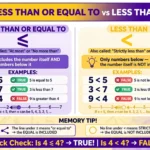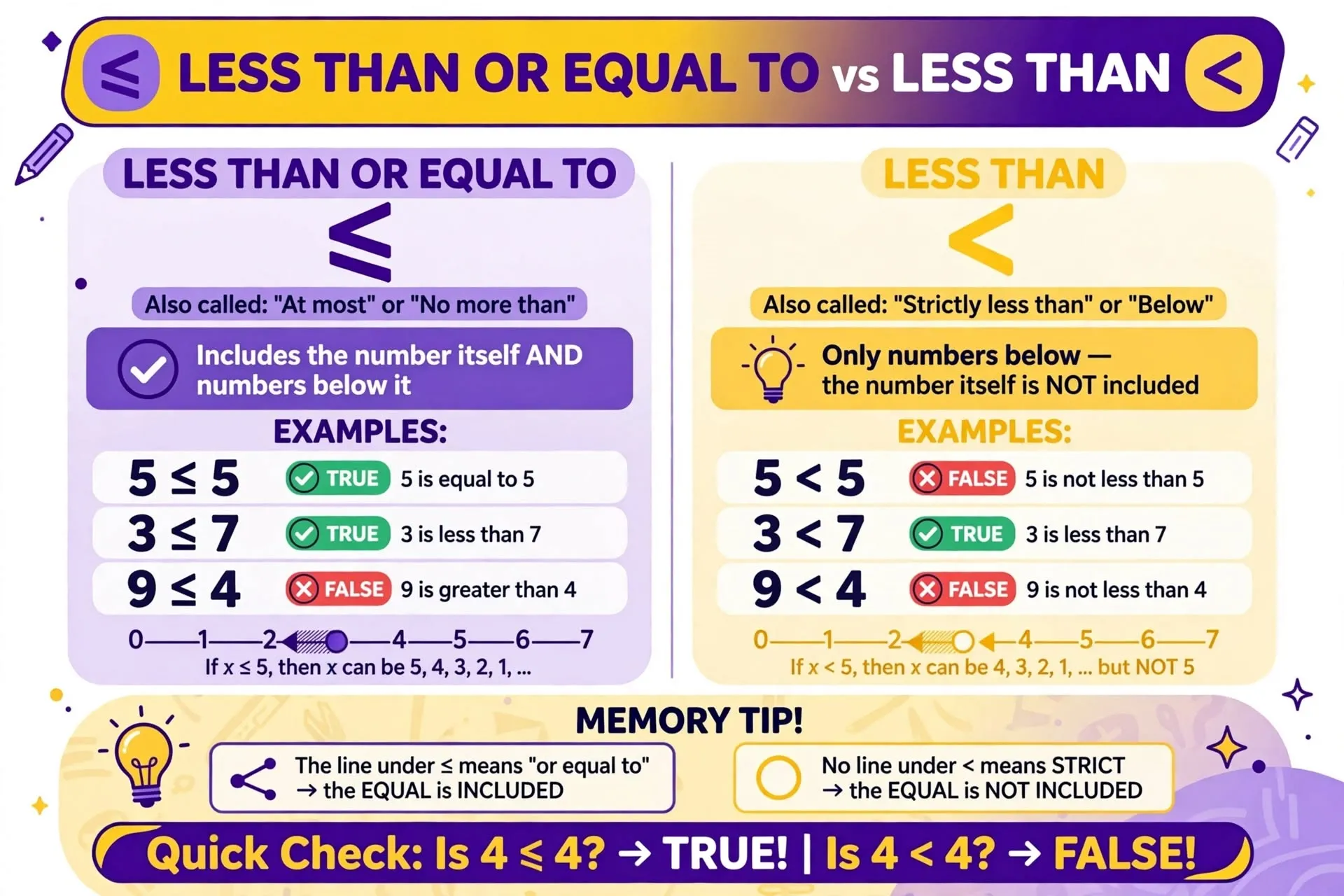
Less than means a number is smaller than another number. Less than or equal to means a number is smaller or the same.
Think about a test score. You need 50 points to pass. If you get 40 points, your score is less than 50. If you get 50 points, it is equal to 50. This small change can affect the answer.
People often search for “less than or” when they learn math or read number rules. They may want to know which sign to use. The phrase “less than or” is often part of “less than or equal to.” These words help us compare numbers.
The less than sign is <. The less than or equal to sign is ≤. Both signs point to the larger number. The open side faces the larger number.
Learning these signs can help with school, work, and daily life. You can use them to compare prices, ages, scores, and many other things.
Pronunciation
- Less than
- US: /lɛs ðæn/
- UK: /lɛs ðæn/
- Less than or equal to
- US: /lɛs ðæn ɔːr ˈiːkwəl tuː/
- UK: /lɛs ðæn ɔː ˈiːkwəl tuː/
Also read more about:https://syntexra.com/accepting-or-excepting/
Difference Between Less Than and Less Than or Equal To
1. Meaning
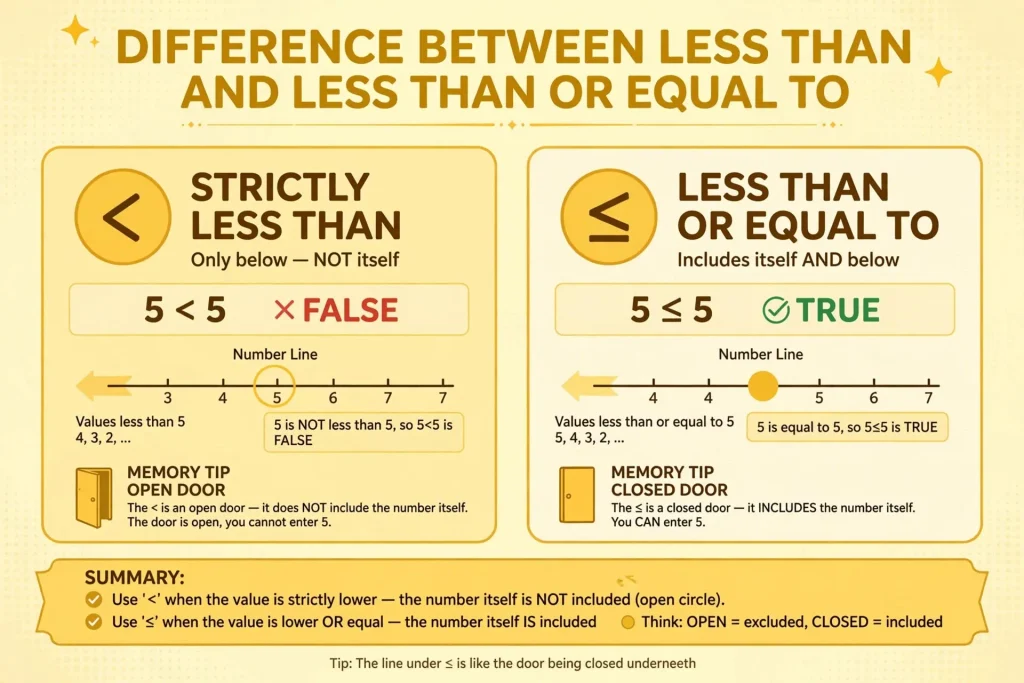
Less than means one number is smaller.
- Example 1: 3 < 5
- Example 2: 8 < 10
Less than or equal to means a number is smaller or the same.
- Example 1: 3 ≤ 5
- Example 2: 5 ≤ 5
2. Math Sign
Less than uses the sign <.
- Example 1: 2 < 4
- Example 2: 6 < 9
Less than or equal to uses ≤.
- Example 1: 2 ≤ 4
- Example 2: 4 ≤ 4
3. Can the Numbers Be the Same?
With less than, the numbers cannot be the same.
- Example 1: 4 < 7 is true.
- Example 2: 4 < 4 is false.
With less than or equal to, the numbers can be the same.
- Example 1: 4 ≤ 7 is true.
- Example 2: 4 ≤ 4 is true.
4. Use in Math
Use less than when the number must be smaller.
- Example 1: x < 10
- Example 2: y < 20
Use less than or equal to when the number can also match the limit.
- Example 1: x ≤ 10
- Example 2: y ≤ 20
5. Number Lines
Less than does not include the limit number.
- Example 1: x < 5
- Example 2: x < 10
Less than or equal to includes the limit number.
- Example 1: x ≤ 5
- Example 2: x ≤ 10
6. Use in Rules
A rule with less than sets a limit that cannot be reached.
- Example 1: Age must be less than 18.
- Example 2: The cost must be less than $20.
A rule with less than or equal to lets you reach the limit.
- Example 1: Age must be 18 or less.
- Example 2: The cost must be $20 or less.
7. Use in School
A teacher may use less than to compare scores.
- Example 1: 40 < 60
- Example 2: 70 < 90
A teacher may use less than or equal to to set a score limit.
- Example 1: A score of 50 or less.
- Example 2: A score of 80 or less.
8. Use with Money
Less than means the price must be lower.
- Example 1: The toy costs less than $5.
- Example 2: The book costs less than $10.
Less than or equal to means the price can match the limit.
- Example 1: Spend $5 or less.
- Example 2: Spend $10 or less.
9. Use in Computer Code
The sign < checks if one value is smaller.
- Example 1:
age < 18 - Example 2:
score < 100
The sign <= checks if one value is smaller or the same.
- Example 1:
age <= 18 - Example 2:
score <= 100
10. The Main Difference
Less than leaves out the same number.
- Example 1: 6 < 6 is false.
- Example 2: 9 < 10 is true.
Less than or equal to allows the same number.
- Example 1: 6 ≤ 6 is true.
- Example 2: 9 ≤ 10 is true.
Nature and Behaviour of Less Than and Less Than or Equal To
Less Than
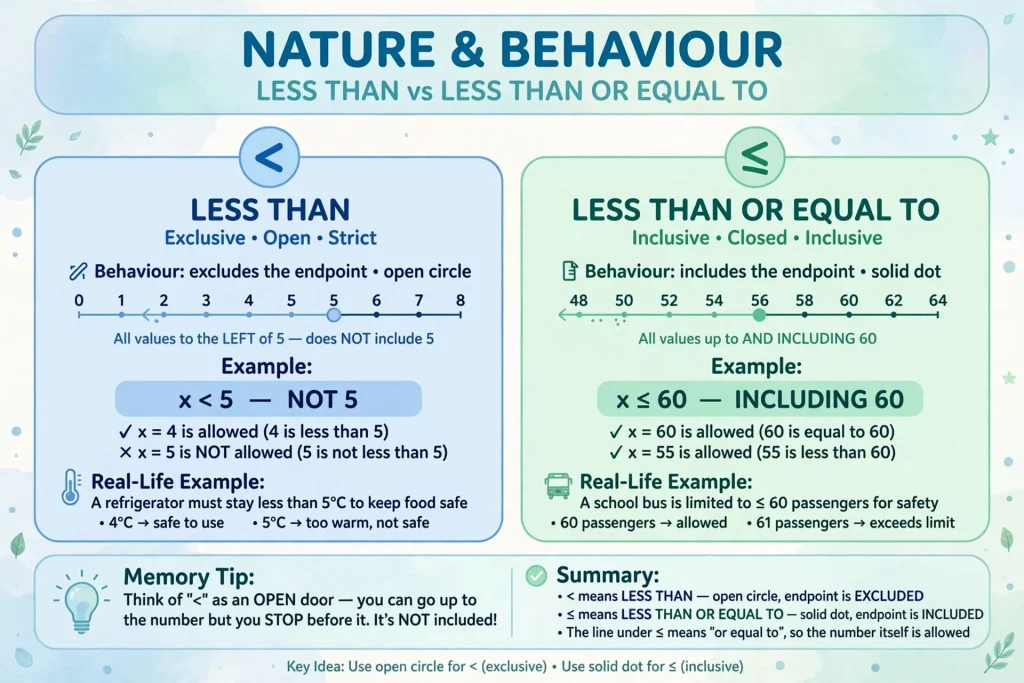
The sign < compares two values. It is true when the left number is smaller than the right number.
For example, 2 < 7 is true. But 7 < 2 is false.
Less Than or Equal To
The sign ≤ allows two results. The left number can be smaller than the right number. It can also be the same.
For example, 2 ≤ 7 is true. Also, 7 ≤ 7 is true.
Why People Get Confused About Less Than or Equal To
People often see the words “less than or” and stop there. The full phrase is usually “less than or equal to.”
The two signs also look alike. The sign < does not include the same number. The sign ≤ does.
A simple tip can help. If the rule allows the limit itself, use ≤. If the number must be smaller than the limit, use <.
Comparison Table
| Feature | Less Than (<) | Less Than or Equal To (≤) |
|---|---|---|
| Meaning | Smaller than | Smaller or the same |
| Sign | < | ≤ |
| Same number allowed? | No | Yes |
| Example | 3 < 5 | 3 ≤ 5 |
| Limit included? | No | Yes |
| Common use | A strict limit | A limit that can be reached |
| Code form | < | <= |
Both signs compare values. The main difference is whether the limit number is allowed.
The Origin of the Keyword
The words “less than” come from everyday English. They tell us that one thing has a smaller amount than another.
Math signs made this idea shorter. The sign < became a common way to show “less than.” The sign ≤ adds a line to show “or equal to.”
The signs are used in school, science, money rules, and computer code. They help people write number rules in a short and clear way.
British vs American English
There is no major difference between British and American English for these math terms. Both use the same words and signs.
| Use | British English | American English |
|---|---|---|
| Less than | 3 < 5 | 3 < 5 |
| Less than or equal to | 3 ≤ 5 | 3 ≤ 5 |
| Spoken form | Less than or equal to | Less than or equal to |
Examples:
- UK: The cost must be less than £10.
- US: The cost must be less than $10.
- UK: The age must be 18 or less.
- US: The age must be 18 or less.
The money signs may change. The math rules do not.
Which One Should You Use?
Use less than (<) when the number must be smaller than the limit.
Example: A child must be under 12 years old.
Use less than or equal to (≤) when the number can match the limit.
Example: A child can be 12 years old or younger.
In the US, UK, and other places, these signs have the same meaning. In school work, use the sign your question asks for. In daily writing, words such as “under,” “at most,” and “or less” may make the rule easier to read.
Common Mistakes
Here are some common errors and their fixes.
- Wrong: 5 < 5 is true.
- Right: 5 < 5 is false.
- Wrong: 5 ≤ 5 is false.
- Right: 5 ≤ 5 is true.
- Wrong: “Less than or” is always a full phrase.
- Right: The full math phrase is often “less than or equal to.”
- Wrong: The open side points to the smaller number.
- Right: The open side faces the larger number.
- Wrong: “At most 10” means less than 10 only.
- Right: “At most 10” includes 10.
Everyday Usage Examples
In Emails
- “Please keep the cost below $50.”
- “The file must be 10 MB or less.”
On Social Media
- “I need a score of 80 or less.”
- “Keep the video under one minute.”
In News
- “The town has fewer than 1,000 people.”
- “The plan is for people aged 18 or younger.”
In Formal Writing
- “The value must be less than 100.”
- “The result must be less than or equal to 100.”
These examples show how number limits work in daily life.
Usage Trends
The signs < and ≤ are used around the world. They appear in math books, school tests, science work, and computer code.
People may write the words instead of the signs when they want a rule to be easy to read. For example, “10 or less” may be clearer in a short note than “x ≤ 10.”
Both signs remain useful because they make number rules short and clear.
Metaphors and Similes
These math terms can also help explain ideas in simple ways.
- “Less than the goal” means you did not reach the goal.
- “At most 10” means 10 is the top limit.
- “Under the line” can mean below a set level.
- “The limit is a fence” means you must not go past it.
Connotative Meaning
The words can have different feelings based on the sentence.
Positive Meaning
“Your wait was less than five minutes.”
This sounds good because the wait was short.
Negative Meaning
“Your score was less than the goal.”
This may sound bad because the goal was not reached.
Neutral Meaning
“The number is less than 10.”
This is a plain fact. It does not show good or bad feelings.
The signs themselves are neutral. The rest of the sentence gives them a feeling.
Idioms and Proverbs
There are no common idioms built around the exact math sign ≤. But some common phrases share the same idea.
- At most: “You can bring at most five bags.” Five bags are allowed.
- No more than: “The trip will take no more than two hours.” Two hours is the limit.
- Under the limit: “The cost stayed under the limit.” The cost did not reach the limit.
- A little goes a long way: “A little practice goes a long way.” A small amount can still help a lot.
Literature and Movies
Math signs often appear in books and films about school, science, and problem-solving.
Literature
- The Number Devil by Hans Magnus Enzensberger, published in 1997, is a book about math ideas.
- Flatland by Edwin A. Abbott, published in 1884, uses shapes and space to explore ideas about math and society.
These books help readers think about numbers and shapes. They do not focus only on the signs < and ≤.
Movies
- Hidden Figures (2016, United States) tells the story of Black women mathematicians who worked at NASA.
- The Man Who Knew Infinity (2015, United Kingdom) tells the story of Indian math expert Srinivasa Ramanujan.
These films show how math can shape real lives and big events.
Why This Difference Matters
Knowing the difference helps you solve math questions. It also helps you read rules the right way.
If a rule says “less than 10,” the number 10 is not allowed. If it says “10 or less,” the number 10 is allowed.
This small detail can matter in school tests, price limits, age rules, and computer programs. A wrong sign can change the meaning of a whole rule.
Usefulness in Daily Life
You may use these ideas more often than you think.
- Shopping: Spend $20 or less.
- School: Get a score below 50.
- Travel: Keep your bag under 10 kg.
- Age rules: The age limit is 18 or younger.
- Computer use: Check if a score is below a set value.
Situational Preference
Choose less than (<) when the limit must not be reached. For example, a contest may ask for a video that is less than one minute long. A video that lasts one full minute may not fit the rule.
Choose less than or equal to (≤) when the limit is allowed. For example, a bag may weigh 10 kg or less. A bag that weighs exactly 10 kg is fine.
In school, read the question with care. In daily life, words like “under,” “at most,” and “or less” can help. Always check if the rule allows the exact limit.
Possible QUESTIONS
1. What does less than mean?
It means one number is smaller than another. For example, 2 < 5.
2. What does less than or equal to mean?
It means a number is smaller than or the same as another number. For example, 5 ≤ 5.
3. What is the sign for less than?
The sign is <.
4. What is the sign for less than or equal to?
The sign is ≤. In computer code, it is often written as <=.
5. Is 5 less than 5?
No. The numbers are the same, so 5 < 5 is false.
6. Is 5 less than or equal to 5?
Yes. The numbers are the same, so 5 ≤ 5 is true.
7. Does “10 or less” include 10?
Yes. It means 10 or any number below 10.
Conclusion
Less than (<) means a number is smaller. For example, 3 < 5. The numbers cannot be the same.
Less than or equal to (≤) means a number is smaller or the same. For example, 3 ≤ 5 and 5 ≤ 5.
You can use these signs in math, school, and daily life. Remember: < means smaller, while ≤ means smaller or the same.

Eman Sarfraz is a professional content writer, researcher, and English language specialist with strong expertise in English grammar, vocabulary, word meanings, synonyms, and antonyms. I creates well-researched, accurate, and easy-to-understand content that helps readers master English concepts and communicate with greater confidence.