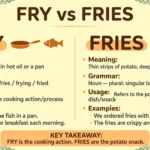
“Fry” is the correct English word for cooking food in hot oil. “Frie” is not a standard English word.
Have you ever typed a word and wondered if it looked right? You may want to write, “I will fry some eggs,” but then stop and ask, “Is it frie or fry?” This is a common spelling question for English learners.
The correct word is fry. It means to cook food in hot oil or fat. It can also mean to become very hot, as in “The sun will fry us today.” The word can be used as a verb or a noun in some cases.
The spelling frie may look right because English has many words that do not follow simple spelling rules. For example, words like “tie” and “lie” end in “ie.” But the correct spelling is “fry,” not “frie.”
Knowing the difference helps you write clear emails, schoolwork, recipes, and social media posts. It also helps you avoid common spelling errors. In this guide, you will learn how to use “fry” and why “frie” is usually incorrect.
Pronunciation of Frie and Fry
How to Say “Fry”
- US English: /fraɪ/
- UK English: /fraɪ/
- Sound it out: “fry,” like “try” with an “f.”
How to Say “Frie”
“Frie” is not a standard English word, so it has no usual pronunciation. If someone uses it by mistake, they may mean “fry.”
Now, let’s look at the key differences and learn how to use the correct spelling.
also read more about:https://syntexra.com/peeta-or-gale/
Difference Between Frie and Fry
1. Correct Spelling
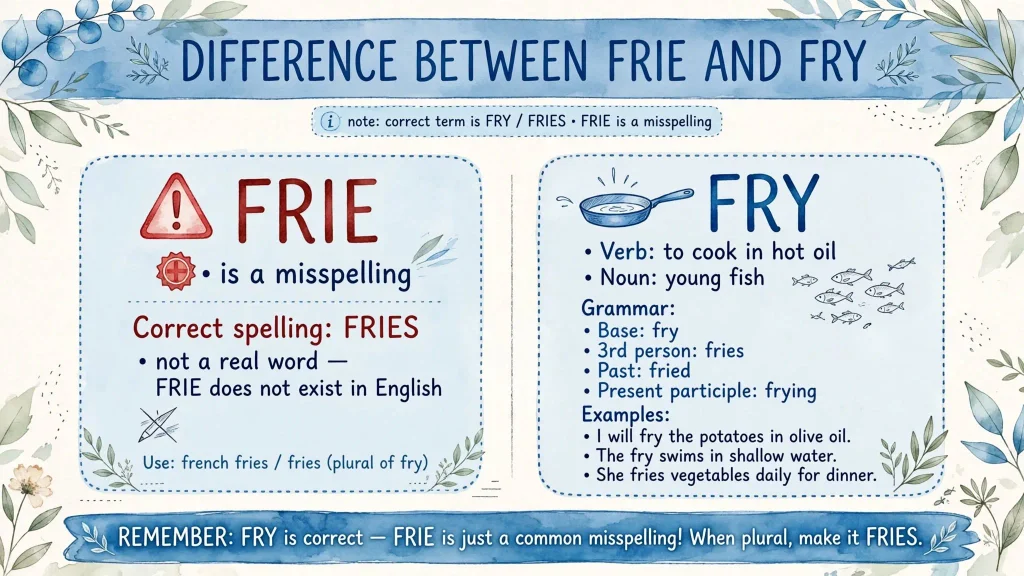
“Fry” is the correct spelling. “Frie” is usually a spelling mistake.
- Correct: I will fry the eggs.
- Incorrect: I will frie the eggs.
2. Meaning
“Fry” means to cook food in hot oil or fat. “Frie” has no common meaning in standard English.
- Correct: We fry fish for dinner.
- Incorrect: We frie fish for dinner.
3. Use as a Verb
“Fry” is a verb when it tells us how food is cooked.
- I fry an egg each morning.
- They fry potatoes for lunch.
4. Use as a Noun
“Fry” can also mean a young fish. The word is used in this way in fishing and nature writing.
- The pond is full of young fry.
- The fish fry swim near the plants.
5. Use in Recipes
Recipes use “fry” to explain a cooking step.
- Fry the onions until soft.
- Fry the chicken in hot oil.
6. Use in Everyday Speech
People use “fry” when they talk about cooking.
- I will fry some bacon.
- Dad can fry the fish.
7. Use in Informal Speech
“Fry” can also describe strong heat in a casual way.
- The hot sun will fry us.
- I felt like I would fry in that room.
These are informal uses. They do not mean that a person is being cooked.
8. Use in Schoolwork
Use “fry” in essays, homework, and tests.
- The chef will fry the food.
- The fish fry need clean water.
Do not use “frie” unless it is part of a proper name or a special term.
9. Use in Online Writing
The correct spelling matters in posts, messages, and comments.
- I love to fry fresh fish.
- These fries taste great.
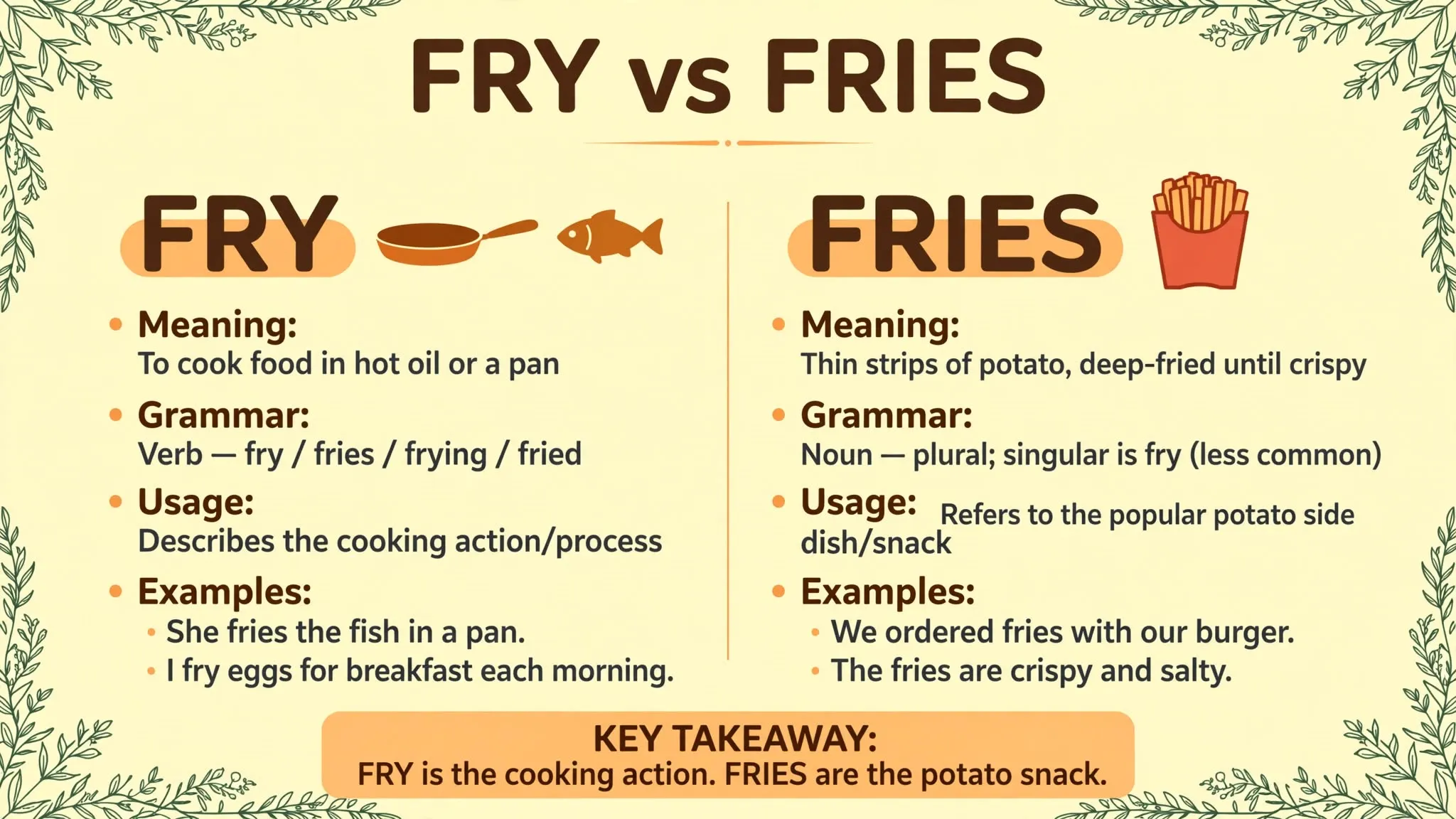
“Fries” is the plural form often used for fried strips of potato.
10. Use in Formal Writing
In formal writing, always use “fry” when you mean cooking food.
- The cook will fry the vegetables.
- The fish fry were seen near the shore.
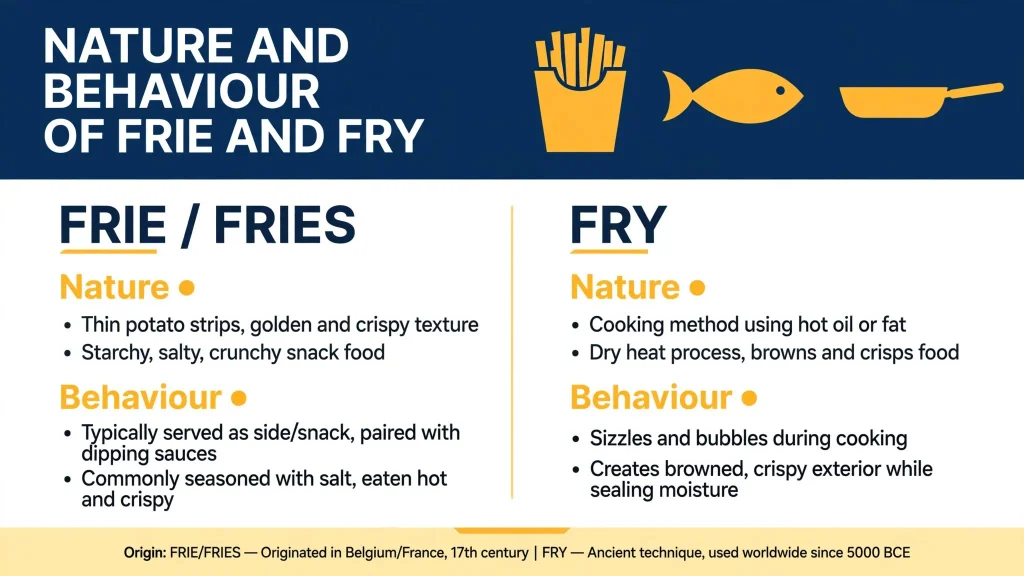
Nature and Behaviour of Frie and Fry
Fry in Nature
In nature, fry means young fish. These small fish often live in water near plants or other safe places. They may feed on tiny plants and animals. Their needs depend on the type of fish.
Example: “The lake is home to many young fry.”
Fry in Cooking
As a cooking word, “fry” describes food cooked in hot oil or fat. People fry eggs, fish, meat, and vegetables. The food may become crisp or brown.
Example: “We fry potatoes in a pan.”
What About Frie?
“Frie” does not have a common role in nature or cooking. In most cases, it is simply a misspelling of “fry.”
Why People Get Confused About Frie and Fry
People often confuse these words because English spelling can be hard to learn. Some words end in “ie,” such as “tie” and “lie.” This may lead people to write “frie.”
But “fry” follows a different spelling pattern. The letter “y” makes the same sound as the “y” in “try” and “dry.”
A simple way to remember it is this: fry rhymes with try. Both words end in “y.”
Comparison Table
| Feature | Frie | Fry |
|---|---|---|
| Correct spelling | Usually incorrect | Correct |
| Common meaning | No standard meaning | Cook in hot oil |
| Verb | No common use | Yes |
| Noun | No common use | Can mean young fish |
| Used in recipes | No | Yes |
| Used in daily speech | Usually a mistake | Yes |
| Formal writing | Avoid it | Use it when correct |
| Example | Frie the egg | Fry the egg |
The Origin of the Word
The word fry comes from older forms of English and French. It has long been used to describe cooking food in hot fat or oil.
The noun “fry,” meaning young fish, has a separate history in English. It is linked to the idea of small or young fish.
The spelling “frie” is not the standard spelling of the cooking word. People may type it because they are unsure of the spelling or because they follow the pattern of other words.
British vs American English
There is no spelling difference between British and American English for “fry.” Both use the same spelling.
| Use | British English | American English |
|---|---|---|
| Correct spelling | Fry | Fry |
| Past tense | Fried | Fried |
| Present action | Frying | Frying |
| Food example | Fried fish | Fried fish |
| Potato dish | Chips or fries, depending on context | French fries |
Examples:
- British English: I will fry an egg for breakfast.
- American English: I will fry an egg for breakfast.
The word “frie” is not the standard form in either variety.
Which One Should You Use?
Use fry in the US, the UK, Canada, Australia, and other English-speaking places. The spelling does not change by country.
Use “fry” in recipes, such as “Fry the onions.” It can also mean young fish. For potato strips, use “fries” in the US and “chips” in the UK. “French fries” is common in the US, while “chips” often means the same food in the UK.
Avoid “frie” in schoolwork, emails, reports, and online posts. If you are unsure, remember that “fry” rhymes with “try.”
Common Mistakes
Here are common errors and their correct forms.
- Wrong: Frie the egg.
Right: Fry the egg. - Wrong: I like to frie fish.
Right: I like to fry fish. - Wrong: She will frie the potatoes.
Right: She will fry the potatoes. - Wrong: The food is frieing.
Right: The food is frying. - Wrong: I frieed the chicken.
Right: I fried the chicken.
Remember these forms:
- Present: fry
- Past: fried
- Present action: frying
- Food: fries
Everyday Usage Examples
In Emails
“Please fry the fish before the guests arrive.”
On Social Media
“Time to fry some eggs for breakfast!”
In News
“The restaurant plans to fry fresh fish for its weekend menu.”
In Formal Writing
“The sample was placed in a pan and fried in oil until it was cooked.”
In Nature Writing
“The young fry stayed close to the plants in the pond.”
Usage Trends
“Fry” is a common English word. People use it in recipes, cooking shows, food blogs, and daily talks. It is also used in nature writing when people discuss young fish.
“Frie” is not a standard spelling. It may appear in online searches, messages, or posts when someone makes a spelling mistake. People may search for “frie or fry” because they want to check which form is right.
Metaphors and Similes
The word “fry” can be used in an informal or figurative way.
“Fry Your Brain”
This means to make someone feel tired or confused from too much work or thought.
- This hard puzzle will fry your brain.
- Too much screen time can make me feel like my brain is fried.
“Fry in the Sun”
This means to feel very hot in strong sunlight.
- We felt like we would fry in the summer sun.
- Take water with you, or you may feel like you are frying.
Connotative Meaning
The word “fry” can have different feelings based on the context.
Positive Meaning
It can bring to mind tasty food and happy meals.
- The chef fried fresh fish for us.
- I love the smell of fries cooking.
Negative Meaning
It can suggest too much heat or mental stress.
- My brain is fried after the test.
- We were frying in the hot room.
Neutral Meaning
It can simply describe a cooking action or young fish.
- Fry the eggs for five minutes.
- The young fry moved through the water.
“Frie” has no usual connotation because it is not a standard English word.
Idioms and Proverbs
“Fry” appears in a few informal expressions, but there are no widely used traditional proverbs built around the spelling “frie.”
“Your Brain Is Fried”
This means you feel tired or unable to think clearly.
Example: “After three hours of study, my brain is fried.”
“Out of the Frying Pan and Into the Fire”
This idiom means leaving one bad situation and entering an even worse one.
Example: “He left a hard job for a worse one. He went out of the frying pan and into the fire.”
The idiom uses “frying,” not “frie.”
Literature and Movies
The word “fry” appears in writing and films about food, family life, work, and nature. It can describe cooking or help create an image of strong heat.
Literature
Cookbooks and food writing often use “fry” to explain how to prepare a meal. Nature books may use “fry” to describe young fish.
For example, The Joy of Cooking by Irma S. Rombauer and Marion Rombauer Becker, first published in 1931 in the United States, is a well-known cookbook that covers many cooking methods.
Movies
Food and cooking films may show people frying food as part of daily life or restaurant work. For example, Ratatouille (2007), a US animated film, features cooking as a key part of its story.
These examples show how food words such as “fry” are used in books and films. “Frie” is not a standard word choice in this context.
Why This Difference Matters
Correct spelling helps people understand your message. If you write “frie” in a recipe, the reader may guess what you mean, but the spelling is still wrong.
For English learners, learning the correct form builds confidence. It also helps with schoolwork, tests, job tasks, and daily messages.
The difference matters for search engines, too. People often type spelling questions into search boxes. Using the right word helps your content look clear and reliable.
Remember that “fry” has more than one meaning. It can describe cooking food or young fish. The sentence tells the reader which meaning you intend.
Usefulness in Daily Life
You can use “fry” in many daily situations.
- Cooking: Fry an egg for breakfast.
- Shopping: Buy some frozen fries.
- School: Write a sentence with the word “fry.”
- Nature: Learn how young fish, or fry, grow.
- Work: Follow the steps in a kitchen guide.
- Online: Use the correct spelling in a post or recipe.
Knowing this word helps you speak and write with care. It also makes it easier to read recipes, food labels, and simple nature guides.
Situational Preference
Choose “fry” whenever you mean to cook food in hot oil or fat. Use it in recipes, daily chats, emails, schoolwork, and formal writing. Use “fry” as a noun when talking about young fish. In the US, the phrase “French fries” is common. In the UK, people often say “chips” for the same type of potato food. The spelling of “fry” stays the same in both places. Do not use “frie” unless it is a proper name or a special spelling used by a specific person or group.
Possible Questions
1. Is “frie” a real English word?
“Frie” is not a standard English word in common use. It is usually a misspelling of “fry.”
2. Is it “frie” or “fry”?
“Fry” is correct. Use it when you mean to cook food in hot oil or fat.
3. How do you spell the past tense of “fry”?
The past tense is “fried.”
Example: “I fried an egg this morning.”
4. Is it “frieing” or “frying”?
The correct spelling is “frying.”
Example: “She is frying potatoes.”
5. Does “fry” have more than one meaning?
Yes. It can mean to cook food in hot oil. It can also mean a young fish or young fish in a group.
6. Is “fry” spelled the same in British and American English?
Yes. Both British and American English use “fry.”
7. Why do people write “frie”?
People may follow the spelling pattern of words like “tie” and “lie.” But “fry” is the correct spelling.
Conclusion
Fry is the correct spelling. It means to cook food in hot oil or refers to young fish. Its other forms are fried and frying. Remember, fry rhymes with try. Learn the correct spelling and usage of fry to improve your English.

Eman Sarfraz is a professional content writer, researcher, and English language specialist with strong expertise in English grammar, vocabulary, word meanings, synonyms, and antonyms. I creates well-researched, accurate, and easy-to-understand content that helps readers master English concepts and communicate with greater confidence.