If you work with chemicals, you may often see the terms MSDS and SDS, and they can be confusing. Many people wonder if they are the same and what the exact difference is.
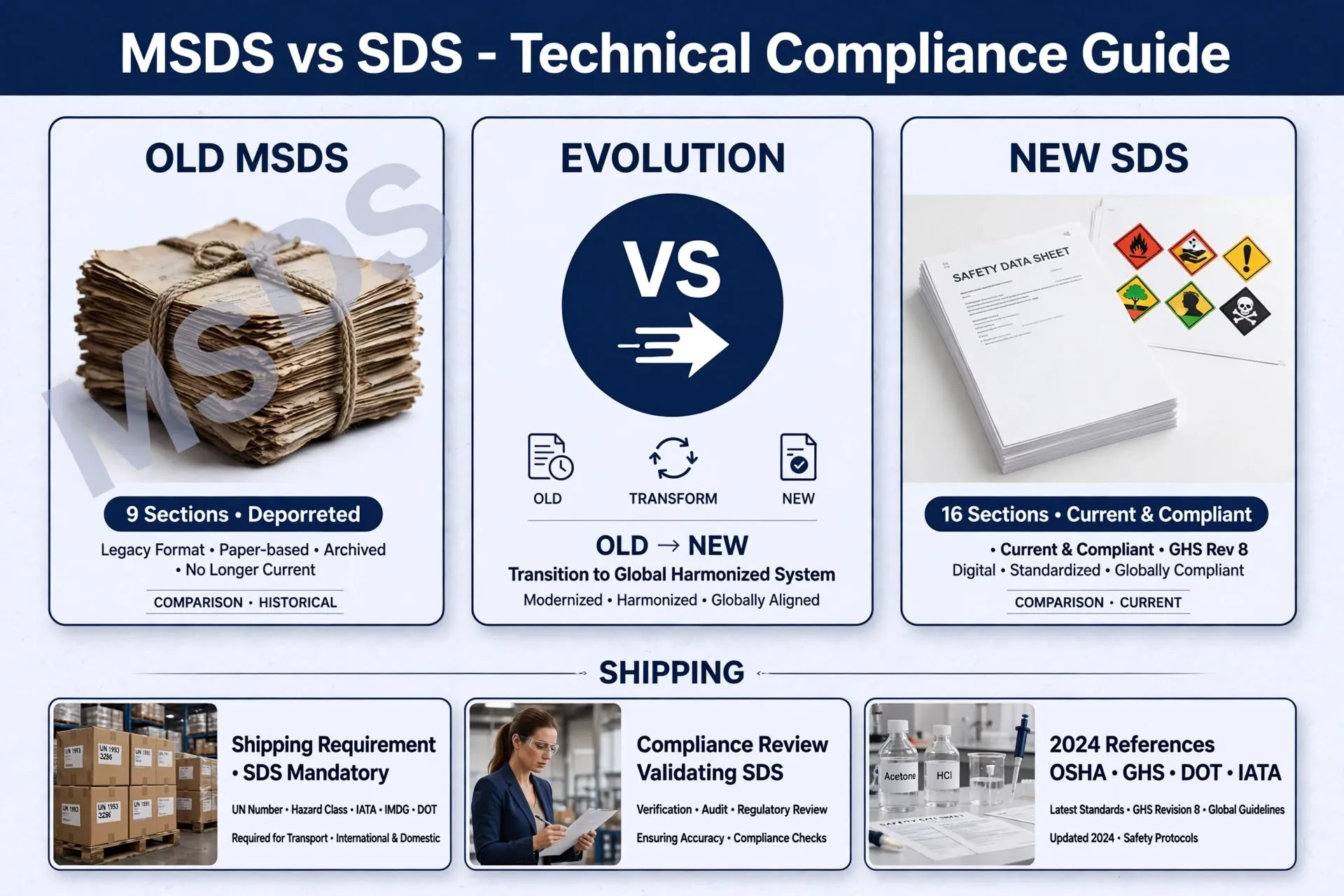
The simple answer is that MSDS is the old name and SDS is the new name. MSDS stands for Material Safety Data Sheet, while SDS stands for Safety Data Sheet. Both documents provide essential safety information about chemicals, including details about chemical dangers, safe handling and use, first aid measures, storage requirements, and more.
Today, SDS is the term used more often. Since 2012, under OSHA HazCom 2012 and the Globally Harmonized System (GHS), the 16-section standardized SDS format has officially replaced the old non-standardized MSDS format for regulatory compliance and shipping worldwide.
What Is MSDS?
MSDS means Material Safety Data Sheet.
It is an old term for a chemical safety sheet.
An MSDS can give information about a chemical, such as:
- What the chemical is
- What dangers it has
- How to use it safely
- How to store it
- What to do after an accident
- What to do if it gets on your skin
What Is SDS?
SDS means Safety Data Sheet.
It is the newer term for a chemical safety sheet.
An SDS gives important information about a chemical. It helps people use and store chemicals safely.
In the United States, OSHA uses a 16-section SDS format.
This makes it easier to find information.
For example, you can look at the first-aid section when someone gets a chemical on their skin.
MSDS or SDS: What Is the Difference?
The main difference is simple.
MSDS is the older term.
SDS is the newer term.
There is also a difference in the format.
Old MSDS sheets could look very different. Each company could use its own format.
SDS sheets use a standard format.
This helps workers find important information faster.
MSDS vs SDS Table
| MSDS | SDS |
| Old term | New term |
| Material Safety Data Sheet | Safety Data Sheet |
| Format could be different | Standard format |
| Used in older records | Used today |
| Gives safety information | Gives safety information |
Both are about chemical safety.
Why Did MSDS Change to SDS?
Chemical safety information was not always written in the same way.
This could make things hard for workers.
A worker in one place might see information in a different order than a worker in another place.
The GHS, or Globally Harmonized System, helped make chemical safety information more alike around the world.
OSHA also changed its rules to use SDS and a standard 16-section format.
This made safety information easier to find and use.
What Is in an SDS?
An SDS has 16 sections.
These sections give different types of information.
Here are some of the main things you can find:
- Product name
- Chemical dangers
- Ingredients
- First aid
- Fire safety
- Spill safety
- Safe use
- Safe storage
- Personal protection
- Health information
Why Is an SDS Important?
Chemicals can be dangerous.
Some chemicals can burn the skin. Others may hurt the eyes. Certain chemicals can cause breathing problems. In some cases, chemicals can also catch fire.
An SDS helps people understand these dangers.
It also tells people how to use the chemical in a safer way.
Think of an SDS as a safety guide for a chemical.
SDS and Chemical Labels
An SDS is not the same as a chemical label.
A label is placed on the chemical bottle, box, or container.
An SDS is a separate safety document.
The label gives quick safety information.
The SDS gives much more information.
Both are important.
MSDS or SDS for Shipping
SDS can also be useful when shipping chemicals.
Some products may be dangerous to transport.
A shipping company may ask for an SDS to learn more about the product.
For example, an SDS may be needed for some:
- Cleaning products
- Paints
- Solvents
- Adhesives
- Powders
- Chemicals
- Products with batteries
The shipping rules can be different for each product and country.
So, always check the rules before shipping a chemical product.
Can You Still Use the Word MSDS?
Yes.
People still use the word MSDS, especially when talking about old documents.
You may see MSDS in:
- Old files
- Old websites
- Old training books
- Old company records
But if you are asking for a new safety document, SDS is usually the better word.
For example:
Please send me the latest SDS.
This is a good way to ask for the current safety sheet.
Is MSDS the Same as SDS?
They are very similar.
Both give safety information about chemicals.
But they are not exactly the same in format.
MSDS is the old term.
SDS is the newer and more standard term.
Common Mistakes
Mistake 1: Saying SDSL
Some people write SDSL.
This is not the standard term.
The correct word is:
SDS
It means Safety Data Sheet.
Mistake 2: Thinking MSDS and SDS Are Totally Different
They are closely related.
MSDS is the old name.
SDS is the new name.
Mistake 3: Thinking an SDS Is a Label
It is not.
A label goes on the product.
An SDS is a separate document.
Mistake 4: Using an Old Safety Sheet
An old safety sheet may not have the latest information.
Try to use the latest SDS when possible.
Mistake 5: Thinking All Countries Have the Same Rules
Different countries can have different chemical safety rules.
Always check the rules for your country.
Simple Examples
Here are some easy examples of how to use the word SDS.
At work:
Please check the SDS before using this chemical.
In an email:
Please send the latest SDS.
During training:
Read the SDS before you use the product.
For shipping:
The shipping company needs the SDS.
For an old file:
We found the old MSDS.
Where Can You Find an SDS?
You can often find an SDS on the website of the company that makes the product.
You can also ask the seller or supplier for it.
When looking online, try searching:
Product name + SDS
You can also search:
Product name + Safety Data Sheet
Make sure the SDS is for the correct product.
When Should You Use MSDS or SDS?
Use SDS when you talk about a current safety sheet.
For example:
Please send the SDS for this cleaner.
Use MSDS when talking about an old safety sheet.
For example:
We found an old MSDS in the file room.
A simple rule is:
New document = SDS
Old document = MSDS
Why This Difference Matters
Knowing the difference between MSDS and SDS can save time.
Imagine you need safety information for a chemical.
You search for “MSDS,” but the company website calls the document “SDS.”
If you know both words, you will know that you are looking at the right type of document.
It also helps when talking to workers, suppliers, and shipping companies.
Frequently Asked Questions
1. What does MSDS stand for?
MSDS stands for Material Safety Data Sheet.
2. What does SDS stand for?
SDS stands for Safety Data Sheet.
3. Is MSDS the same as SDS?
They are closely related. MSDS is the old term, while SDS is the newer standard term.
4. Which term should I use?
Use SDS when talking about a current safety document.
5. How many sections does an SDS have?
An SDS uses 16 sections under the OSHA format.
6. Can I still say MSDS?
Yes. You may still see MSDS in old files and hear people use the word.
7. Is SDSL correct?
No. The correct term is SDS.
8. Do I need an SDS for shipping?
Some products may need an SDS for shipping. It depends on the product and the shipping rules.
Conclusion
The difference between MSDS and SDS is easy to understand. MSDS means Material Safety Data Sheet and it is the older term, while SDS means Safety Data Sheet and it is the newer term. Both provide important information about chemical safety.
An SDS can tell you about chemical dangers, first aid, fire safety, spills, storage, safe use, and personal protection. SDS documents also use a standard 16-section format in the OSHA system, which helps people find information more easily.
You may still see the word MSDS in old files or documents, and that is normal. But when you ask for a current chemical safety document, SDS is usually the best term to use.
Remember this simple rule: MSDS is the old term and SDS is the modern term.

Eman Sarfraz is a professional content writer, researcher, and English language specialist with strong expertise in English grammar, vocabulary, word meanings, synonyms, and antonyms. I creates well-researched, accurate, and easy-to-understand content that helps readers master English concepts and communicate with greater confidence.