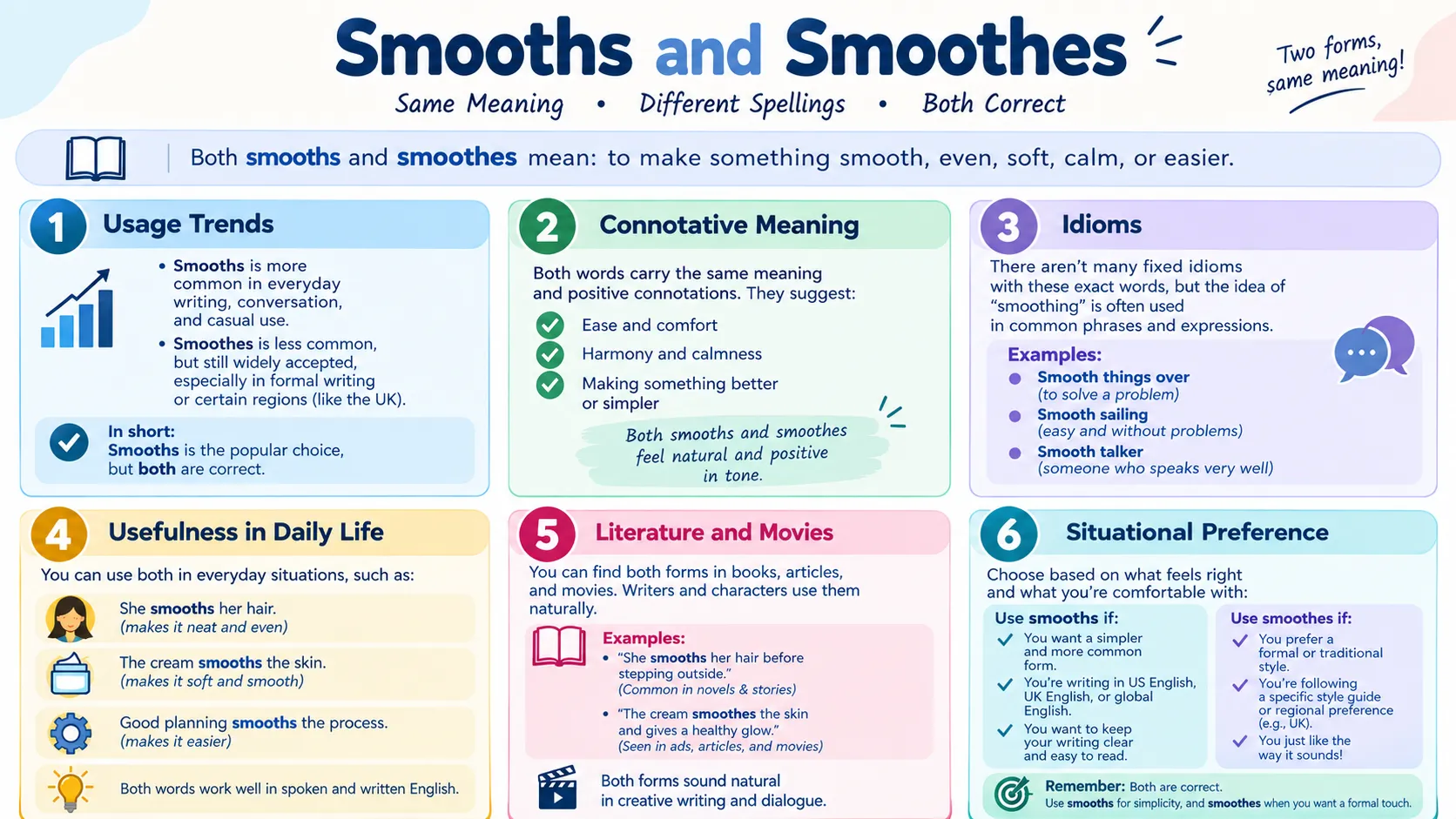
Both “smooths” and “smoothes” are correct, but “smooths” is the simpler choice for most writing.
Imagine you are writing an email about a new skin cream. You type, “This cream smooths the skin.” Then you stop. You wonder, “Should it be smoothes?” Many English learners have the same question.
The word smooth can be an adjective or a verb. As a verb, it means to make something even, soft, calm, or easier. When the subject is he, she, it, or one thing, the verb can be smooths or smoothes. Merriam-Webster lists both forms.
This is why people search for smooths or smoothes. They want to know which spelling is right. They may also wonder if one spelling is American and the other is British. The answer is simple: both forms are accepted, but smooths follows the usual English pattern of adding -s.
Pronunciation
Both forms have the same basic pronunciation.
- Smooths: /smuːðz/
- Smoothes: /smuːðz/
US English
- smooths — sounds like “smooth-z”
- smoothes — sounds like “smooth-z”
UK English
- smooths — sounds like “smooth-z”
- smoothes — sounds like “smooth-z”
The spelling changes, but the spoken form is normally the same.
A Simple Transition
Now let us look at the key differences between these two spellings.
Difference Between Smooths and Smoothes
1. Both Are Verb Forms
Both words can be the third-person singular present form of smooth.
Examples:
- She smooths her hair.
- She smoothes her hair.
Both sentences can be correct.
2. Smooths Is More Direct
Smooths follows the simple rule of adding -s to the base verb.
Examples:
- He smooths the paper.
- The cream smooths the skin.
This form is easy to learn and easy to use.
3. Smoothes Has an Extra E
Smoothes has an extra e before the final s.
Examples:
- She smoothes the cloth.
- The tool smoothes the rough edge.
The extra e does not create a new meaning.
4. The Meaning Is the Same
There is no important meaning difference between the two forms.
Examples:
- The machine smooths the surface.
- The machine smoothes the surface.
Both say that the machine makes the surface smoother.
5. Smooths Is Easier for Learners
For beginners, smooths is often easier to remember.
Examples:
- The lotion smooths dry skin.
- The brush smooths the hair.
It follows a common verb pattern like:
- help → helps
- clean → cleans
- smooth → smooths
6. Smoothes Is Also Accepted
You should not think that smoothes is always wrong. Major dictionary evidence accepts it as a variant form.
Examples:
- The cream smoothes the skin.
- She smoothes the paper.
These forms can be used in standard English.
7. Neither Form Changes the Base Verb
The basic verb is smooth.
Examples:
- I smooth the paper.
- They smooth the table.
With he, she, or it, you can use smooths or smoothes.
8. Both Work in Present Tense
Both forms can describe something that happens now or regularly.
Examples:
- This cream smooths the skin.
- This cream smoothes the skin.
The tense is the same.
9. Both Can Be Used in Formal Writing
Both forms can appear in normal English writing.
Examples:
- The process smooths the transition.
- The process smoothes the transition.
Smooths is a good choice for simple and clear writing.
10. Smooths Is a Safe Modern Choice
If you do not know which form to use, choose smooths.
Examples:
- The new plan smooths the process.
- Good communication smooths the way.
This form is short and follows the usual spelling rule.
Nature and Behaviour of Smooths and Smoothes
Smooths
Smooths is the third-person singular present form of smooth.
It can mean:
- makes a surface even
- makes something less rough
- makes a situation easier
- makes something calmer
- removes problems or difficulties
Examples:
- The cream smooths the skin.
- His kind words smooths the problem.
The second example needs a plural subject if using standard grammar:
- His kind words smooth the problem.
- His apology smooths the problem.
Smoothes
Smoothes has the same basic role and meaning.
Examples:
- The cream smoothes the skin.
- She smoothes the paper.
Why People Get Confused About Smooths and Smoothes
The confusion comes from the spelling.
Many learners see words such as:
- soothe → soothes
- use → uses
- close → closes
They may expect smooth to become smoothes.
But English does not always work in a fully regular way.
The usual form is:
smooth → smooths
However, smoothes is also accepted.
That means both forms can appear in good English. The choice is mostly about spelling preference and style.
Comparison Table
| Point | Smooths | Smoothes |
| Base verb | smooth | smooth |
| Word type | Verb | Verb |
| Person | Third-person singular | Third-person singular |
| Tense | Present | Present |
| Meaning | Same | Same |
| Spelling | Shorter | Has extra e |
| Accepted | Yes | Yes |
| Easy for learners | Yes | Yes |
| Best simple choice | Yes | Less common choice |
| Pronunciation | Same | Same |
The Origin of Smooths or Smoothes
The word smooth is very old. Merriam-Webster traces it to Middle English smothe and Old English smōth. The adjective has been used since before the 12th century. The verb appeared later, in the 15th century.
The old word had the basic idea of something that was not rough.
Over time, smooth gained more meanings. It could describe a flat surface, an easy path, calm behavior, or polite speech.
Today, the verb can mean to make something even, calm, or easier. It can also mean to reduce a problem or remove an obstacle.
The spelling smoothes has also been used as a variant form. Modern dictionaries can list both smooths and smoothes.
British vs American English
There is no simple rule that says smooths is American and smoothes is British.
Both forms can be found in English varieties.
American English
In simple modern writing, smooths is a clear choice.
Example:
- This cream smooths the skin.
British English
British writers may also use smooths or smoothes.
Example:
- The new plan smooths the change.
The main point is that this is not like color/colour or center/centre. Those are well-known US and UK spelling differences. Smooths and smoothes are better understood as variant verb spellings.
Which One Should You Use?
For US English
Use smooths if you want the simplest and most direct form.
Example:
- This product smooths dry skin.
For UK English
Smooths is also a good choice. Smoothes can appear as a variant.
Example:
- The lotion smooths the skin.
For Global English
Choose smooths.
It is short, clear, and easy for English learners to understand.
For websites, blogs, emails, and school work, smooths is usually the safest simple choice.
Common Mistakes
Mistake 1: Using “smoothe”
❌ She smoothe the paper.
✅ She smooths the paper.
Mistake 2: Adding “-es” because the word ends in “th”
❌ He smoothes the road. — not wrong, but not the simplest form.
✅ He smooths the road.
Mistake 3: Forgetting the third-person “s”
❌ She smooth her hair.
✅ She smooths her hair.
Mistake 4: Using “smoothes” as the base verb
❌ I smoothes the paper.
✅ I smooth the paper.
Mistake 5: Confusing smooth with smoothly
❌ The car moves smooth.
✅ The car moves smoothly.
Smooth can be an adjective. Smoothly is the usual adverb.
Everyday Usage Examples
In Emails
- This change smooths the process for our team.
- The new plan smooths the handover.
On Social Media
- This cream smooths my skin.
- A little planning smooths the whole trip.
In News Writing
- The new policy smooths the path for future talks.
- The agreement smooths relations between the two groups.
In Formal Writing
- The new system smooths the flow of information.
- Better planning smooths the transition.
On Daily Speech
- This brush smooths my hair.
- The oil smooths the wood.
Usage Trends
Both spellings have appeared in English for a long time.
Modern dictionaries still recognize both smooths and smoothes. Merriam-Webster lists smooths and smoothes as forms of the verb smooth.
Older usage records also show that writers have debated these forms for many years. Some dictionaries preferred one form, while others accepted both.
For modern readers, the easiest choice is smooths.
This is shorter. It is simple. It follows the normal pattern of adding -s to many verbs.
Metaphors and Similes
The word smooth is often used in a figurative way.
Metaphor
- Her calm voice smooths the tension.
This does not mean her voice makes something physically smooth. It means her voice makes the situation calmer.
Another Metaphor
- His smile smooths the meeting.
This means his friendly manner helps the meeting go well.
Simile
- The water was as smooth as glass.
This means the water had almost no waves.
Another Simile
- The road felt smooth like silk.
This means the road felt very easy and even.
Connotative Meaning
Smooth can have positive, negative, or neutral meanings.
Positive
- She has a smooth voice.
- We had a smooth trip.
Here, smooth suggests comfort and ease.
Negative
- He is a smooth talker.
This can suggest that someone sounds charming but may not be fully honest.
Neutral
- The machine makes the surface smooth.
Here, the word simply describes a physical result.
The verb forms smooths and smoothes can carry the same ideas.
Idioms and Proverbs
The exact forms smooths and smoothes are not common in famous English proverbs. However, the word smooth appears in many common expressions.
Smooth Things Over
This means to make a problem less serious.
Example:
- She apologized to smooth things over.
Smooth the Way
This means to make something easier.
Example:
- Good planning can smooth the way for success.
Smooth Sailing
This means that something is going well without major problems.
Example:
- After the first week, the project was smooth sailing.
Literature and Movies
The word smooth and its verb forms can appear in literary and film writing.
Literature
F. Scott Fitzgerald’s The Great Gatsby, a US novel published in 1925, includes the verb form smooths in the famous scene where Daisy smooths her hair. Literary discussion of the scene uses this exact form.
Jane Austen’s Pride and Prejudice, an English novel published in 1813, also provides a useful example of the idea of smoothing a difficult social situation. Modern analysis often describes characters as smoothing over awkward moments.
Movies
The 1995 British film Pride and Prejudice shows how the word smooth can describe a person’s calm or charming manner. The script includes the phrase “smooth and plausible” when describing Mr. Wickham.
The 2022 US romantic comedy Fire Island is a modern example of the verb smooths in film criticism. A review says the story “smooths” into the beats of Pride and Prejudice.
These examples show that smooth is useful far beyond physical surfaces. It can describe people, stories, feelings, and events.
Why This Difference Matters
The difference matters because small spelling choices can make writing feel uncertain.
For English learners, it is useful to know that both smooths and smoothes can be correct. This prevents you from thinking that every use of smoothes is a spelling error.
At the same time, knowing the simple form helps you write with confidence.
If you are writing for school, work, a website, or a blog, smooths is an easy choice.
It is also helpful to understand the difference between a spelling variant and a grammar mistake. Smoothes is not the same as an incorrect form such as smoothe when you need the normal base verb.
Good English is not only about knowing rules. It is also about choosing words that are clear and easy to read.
Usefulness in Daily Life
You can use smooths when you talk about many things.
You can describe skin:
- This cream smooths the skin.
Hair can be described as:
- This brush smooths the hair.
A road can be described as:
- The new road smooths the ride.
You can describe a process:
- This tool smooths the work.
A problem can be described as:
- Her apology smooths things over.
You can also use smooth in everyday phrases such as smooth sailing, smooth things over, and smooth the way.
Situational Preference
Choose smooths when you want simple, modern, and clear writing. It works well in blogs, emails, school work, business writing, and everyday English. Smoothes is also correct and may be preferred by some writers or dictionaries. If you are writing for a global audience, smooths is often the easiest form to understand. If a company has a style guide, follow that guide. The most important point is consistency. Do not switch between forms without a reason. When in doubt, use smooths.
Possible Questions
Is “smooths” correct?
Yes. Smooths is a correct form of the verb smooth.
Is “smoothes” correct?
Yes. Smoothes is also an accepted variant of the third-person singular present form.
Which is more common: smooths or smoothes?
Smooths is a simple and widely used form. It is also the form shown first by Merriam-Webster.
Is “smoothes” wrong?
No. It is not automatically wrong. It is an accepted spelling variant.
Is “smoothe” correct?
Usually, no. The normal base verb is smooth. Do not use smoothe as your normal modern base form.
Should I use smooths in SEO writing?
Yes. Smooths is a clear choice for SEO content. Use it naturally and do not force the word into every sentence.
Do smooths and smoothes have different meanings?
No. When they are used as third-person singular forms of smooth, they have the same basic meaning.
Conclusion
Both smooths and smoothes can be correct. The base verb is smooth, which means to make something even, soft, calm, or easier. When the subject is he, she, it, or one thing, you can use either form. For example, you can say, “She smooths her hair” or “She smoothes her hair.” Both sentences are correct. However, smooths is more common and is usually the simpler choice in everyday writing. So, if you are confused about smooths or smoothes, using smooths is an easy way to keep your writing simple and clear.

Eman Sarfraz is a professional content writer, researcher, and English language specialist with strong expertise in English grammar, vocabulary, word meanings, synonyms, and antonyms. I creates well-researched, accurate, and easy-to-understand content that helps readers master English concepts and communicate with greater confidence.