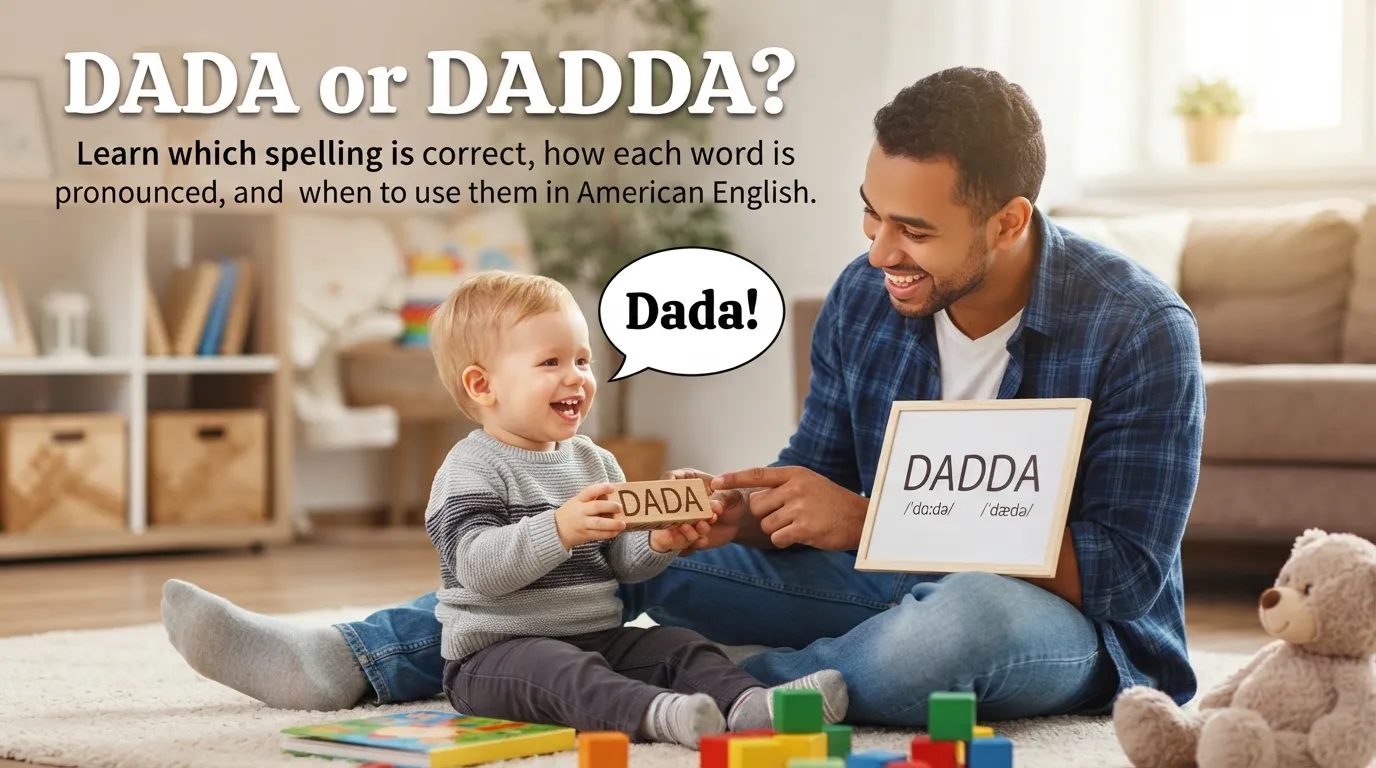
“Dada” is the more common spelling, while “Dadda” is a less common variant.
Imagine a young child looking at his father and saying, “Dada!” The family smiles because the child has found a simple name for Dad. But another family may spell the same sound as “Dadda.” This can create a common spelling question: dada or dadda, which one is correct?
In American English, dada can be used as an informal, childlike word for father or daddy. It is also commonly associated with early baby speech, when children begin experimenting with simple sounds. When comparing dada or dadda, the meaning is usually the same.
Dadda is also a real spelling, but it is much less common. It may be used as a personal or family spelling for “father” or “dad.” This is why people may wonder whether dada or dadda is the better choice.
People search for dada or dadda because the two words look and sound very similar. You may see either spelling in family messages, children’s books, parenting conversations, or social media. In most cases, dada is the safer and more widely recognized spelling.
Pronunciation
Dada
In American English, dada is commonly pronounced like:
DAH-dah
The exact pronunciation can vary slightly depending on the child, family, or speaker.
When a child uses dada for their father, the word is usually pronounced with two simple syllables.
Examples:
- “Dada is home.”
- “The baby said Dada.”
- “I want Dada.”
Dadda
Dadda can be pronounced similarly to dada, although some speakers may pronounce it closer to DAD-uh.
Because the word is often used in child or family speech, pronunciation can vary.
Examples:
- “Dadda, look at this!”
- “Come to Dadda.”
- “Dadda is here.”
Difference Between Dada and Dadda
1. Spelling
The main difference is the spelling.
Dada has one “d” at the end of the first syllable.
Examples:
- The baby said dada.
- “Dada, come here!”
- The child reached for Dada.
Dadda uses a double “d.”
Examples:
- The child called his father Dadda.
- “Dadda, look at this!”
- Their family writes the name as Dadda.
Both spellings can appear in family and child-directed speech, but dada is more common.
2. Commonness
Dada is the more common general spelling.
Examples:
- “The baby said dada.”
- “Dada is home.”
- “Where is Dada?”
Dadda is less common and is usually more personal or family-specific.
Examples:
- “The kids call him Dadda.”
- “Her first word was Dadda.”
- “The family always spells it Dadda.”
If you are unsure which spelling to use, dada is generally the better choice.
3. Meaning in American English
In American English, dada can be used as a child’s informal name for their father.
It has a warm, simple, and childlike quality.
Examples:
- “Dada is home.”
- “The baby wants Dada.”
- “Look at Dada!”
- “Dada, pick me up.”
Dadda can have the same basic meaning, but it is less common and is often chosen as a family-specific spelling.
Examples:
- “Dadda is here.”
- “Come sit with Dadda.”
- “I love you, Dadda.”
4. Baby Talk
Dada is strongly associated with baby speech.
Young children often begin with simple repeated sounds such as “da-da.” As their language develops, the sound may become associated with their father.
Examples:
- “The baby keeps saying dada.”
- “Dada was one of her first words.”
- “He reached toward his father and said, ‘Dada!’”
The word does not necessarily mean “father” every time a baby says it. Young children often experiment with sounds before they consistently attach a specific meaning to them.
5. Family Names
Both Dada and Dadda can be used as affectionate family names.
For example:
- “Good morning, Dada.”
- “I love you, Dada.”
- “Happy birthday, Dada!”
A family may instead choose:
- “Good night, Dadda.”
- “We love you, Dadda.”
- “Happy birthday, Dadda!”
When the word is being used as a personal family name, the family’s preferred spelling should be respected.
6. Informal Use
Both forms are informal.
They are most likely to appear in:
- Family conversations
- Children’s books
- Parenting discussions
- Text messages
- Social media posts
- Personal notes
- Children’s speech
They are not normally used in formal writing when referring to someone’s father. In a formal context, words such as father or dad are usually more natural.
For example:
Informal:
- “Dada is picking me up.”
More standard:
- “My father is picking me up.”
7. Formal Writing
If you are writing for a general American audience, dada is usually the safer spelling when you intentionally want a childlike or affectionate term for father.
Examples:
- “The baby reached for Dada.”
- “She smiled when Dada walked into the room.”
However, if a specific family uses Dadda, keep that spelling.
Example:
- “The children ran to Dadda when he came home.”
When writing about a person’s personal nickname, the individual’s preferred spelling is more important than the general spelling rule.
8. Sound and Spelling
The two forms can sound almost identical.
For example:
- “Dada is here.”
- “Dadda is here.”
A listener may not know which spelling is being used unless they see it written down.
This is especially common with children’s speech because young children may pronounce words differently from adults.
The difference between dada and dadda is therefore mainly a spelling preference rather than a major difference in meaning.
9. Best General Choice
If you need one general spelling, choose dada.
Use dada for:
- A child’s name for father
- Informal family speech
- Baby talk
- Children’s writing
- A general American English audience
Use dadda when:
- A family specifically spells it that way
- A child or character uses that spelling
- A person has chosen “Dadda” as a personal family nickname
- You are preserving the spelling from an original source
The simplest rule is:
Dada = common general spelling
Dadda = less common personal or family variant
Nature and Feeling of Dada and Dadda
Dada
The word dada often has a warm, affectionate, and childlike feeling.
It can suggest:
- Family
- Love
- Childhood
- Comfort
- Closeness
- Affection
Example:
“The baby reached for Dada as soon as he walked through the door.”
Dadda
Dadda can feel even more personal because it is less common and may represent a family’s unique way of spelling the word.
It can suggest:
- Childlike speech
- Affection
- Family closeness
- A personal nickname
- Warmth
Example:
“The little girl ran to Dadda and gave him a hug.”
Why People Get Confused About Dada and Dadda
The main reason is pronunciation.
A young child may say a sound that can be written as either dada or dadda. Because the sound is so similar, adults may choose different spellings.
Another reason is that family nicknames do not always follow standard spelling conventions.
For example, one family might write:
- “Dada”
while another might write:
- “Dadda”
Both families may pronounce the word almost exactly the same way.
This is common with family nicknames because people often create their own spellings based on how a word sounds.
Dada vs. Dadda Comparison Table
| Point | Dada | Dadda |
|---|---|---|
| Common spelling | Yes | Less common |
| Meaning | Father or daddy in child/family speech | Father or daddy as a variant |
| Baby speech | Very common | Possible |
| Family nickname | Yes | Yes |
| Formal English | Informal | Informal |
| Children’s speech | Common | Possible |
| Personal spelling | Yes | Yes |
| General American usage | Better choice | Less common |
| Main difference | Standard, common form | Variant family spelling |
| Best general choice | Dada | Use when specifically chosen |
The Origin of Dada
Babies often begin producing repeated syllables such as “da-da.” Over time, these sounds can become associated with familiar people, including fathers. This is one reason people may ask about dada or dadda when choosing a spelling for this childlike word.
Words used by young children can develop into affectionate family names. This helps explain why forms such as dada, daddy, and similar family expressions appear across English-speaking communities. The question of dada or dadda often depends on family preference and the spelling people are accustomed to.
Dadda can be understood as a variant spelling that represents the same or a very similar childlike pronunciation. In discussions about dada or dadda, both spellings may be understood in a family or informal context.
The exact history of these family words is not always simple because baby-talk forms can develop naturally within families and language.
For additional information: https://syntexra.com/airalo-or-holafly/
British vs. American English
There is no major American-versus-British spelling rule that makes dada correct in one variety of English and dadda correct in the other.
In both American and British English, dada can be used as a childlike term for father.
For an American audience:
- “The baby said Dada.”
- “Dada is home.”
- “She reached for Dada.”
Which One Should You Use?
Use dada when you want the most common and recognizable spelling.
Use dada for:
- A child’s name for father
- Baby talk
- Informal family speech
- Children’s stories
- Parenting content
- General American English writing
Also use dadda when the spelling is intentionally used by a particular family, child, writer, or character.
For example:
- “The baby called his father Dada.”
- “The children call their father Dadda.”
Common Mistakes
Here are some common mistakes and corrections:
Mistake 1
❌ Assuming dadda is always wrong.
✅ Dadda is a real variant spelling and may be used as a family nickname.
Mistake 2
❌ Assuming dada and dadda have completely different meanings.
✅ They can have the same basic meaning when used as childlike names for a father.
Mistake 3
❌ Changing someone’s preferred spelling from Dadda to Dada.
✅ Keep the spelling chosen by the person or family.
Mistake 4
❌ Treating baby speech as if it always follows standard spelling.
✅ Baby words can have many spellings because adults are often writing down sounds.
Mistake 5
❌ Using dada in a formal sentence when “father” is more appropriate.
✅ Choose the word that matches the tone and audience.
Everyday Usage Examples
In Family Messages
- “Dada is coming home soon.”
- “Can you ask Dada?”
- “Dada will pick you up.”
In Text Messages
- “The baby just said Dada!”
- “She keeps calling for Dada.”
- “Dada is home!”
On Social Media
- “My little one said ‘Dada’ for the first time!”
- “Nothing beats hearing your child say Dada.”
- “Happy Father’s Day to the best Dada!”
In Children’s Books
- “Dada picked up the baby.”
- “Where is Dada?”
- “Dada and I went to the park.”
In Formal Writing
If your readers may not understand the word, use a clearer expression.
For example:
- “The child called his father ‘Dada.’”
Usage Trends
Dada is the safer and more widely recognizable spelling for an American audience when referring to a child’s name for father.
It appears naturally in:
- Parenting conversations
- Children’s books
- Family messages
- Social media
- Baby-name discussions
- Personal stories
Dadda is less common and is generally better understood as a personal or family spelling.
Because family nicknames can be spelled creatively, you may still encounter Dadda in real-world writing.
Metaphors and Similes
Dada and Dadda are family words, so they do not have many established metaphors or similes in American English.
Writers can still use them creatively.
Examples:
- “Dada was like a strong tree in the family.”
- “Her Dada was a guiding light in her childhood.”
- “He held on to Dada’s hand like it was the safest place in the world.”
Connotative Meaning
Positive Meaning
Dada can suggest:
- Love
- Safety
- Family
- Care
- Comfort
Example:
- “My Dada always made me feel safe.”
Neutral Meaning
It can simply identify a child’s father.
Example:
- “Dada is in the kitchen.”
Childlike Meaning
In American English, dada often has a distinctly young or childlike quality.
Example:
- “The baby reached for Dada.”
Dadda
Dadda can feel especially personal because it is less common and may be a spelling chosen by one particular family.
Example:
- “Good night, Dadda!”
The emotional meaning depends on how the word is used.
Idioms and Proverbs
There is no major standard American English idiom or proverb based specifically on dada or dadda.
However, the words can appear in ordinary family expressions.
Examples:
- “Dada knows best.”
- “Ask Dada for help.”
- “Dada will take care of it.”
- “Dada is coming home.”
These are ordinary sentences rather than established idioms or proverbs.
Literature and Movies
The spelling dadda has appeared in English literature as a childlike form for father.
The word Dada can also have another meaning unrelated to family language. Capitalized Dada refers to an early 20th-century European art movement. This is completely different from the family word dada.
The meaning therefore depends heavily on capitalization and context.
For example:
- dada = a childlike family word for father
- Dada = can refer to the art movement
In movies, television, children’s books, and family stories, similar forms may appear as names for fathers or affectionate family nicknames.
Why This Difference Matters
The difference matters because dada and dadda are often used in informal family communication.
Choosing the right spelling can make your writing feel more natural to an American audience.
For example:
“The baby said dada.”
sounds natural and familiar.
You could also write:
“The baby said Dadda.”
if Dadda is the family’s preferred spelling.
The important point is that the spelling should match the intended context.
Usefulness in Daily Life
Understanding dada and dadda can help when reading or writing:
- Family messages
- Baby books
- Parenting content
- Children’s stories
- Social media posts
- Text messages
- Personal letters
- Family announcements
For example:
- “Dada is home.”
- “The baby said dada.”
- “I want Dada.”
- “Dadda, look at this!”
In most general American English situations, dada will be the more familiar spelling.
Situational Preference
Use dada in most situations because it is the more common and recognizable spelling for a child’s name for father.
Use dada for:
- Baby talk
- Children’s speech
- Family conversations
- Children’s books
- Parenting content
- Informal American English
Also use dadda when a person, child, family, or story specifically uses that spelling.
For formal writing, consider using father or dad if the childlike or affectionate tone is not necessary.
The best choice depends on context, but when there is no specific family preference, dada is the safer general spelling.
Possible short questions
Is dada or dadda correct?
Dada is the more common spelling. Dadda is a less common variant that may be used as a personal or family spelling.
Does dada mean father?
Yes. In American English, dada can be used as an informal, childlike word for father or daddy.
Is dadda a real word?
Yes. Dadda can be used as a variant spelling for a child’s name for father.
Is dada a baby word?
Yes. Dada is strongly associated with early baby speech and is commonly used by young children when referring to their father.
Should I use dada or dadda?
Use dada if you want the more common general spelling. Use dadda if that is the spelling preferred by a particular family or person.
Is Dada formal English?
No. Dada is generally informal and childlike when it means father. In formal writing, father or dad is usually more appropriate.
Is Dada the same as Dad?
They can refer to the same person, but they have a different tone. Dada sounds more childlike and affectionate, while Dad is the standard informal word used by older children and adults.
Is Dada the same as Daddy?
They can have the same basic reference, but dada is generally more associated with very young children and early speech.
Conclusion
Dada or dadda which spelling should you choose?In most cases, dada is the more common spelling. When comparing dada or dadda, both can be used, but dada is more widely recognized in American English.
Dadda is a less common variant and may be used as a personal or family spelling. If you’re unsure about dada or dadda, choose dada.
For a general US audience, dada is the safest choice. Ultimately, when deciding between dada or dadda, use the spelling preferred by the person or family.

Eman Sarfraz is a professional content writer, researcher, and English language specialist with strong expertise in English grammar, vocabulary, word meanings, synonyms, and antonyms. I creates well-researched, accurate, and easy-to-understand content that helps readers master English concepts and communicate with greater confidence.